

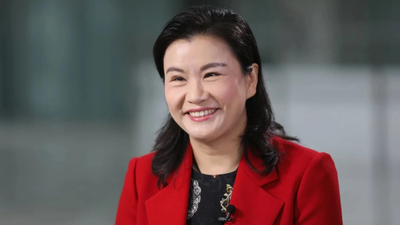
Zhou Qunfei has one of the most prominent self-made success stories in the global technology industry. Born into poverty in rural China, she dropped out of school as a teenager and worked in watch glass grinding factories to support her family.
Decades later, she became the founder of Lens Technology, a company now worth about $26 billion. Zhou recently caught the world’s attention after he sat alongside Elon Musk and Tim Cook at a high-level state banquet in Beijing attended by Chinese and American business leaders.
Zhou Qunfei’s journey from factory worker to $26 billion company
Zhou was born in 1970 in Hunan Province to a poor family. Her mother died when she was five, while her father became partially blind and disabled after a workplace accident.
Financial difficulties forced Zhou to leave school at the age of fifteen and move to Guangdong to work in factories that produced watch components and glass products.She reportedly spent her days working on assembly lines grinding glass while studying accounting, computer operations and other technical skills at night. Those years helped shape the discipline and artistic expertise that later defined her career.In 1993, Zhou used his savings of about 20,000 yuan and support from his relatives to launch a small workshop in the Baoan District of Shenzhen.
The business initially focused on printing and processing watch glass. Chu personally handled machinery repairs and managed production and sales during the company’s early years.As China’s mobile phone industry expanded in the early 2000s, the workshop secured orders for phone screens from local manufacturers including TCL Technology. Zhu realized the huge potential of mobile phone glass and created Lens Technology to focus on manufacturing and research for phone screens.A major breakthrough came when the company sought contracts from global brands including Motorola. Lens reportedly invested heavily to meet Motorola’s stringent quality standards and later supplied glass for the Motorola Razr V3, one of the world’s best-selling mobile phones at the time. This success has helped Lens secure more partnerships with Nokia and Samsung.

the apple The partnership that changed the company
The biggest turning point for lens technology arrived in 2007 when Steve Jobs unveiled the first iPhone. Apple needed durable, high-quality glass for its touchscreens, and Lens Technology became one of its key suppliers after working closely with Apple engineers to mass-produce the device’s glass panels.As iPhone sales exploded globally, Apple became Lens Technology’s largest customer, accounting for more than half of the company’s annual revenue through early 2010. Lens later expanded its role within Apple’s supply chain by producing components for iPads, MacBooks, and other products.The partnership has transformed Lens Technology into one of the world’s leading manufacturers of touch screen glass and consumer electronics components.
The company was later listed on Shenzhen’s ChiNext Index in 2015, helping Zhou become one of the richest self-made women in China. Lens has also completed its Hong Kong listing in 2025.Zhou attracted global attention after appearing between Musk and Cook at a state banquet hosted by Xi Jinping during Donald Trump’s visit to China. The dinner was attended by a number of senior Chinese executives along with US business leaders and officials.
Over the past decade, the company has expanded beyond smartphones to include smart vehicles, AI devices, robotics, wearables, and space-related manufacturing.Lens Technology now supplies intelligent cockpit systems, exterior structural parts and advanced glass products to automakers including BMW, Mercedes-Benz and Li Auto. The company has also been linked by investors to projects related to Tesla’s Optimus robot program and SpaceX due to its work in robotics and aerospace manufacturing.
Pushing Lens technology into AI and robotics
Lens Technology is now trying to reposition itself from a smartphone component supplier to what it describes as a “one-stop microfabrication solutions provider” for the AI hardware industry. Its business now spans AI eyewear, smart vehicles, embodied intelligence, wearables, and the commercial space.In December, the company said on an investor platform that it had worked for nearly a decade with a “large North American customer” across intelligent cockpits, humanoid robotics and space-related products.
Lens also said it has developed ultra-thin optical glass modules and flexible glass products designed for space applications.Lens Technology’s market capitalization recently reached about 180.6 billion yuan, or approximately $26.6 billion. Last year, the company reported annual revenue of 74.4 billion yuan, while net profit rose 10.9% to 4 billion yuan. Smartphones and computers remained its largest business segment, generating revenues of more than 61 billion yuan.Zhou’s rise from factory worker to billionaire businesswoman has made her one of the most recognizable figures in China’s technology industry.