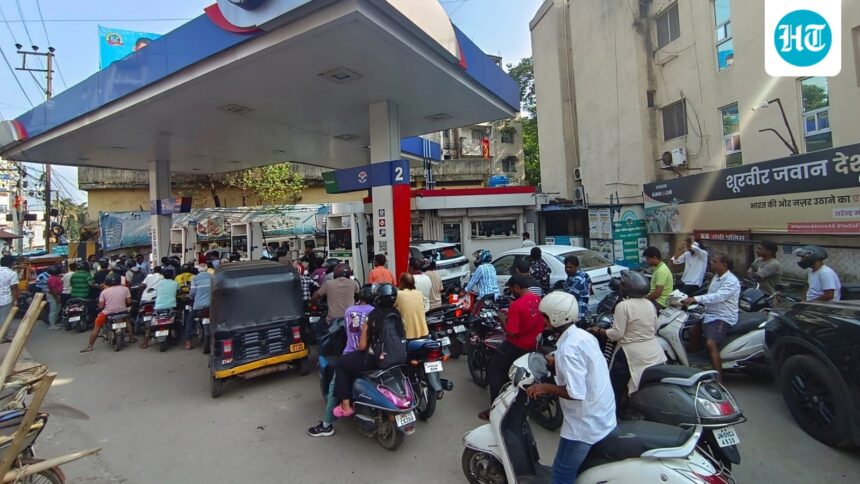
Days of anticipation over the potential impact of conflict in West Asia on domestic fuel prices ended on Friday as oil company stock prices rose $3 prices of both petrol and diesel in India, a move the government has hinted comes as global energy supplies are severely affected.

US-Israeli strikes on Iran on February 28 sparked a retaliatory response from the latter, leading to a full-scale war that shook the entire oil-rich Gulf region and beyond, while effectively closing the Strait of Hormuz – a major waterway through which a fifth of the world’s energy flows. Iran was able to close the strait because of its geographical advantage.
Global energy prices are bearing the brunt of the disruption of ship traffic carrying oil and gas in the Strait of Hormuz, with India now also succumbing to pressure and seeing an increase in fuel prices – which experts believe may not be the only rise.
Hints dropped by the government
On Tuesday, Petroleum Minister Hardeep Singh Puri hinted at a rise in prices. The government at some point has to take a view on raising prices of petroleum products like petrol and diesel, he said at a CII event in Delhi. His confirmation came after Prime Minister Narendra Modi on Sunday called on people to conserve energy and foreign exchange. He repeated the same thing on Monday. Track petrol and diesel prices here
Prime Minister Modi on Sunday had advised citizens to adopt a range of measures, including carpooling, using public transport, working from home, buying less gold and limiting foreign travel among others.
A shareable image titled ‘Modi 7 Appeals’ with key points was circulated across the government and corresponding social media.
Describing the measures as a national duty amid the ongoing US-Iran conflict in West Asia, Prime Minister Modi said that rising crude oil prices and disruption of global supply chains are putting severe pressure on India’s foreign exchange reserves.
Just the beginning?
Some believe that the rise in fuel prices on Friday may be the first of many increases or measures that the government may take gradually to meet the pressures on global energy supplies, so that the general public does not face a sudden huge shock.
Banker and founder of Kotak Mahindra Bank Uday Kotak said on Tuesday that India should prepare itself to face global uncertainty for a prolonged period and avoid “living beyond its means”.
Interacting with industry leaders at the CII’s annual summit, Kotak said the Prime Minister’s remarks reflect a greater strategic concern about India’s economic resilience amid geopolitical instability and rising energy risks.
Referring to the ongoing crisis in West Asia, Kotak described the situation as a “much bigger and more complex problem than it appears,” while emphasizing the country’s need to prepare for external shocks.
Amid global pressures, the rise in fuel prices is “very minimal,” Arvind Kumar, director (refineries) of Indian Oil Corporation Limited (IOCL), said on Friday.
“It is a very small increase, and you know there is a lot of pressure. But I can tell you that the Indian Oils Group companies and ten refineries are working around the clock and more than 100 percent of their capacity so that there is no crisis or drought in any of our retail outlets.. Let us come together to save fuel and in this time of emergency and this critical time,” news agency ANI quoted Kumar as saying.
While the government emphasized that it is trying to take every step to minimize the direct impact of global turmoil on the people of India, policymakers and industry leaders have warned against prolonging uncertainty.
The Prime Minister’s recent push for fuel-saving measures, the opposition’s claim of a gradual rise in prices and the caution of experts, signal an advance warning of sorts for citizens to prepare for further moves to reduce consumption and enhance economic resilience in the face of an increasingly unstable international environment.