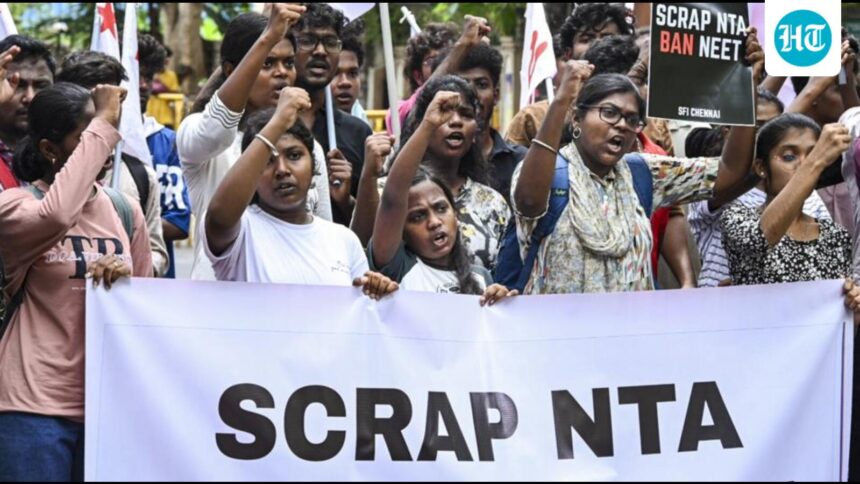
The National Testing Agency has accumulated a surplus $Rs 448.21 crore in examination fees collected over the first five years of its operation – money that experts, aspirants and a parliamentary committee say could have been used to plug security loopholes is now in focus as the agency has canceled NEET-UG 2026 and left 2.275 million students waiting for the re-examination date.

Between 2018-2019 and 2023-2024, it collected NTA $3,512.98 crore application fees while disbursing $3,064.77 crore – 87.2% – on the conduct of examinations, according to the Union Education Ministry’s response to a question asked by Congress Rajya Sabha MP Vivek K Tanka on July 31, 2024.
Read also: The story of two teachers who blew their NEET paper leak cap
In its December 2025 report, a parliamentary committee on education recommended that NTA deploy the group to build internal testing capacity or enhance vendor monitoring. The same committee – which first made the request in March 2025 – reiterated that the NTA should issue an annual report detailing its activities and submit it to Parliament. The NTA did not comply.
The agency’s income grew sharply after the introduction of the CUET program in 2022-2023, jumping by 78% from $490.35 crore in 2021-22 to $873.20 crore in the following year as over a million students started appearing for the Central University entrance examination annually. NTA operates without ongoing government funding – it has received a one-off grant of $25 crore at inception and since then it has been self-sufficient on fee income.
The cancellation of NEET-UG 2026 has added a new dimension to the issue of surplus. NTA DG Abhishek Singh announced the full fee refund on May 12. With over 2.275 million students enrolled – in $1,700 for the public, $1600 for OBC-NCL/EWS and $1,000 for SC/ST/PwD/Third Gender candidates – it is estimated to have been collected by the agency $340-355 Crores for this screening alone. Officials said that dates for re-exams will be announced by the end of next week.
But for the students, the refund was an insult. “It seems like a big joke that NTA is playing with our future and still feels good about itself by refunding exam fee money. But what about our hard work, hours of constant studies and constant revisions? I had plans to go to the mountains with my family after exams but now I have to study again due to NTA’s mistake. Will they be able to compensate for these things? ” said Anshita Tanwar, who appeared for the exam in Indore.
Dr Dhruv Chauhan, national spokesperson for the IMA Junior Doctors Network, described the refund as “completely inappropriate”. “Students and their families spend many times the exam fee on travel, accommodation, food and local transportation, often over the course of two to three days. This is a multi-factorial loss – financial, mental, logistical and emotional. After preparing for a year or two, students finally relieve post-exam stress. If they are suddenly asked to prepare again, this mental preparation is shattered.”
Keshav Agarwal, president of the Delhi Education Union, said the lack of public accountability was structural. “An institution that deals with examination fees running into millions of rupees annually, without any path of public audit, is structurally opaque and prone to corruption. There is no accountability on how contracts are awarded, vendors are selected, and how public funds are spent on examination infrastructure,” he said, alleging that NTA funds do not appear in the Comptroller and Auditor General’s report.
NTA officials said the agency is actively implementing the recommendations of the Radhakrishnan Committee – district level coordination committees, government building examination centres, GPS tracked transport, biometric authentication, control rooms linked with CCTV cameras and real-time monitoring. Regarding infrastructure, the agency has set a specific goal: to expand cash-based education capacity from 150,000 students per shift to 1 million students within one year. An official, who requested anonymity, said: “We are working with district-level committees to ensure that all examination centers have basic facilities of water, toilets and other facilities.”