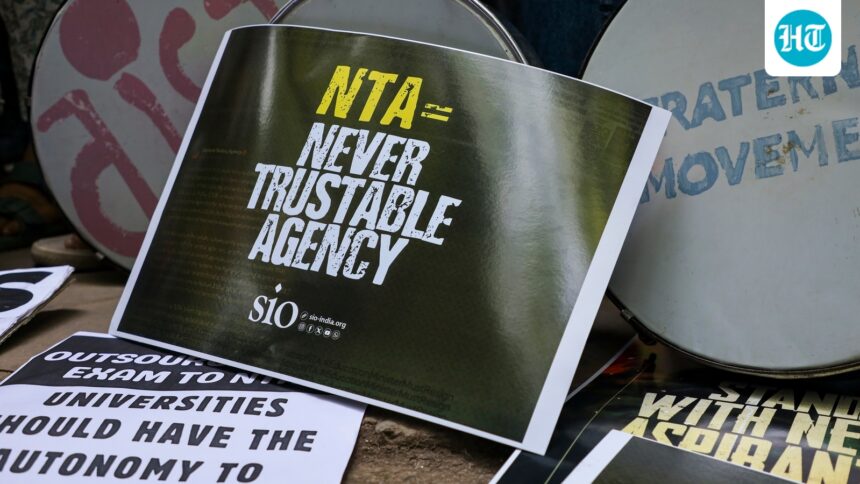
The Central Bureau of Investigation (CBI) told a Delhi court on Thursday that the leak of the NEET-UG 2026 question paper goes back to a source within the National Testing Agency (NTA) — an allegation the court recorded in its order, stating that Shubham Khairnar had obtained the paper from a Pune-based person who in turn had obtained his “NTA source”.

The agency said it is now working to identify NTA officials and other government employees involved in the leak.
The case stems from the cancellation of the NEET-UG 2026 exam on May 12 — nine days after 2.27 million students took the exam in 551 cities — after central agencies confirmed that the question paper had been hacked. According to the CBI’s remand application, a PDF file containing 500-600 questions – of which 180 were “exactly identical” to the actual paper – was shared on Telegram as early as April 29, four days before the exam.
The court order, passed by Special Judge (CBI) Ajay Kumar Gupta of Ross Avenue Courts while granting seven-day remand to five accused, quoted the agency to say: “Accused Shubham Khairnar obtained the said paper from another person from Pune who obtained the same from his NTA source.” The Pune resident has not been named.
Read also | NEET Paper Leak: High-level meeting at Dharmendra Pradhan’s house on NEET UG retest
The CBI told the court that it wants to interrogate the accused “to uncover the larger conspiracy and source of the leaked NEET-UG 2026 question paper” and to further “identify the officials of NTA and other departments” involved.
The five arrested by the CBI are Yash Yadav from Gurugram, Mangilal Khatik, Vikash Bewal and Dinesh Bewal from Jaipur, and Khairnar from Nashik – all of whom have been remanded in judicial custody from their respective states.
Separately, Dhananjay Lokhanda from Ahilyanagar and Manisha Waghmare from Pune were arrested by the CBI on Thursday.
The agency conducted raids at 14 locations in the last 24 hours and recovered incriminating conversations of the accused, leaked question papers and digital evidence including mobile phones. Some deleted data requires forensic examination. The CBI team also visited the NTA headquarters in Delhi to collect documents. A CBI spokesman said: “Several other suspects are currently being examined.”
The remand request sets out the series as it has been defined so far. Khairnar, after getting the paper from an unnamed contact in Pune, informed Yadav in April that Mangilal Khatik was ready to pay. $10-12 lakh for the leaked NEET-UG questions of his younger son.
On April 29, Khairnar Yadav provided 500-600 questions from Physics, Chemistry and Biology papers via Telegram. Yadav was known to Mangilal’s eldest son Vikash Bewal from NEET training in Sikar in Rajasthan – a connection through which Mangilal reached Yadav. The deal was reached between Mangilal and Yadav $10 lakh, subject to 150 questions from the question bank corresponding to the NEET paper.
Mangilal received the papers, printed them out, and distributed three printed sets to his younger son Vikash, his relatives and other acquaintances who were going to appear for the exam, the CBI confirmed. “All communication with Yash Yadav was done through Mangilal. PDF files were printed and three printed sets were distributed,” the statement read.
Yadav also asked Vikash to find additional candidates for the leaked questions to recover some of the money he spent on them; Vikash shared the candidate details with Yadav via WhatsApp and Instagram.
Senior Public Prosecutor Neetu Singh said the CBI needs to “investigate a larger conspiracy to unravel how the exam paper was leaked and to what extent it was circulated”. He said that “the role of public officials” who may have been involved in the crime had not yet been investigated, as well as the role of “the printing press rented by the accused.”
The CBI said the accused were wanted in custody “to prevent further similar crimes involving leakage of question papers, and to identify and arrest other accused involved in the crime.”
The CBI said it is focusing on tracing the “NTA source” of the unnamed Pune-based person – a link that would establish how the question paper left the NTA’s custody. “The CBI is following up on all leads regarding this case,” the agency said.
Defense lawyers objected to the pretrial detention, arguing that the arrests were illegal because the accused did not provide reasons for the arrest and that custodial interrogation was unnecessary.