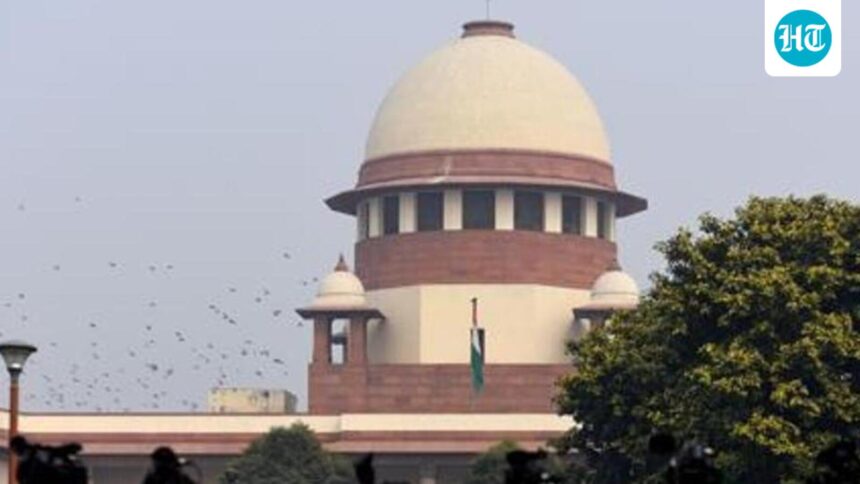
A nine-judge Supreme Court bench on Thursday questioned the continued centrality of the “essential religious practices” (ERP) doctrine in adjudicating religious disputes, observing during the concluding hearing in the Sabarimala bench that the test could become “elitist” by privileging some religious practices over others.

The observation came as the Constitution Bench, after 16 days of marathon hearings spread over several weeks, reserved its verdict on the much-awaited reference arising out of the 2018 Sabarimala ruling that allowed entry of women of all ages into the hill shrine in Kerala.
The proceedings before the court, led by Chief Justice of India Surya Kant, have evolved into one of the broadest constitutional debates on religious freedom in recent years, touching on the scope of judicial review in religious matters, the meaning of religious denominations, the balance between equality and autonomy, and the continued validity of the ERP doctrine.
Apart from the ICC, the bench included Justices B V Nagaratna, M M Sundresh, Ahsanuddin Amanullah, Aravind Kumar, Augustine George Masih, Prasanna P Varali, R Mahadevan and Joymalia Bagchi.
During the concluding hearing on Thursday, senior advocate, amicus curiae K Parameshwar, criticized the ERP principle for effectively classifying religious practices.
“What the ERP doctrine tends to do is favor certain practices over others,” he said. “The easiest criticism of the ERP doctrine is that it is not constitutionally in the text.”
Justice Sandrich responded that the doctrine also tends to be “elitist in some way.”
Parameshwar agreed. “It is very elitist. Because an individual’s spiritual pursuit is as much a part of Article 21 as it is a part of Article 25. And therein lies the relationship between Articles 21 and 25. If you remove my religious practice or my spiritual pursuit, then to that extent you also distort my identity under Article 21,” he said.
However, Justice Nagaratna noted that the ERP doctrine may still have limited utility as a classification aid rather than as a constitutional weapon to invalidate practices altogether.
“The ERP doctrine can only be used as a tool to say ‘the practice is fundamentally religious, not secular.’ But you (the courts) cannot say ‘it is not a religious practice and therefore I will not protect you.’ It is an aid, not a test,” she noted.
The reference goes back to a 2018 Supreme Court ruling that allowed women of menstruating age to enter the Sabarimala Sri Ayyappa temple, abolishing a centuries-old custom that had barred their entry.
When review petitions were filed against that ruling in 2019, the Supreme Court refrained from directly reconsidering the ruling and instead referred seven broad constitutional questions to a larger bench, including the interplay between Articles 25 and 26, which guarantee religious freedom, and Article 14, which guarantees equality.
Over the course of the hearings, the Center and several interveners pushed for a restrictive approach to judicial review in religious matters, warning against courts entering the theological realm or subjecting religious practices to broad constitutional rationale review.
Solicitor General Tushar Mehta has repeatedly argued that courts should normally defer to legislatures and religious communities in matters of reform and that judicial review in religious matters should remain limited.
Likewise, senior advocate Gopal Subramanium contended that the standard of scrutiny applied to Articles 25 and 26 cannot be equated with ordinary review of Article 14.
“The scope and intensity of judicial review under Articles 25 and 26 does not match the scope of review normally undertaken under Article 14,” he said. He emphasized that while rationality may assist courts as a tool of inquiry, the standards applied in religious matters cannot reflect arbitrary review under equality jurisprudence.
Senior advocate Rajeev Dhavan also warned against courts becoming arbiters of theology by over-reliance on ERP doctrine. “Your House of Lords is not the Supreme Pope or the priest walking around in this particular area,” he said, warning that if absolute necessity became a prerequisite, Article 25 and 26 protections could disappear entirely.
In the original Sabarimala judgement, the finding that the exclusionary practice was not “necessary” effectively extinguished denominational and religious claims at the same threshold, Dhavan said.
Senior human rights advocate Rakesh Dwivedi, who has appeared for parties supporting communal autonomy, also opposed attempts to dilute Article 26 protections.
“Hinduism is also a religious philosophy. It is also a highly developed social structure,” Dwivedi said, warning against reducing Hinduism to a mere “way of life.” He said the state’s power of social reform under Article 25(2)(b) could not automatically override sectarian rights under Article 26.
Likewise, senior advocate Abhishek Manu Singhvi, during previous hearings, has warned that courts should not decide whether religious practices are “rational or irrational,” “progressive or regressive,” or redesign religious traditions according to judicial preferences. “The court should not decide whether a religious practice is rational or irrational. This is an absolute no-go area,” Singhvi said.
On the other side of the debate, several lawyers have urged the Court to preserve a meaningful constitutional role for judicial scrutiny when religious practices violate personal dignity, equality, or autonomy.
Justice Bagchi, during previous hearings, had crystallized this fear by observing that India may be a democracy governed by numbers, but constitutionalism ultimately places limits on the motives of the majority. He commented, “It is not the majority rule that troubles the Court. The Court is fundamentally troubled by the supremacy of the majority over constitutionalism and that is the Lakshman Rekha.”
Lawyer Indira Jaising said that disputes between competing fundamental rights cannot be resolved merely by preferential judicial review, and that courts must assess the extent of damage to constitutional rights.
Lawyer Sneha Kalita said centuries-old customs could not remain immune from constitutional scrutiny in a transformative constitutional regime, citing Nepal’s abolished ‘chhaupadi’ practice of segregating menstruating women.
Professor G Mohan Gopal, representing the Sri Narayana Manavadharman Trust, said Indian constitutional jurisprudence had historically silenced reformist voices within the religions themselves. He added: “Please do not allow faith in clergy to defeat the faith in God emerging in the individual’s conscience.”
The hearings also traversed disputes beyond Sabarimala itself, including questions regarding Parsi excommunication practices, denominational rights of muttons, access to religious institutions, bodily integrity, and the constitutional meaning of “religious caste.”
.