Government officials in Delhi said the Punjab government had sought a share in the Yamuna water allocation on the basis that it was also a successor state similar to Haryana, before renegotiating the terms of the 1994 water-sharing agreement between the states riparian to the Yamuna River.

These demands were made during a high-level meeting of state officials of northern district councils held at Kartavia Bhavan on Monday. Delhi, on its part, has maintained that its water quota should not be affected due to the demand, officials told HT.
A senior Delhi government official, requesting anonymity, said Punjab had argued that if Haryana could claim its share of water from the Ravi and Beas rivers as a successor state to united Punjab, then Punjab should also have the right to a share of the waters of the Yamuna. “Irrespective of how Yamuna river water is allocated, Delhi’s allocated share should not be reduced. Delhi is already receiving around 225 cusecs less due to seepage and seepage. Delhi is supposed to get 1,149 cusecs of water through the Munak Canal as per the water sharing agreement, but only 924 cusecs of water is being received at Bawana,” the official said. HT reached out to the Punjab government for a comment but no response was received till the time of going to press.
Read also: The Delhi Jal Board is planning to conduct a doorstep survey for 6 months to “fix” the water database
The waters were allocated among the northern Indian states, including Uttar Pradesh, Uttarakhand, Himachal Pradesh, Haryana, Delhi and Rajasthan, on the basis of a memorandum of understanding signed by the riparian states on May 12, 1994. It is scheduled to be renegotiated after 30 years. Punjab had previously claimed that although it shares the Ravi-Beas waters with Haryana, it was “unfairly excluded” from the 1994 Memorandum of Understanding (MoU) related to the Yamuna River. The 1954 agreement between undivided Punjab and Uttar Pradesh gave Punjab two-thirds of the Yamuna’s waters, and the Irrigation Commission in 1972 recognized Punjab as part of the Yamuna Basin.
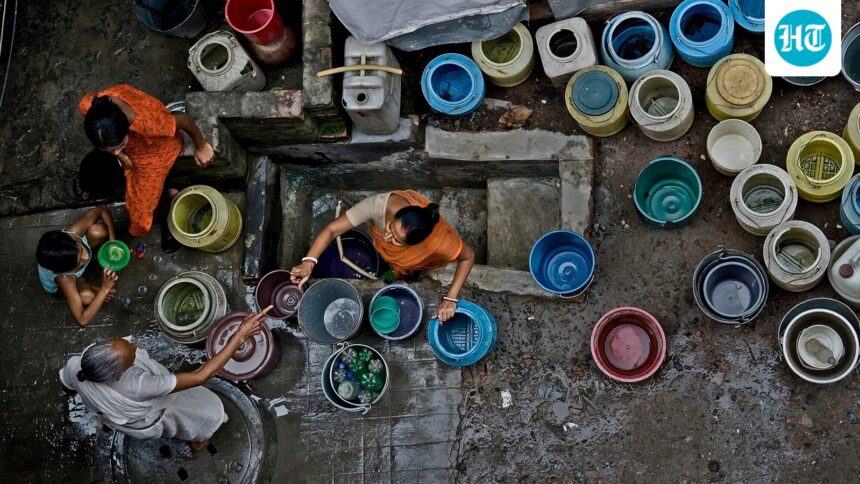
Meanwhile, landlocked Delhi continues to suffer from water shortages, due to its dependence on neighboring states for water supplies. The Delhi Jal Board runs nine water treatment plants and a set of tube wells, which cumulatively aim to supply 1,000 million gallons per day of water, while Delhi’s demand is 1,250 million gallons per day, indicating a gap of 250 million gallons per day. Delhi relies primarily on its neighbors for 86.5% of its raw water supply. Under the 1994 agreement, 0.724 billion cubic meters of Yammouna water is allocated to the capital and the share varies over three periods – July to October, November to February, and March to June.
Read also: Yamuna pollution remains severe in Delhi despite improvement in some points
Delhi’s population was around 10-11 million in 1994 when the agreement was signed and it has risen to around 25 million now, a DJB official said.
“Our demands have also risen significantly. The Delhi Jal Board has no objection to the reallocation of water resources in the Yamuna river, but the quota set for Delhi should not be reduced,” the official said. Dewan Singh, a water expert and Yamuna activist, said that if Delhi and Haryana get water from the Ravi-Beas system, Punjab can technically also claim the Yamuna water but the rights of the river must also be taken care of. “Countries need to improve water management in their regions. River health cannot be ignored.”