The romantic screwball is getting ready Anais in love (2021) saw the arrival of Charlene Bourgeois-Tacquet among the growing ranks of French female directors, giving national cinema a powerful dust-up – an honor roll that includes Mia Hansen-Love, Justine Treat, Rebecca Zlotowski, and with Little sister (Forthcoming in the United States), Hafsa Harzi.
Starring Anaïs Demoustier as an irrepressible Parisian graduate student who weaves her way in and out of affairs, the film was the highlight of Critics’ Week at Cannes that year. However, Bourgeois-Tackett now has a place in the festival competition A woman’s life (La vie d’une femme) It’s the kind of intimate, modest-sized Gallic film that will likely be greeted with some dismay about whether such promotion is premature – as if it were simply a Cannes entry. He should Be a great swing over the fences.
Women’s life
Bottom line Study of the thriving and influential personality.
place: Cannes Film Festival (competition)
ejaculate: Leah Drucker, Mélanie Thierry, Charles Berling, Laurent Capilouto, Marie-Christine Barrault
exit: Charlene Bourgeois-Tackett
author: Charlene Bourgeois-Tackett, with Fanny Bordino
1 hour and 38 minutes
But while it’s not the major technical step that a quick promotion to the main event might herald, Women’s life It is, in its own way, an almost satisfying thing: a stylish, fun sophomore outing that proves the breakout was no fluke.
Bourgeois-Tackett’s soaring exposition — in which unexpected circumstances lead Gabrielle, a 55-year-old workaholic surgeon, to question her life choices — isn’t exactly earth-shattering, and the film lacks the propulsive spontaneity that made Anais in love Such an unexpected delight. This is partly a reflection of the type of protagonist Women’s life Dealing with: Gabrielle is as composed — or “rational,” to borrow her word — as the volatile Anaïs. However, there is an unmistakable safety here – a sense that the writer-director never goes beyond the familiar contours of a certain slice of contemporary French cinema, complete with the usual story staples (an extramarital affair, an ailing parent, a career crossroads) and stylistic moves (fast-paced editing, a soundtrack filled with peppy classical piano, chapter titles that break up the narrative).
However, when coloring within the lines leads to a second successive character study this vivid and perceptive, it is churlish to complain too much. Especially with a starring role like Leah Drucker – so wonderful in Catherine Breillat’s latest film Last summer – Delivering another performance of nuance, feeling and intelligence.
Written by Bourgeois-Tackett and Fanny Bordino, Women’s life The film opens with flashes of Gabrielle panting mid-coitus in close-up—a clear indication that we’re in this privileged world known as French cinema. The following scenes show Gabrielle, the talented and indefatigable head of facial reconstruction surgery at an underfunded Parisian hospital, in her hypothetical situation: racing through a daily gauntlet of macro and micro medical, administrative, and personal challenges, all while complaining about everyone’s incompetence.
At the same time, Gabrielle is good-humored and ill-tempered in that quintessentially French way, and actually carries an enormous amount of responsibility. In addition to her daily schedule of operations and consultations, there are interns to train and a clinic renovation to supervise. Her surgical partner and best friend Kamiar (Laurent Capilouto) is about to go on paternity leave. Tensions rise with her husband (Charles Burling) due to the fact that his grown children are still living and partying at home. (Gabrielle has no biological children.) Her mother (Marie-Christine Barrault, wonderful) has Alzheimer’s disease and requires around-the-clock care.
Gabrielle is frighteningly self-sufficient, so skilled at juggling, twirling, and taking care of everyone and everything, that – you guessed it – no one really cares about her. The people who inhabit her world don’t seem impressed by her ability to curb chaos; Not only do they rely on its prowess, they are accustomed to it. Somehow, the formidable Gabrielle became invisible, even to herself.
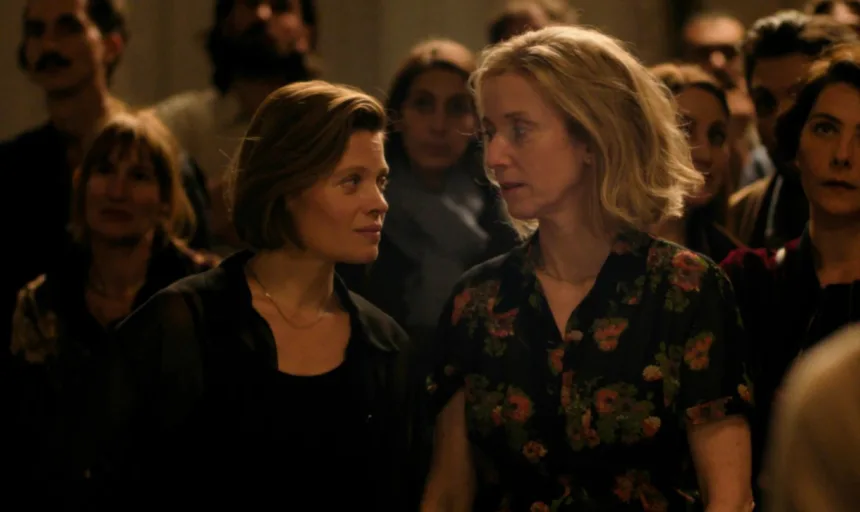
This status quo is shaken up by Frieda (Melanie Terry), a writer who comes to observe Gabrielle at work as research for her next novel. The experience of observing Frida in the operating room, and feeling valued and admired by this young woman, awakens something in Gabrielle. When Frida’s interest seems to go beyond strict professionalism, Gabrielle gives in to him after a moment of resistance.
Any fan of French films will easily sense how all this happens. But if Women’s life It’s missing the spark of surprise that powers it Anais in loveHowever, it delves well, building Gabriel’s outer and inner worlds with arrows of sly humor and sweeping brushstrokes of melancholy. This is, in the broadest sense, a story of serial heartbreak—of the inevitable sacrifices, trade-offs, and losses we endure in life, from which no measure of achievement or privilege can protect us. More specifically, the film suggests that women like Gabrielle — of a certain age, and high achievers — are particularly vulnerable to this kind of regret or second-guessing.
But Bourgeois-Tackett is very careful not to deny the character she has. Gabrielle is no “victim,” she insists, and her occasional outbursts seem to result less from the impossibility of “having it all” than from the assumption that she will. He wants To get everything in the first place. Beneath its refreshing surface, the film grapples with these complex questions about gender, choice, ambition, and identity—just as Gabrielle constantly negotiates her way through her day, constantly negotiating competing urges, and figuring out how to wring meaning from her existence.
One of the pleasures of the film – and French cinema today in general – is the delicious multi-dimensionality of its female heroine. Like so many precious screen heroines before her, Gabrielle skates the line between speed and rudeness, with patience down to zero and phone etiquette more charitably described as “routine.” She certainly doesn’t suffer fools, but she can also be cruel and unfair to those close to her. When Kamiar, her co-department chair and dear friend, brings up his upcoming parental leave, Gabriel’s response is one part sarcasm to ten parts guilt.
But if Drucker refuses to round off her character’s prickly edges, she never overstates her toughness. Gabrielle’s unflinching efficiency and dynamism belie acute sensitivity, and the actress allows hints of mischief and child-like hesitation to penetrate the armor. Much of the drama in the film stems from this extremely empowered woman’s confrontation with the reality that she needs, and He wantsother people too.
The supporting characters are more functional than fleshed out, perhaps not out of place for a portrait of someone like Gabrielle, a force of purpose and passion who has the effect of making those around her feel superfluous. Henry, in particular, suffers from the film’s lack of interest in anyone but its central character. A key scene between him and Gabrielle explains their history in clumsy expository snippets. Kamiar Capilouto — a colleague with whom Gabrielle shares a long professional history and pleasant personal chemistry — and the vulnerable but sharp-tongued Arlette Barrault are more compelling, in part because the film conveys the specifics of their relationships to its protagonist without spelling them out.
Frida is the most important secondary character – the one who tempts Gabrielle away from her path, making her stop and reflect on the roads not taken. But given her cuteness, Terry doesn’t have much to work with here besides Cheshire cat smiles and cute entrances. Gabriel’s feelings toward Frieda are understandable in theory. The latter approaches her with fresh eyes and few demands, giving her space to be something other than an extraordinary problem solver. It’s too bad the movie doesn’t take the time to make us feel feel In our guts Which greatly excites Gabriel in the young woman, to explore their relationship a little more. (Compare that to reckless, chill-inducing romance.) Anais in lovewith Valeria Bruni Tedeschi matching Demoustier’s magnetic beat to the beat — literally, in the knockout “Bette Davis Eyes” dance scene).
Working with DP Noé Bach and editor Clément Pinteaux, Bourgeois-Tackett maintains that Women’s life Moving with a clear efficiency that reflects Gabriel’s efficiency. But she knows when to slow things down, as the camera gently zooms in and out around Gabrielle to capture the small transitions and turning points. The director rarely lingers, crafting brief moments of grace — like Gabrielle’s glance at her mother and stepfather as they take a nap — that heighten their fading resonance. She can also turn up the volume, staging a harrowing first-date scene that finds Gabrielle and Frida drawn into intimacy through an immersive dance performance.
One of Bourgeois-Tackett’s strengths as a writer and director is her deft approach to tone and focus. A family encounter with a social worker about Arlette’s worsening dementia is a marvel of unexpected comedy, while Gabrielle’s meeting with a severely traumatized tongue cancer patient forms an unexpected emotional pivot. “Sometimes life is hard,” she tells the man who is resisting the surgery that could save him. “That’s always unfair.”
These words may seem harsh. This is, after all, a doctor telling her trainee doctors that they won’t remember them fondly when their residency is over. But Gabrielle’s approach to the patient is gentle, and at this point we realize that her statement expresses compassion, solidarity, and deep, hard-earned honesty. Such honesty is the hallmark of this flawed but deeply human character—a gift she gives to the people around her and, by the end of the film, to herself as well.