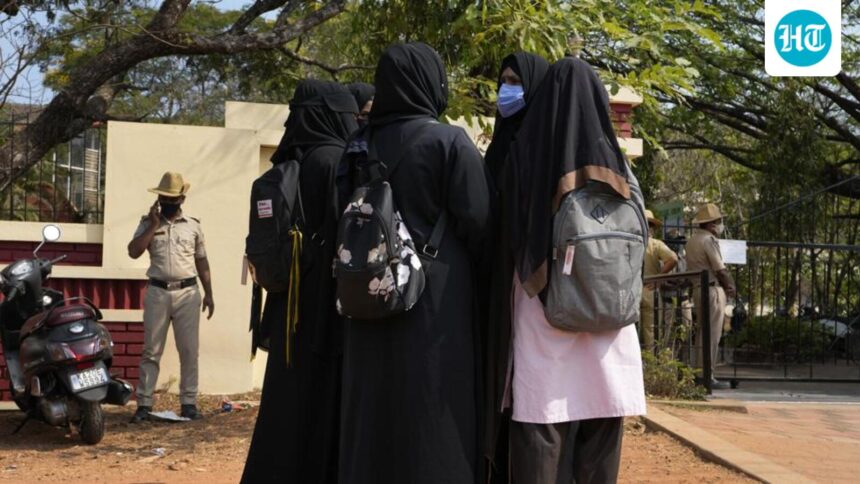
The Karnataka government on Wednesday revoked the state order 2022 that effectively banned the wearing of hijab in classrooms where uniform was prescribed, reopening the door for students to wear limited religious and traditional symbols in schools and colleges across the state.

The new directive, issued by the Department of School Education and Literacy, allows students to wear items like hijab, turban, sacred thread and rudraksha along with institutional dress, provided they do not conflict with discipline, safety or the identity of the student.
“Government Order No: EP 14 SHH 2022, dated: 05.02.2022, is withdrawn with immediate effect,” the order dated May 13 read.
The government order stated that students cannot be forced to wear or remove religious or traditional symbols permitted under the order, stressing that educational institutions are spaces intended to promote “scientific temperament, rationality, equality, dignity, brotherhood, discipline, mutual respect, social harmony, and the responsibilities of our constitutional democracy.”
She added, “Secularism in the constitutional sense is not opposition to personal beliefs; rather, it is giving equal respect to all, institutional neutrality, and non-discriminatory behavior.”
The decision formally repeals the rule introduced by the previous BJP government during the height of the hijab controversy in Karnataka in 2022, a dispute that drew national attention, led to widespread protests at educational institutions and led to a long legal battle.
The controversy first surfaced in January 2022 at a government pre-university college in Udupi, where a group of Muslim students said they were banned from entering classrooms because they were wearing a hijab. Similar conflicts soon emerged in other areas, leading to student demonstrations for and against the hijab.
As tensions rose and questions were raised over the powers of the institutions, the state government issued an order on February 5, 2022 directing students to follow the uniform prescribed by educational institutions. In places where there was no uniform, students were instructed to wear clothing consistent with “equality, integrity, and public order.” This order became the basis for restricting the hijab in many colleges.
The issue quickly escalated into one of the most divisive political debates in Karnataka. Some institutions temporarily suspended classes amid protests and counter-mobilization, while images of students wearing saffron shawls and hijabs became a symbol of confrontation.
The government’s order was challenged in the Karnataka High Court by Muslim students who said wearing the hijab was protected under constitutional guarantees of religious freedom and privacy. But the Supreme Court upheld the government’s position in March 2022, ruling that the hijab is not an essential religious practice under Islam, and affirmed the authority of educational institutions to impose dress codes.
The case later reached the Supreme Court, where a two-judge panel issued a split ruling in October 2022. One justice upheld the restrictions while the other ruled in favor of the petitioners. The case was referred to a larger bench, where it remains pending.
The Congress, which was in opposition at the time, opposed the restrictions and promised to revisit the issue if elected to power in Karnataka.
In its order, the government said it reconsidered the matter after receiving concerns regarding “traditional and belief-based marks worn by students of different faiths and traditions.”
“Having reconsidered the matter, the government is of the opinion that discipline and order can be maintained in the institution without restricting such traditional and limited practice-based codes normally worn by students,” the order said.
The government confirmed that uniforms will remain mandatory in educational institutions. “All government schools, aided educational institutions, private educational institutions and pre-university colleges in the country shall continue to prescribe and make uniform uniform as per the rules,” the order said.
At the same time, she explained that religious and traditional symbols cannot overshadow the basic character of the uniform. “Such traditional and practice-based symbols shall be complementary to the uniform and shall not alter, modify or conflict with the essential purpose of the designated uniform,” the order stated.
The directive specifically listed “Peeta/turban, Ganevara/sacred thread, Shivadaara, Rudrakshi, veil (veil)” among the permitted symbols.
It also prohibited institutions from excluding students from classes, examinations, or academic activities because they wear such items with their uniforms.
“No student shall be prevented from entering the educational institution, classroom, examination hall or academic activities on account of wearing such traditional symbols and limited practice with the prescribed uniform,” the order said.
The government said that any institutional circular, instruction or custom that conflicts with the new system will be treated as invalid.