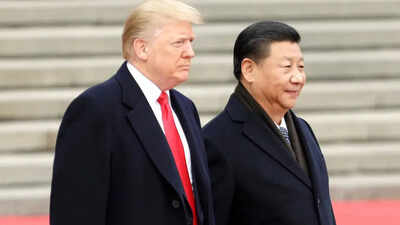
Donald Trump, Xi Jinping
TOI correspondent from Washington: Americans are holding their breath as US President Donald Trump arrives in Beijing on Wednesday, not only over the outcome of the summit with Chinese President Xi Jinping, but also over whether their volatile leader might stumble into another unscripted diplomatic or political controversy.This visit, the first by an American president in nearly a decade, comes in an atmosphere of imperial pomp and grandeur. But beneath the party lies a more transactional reality: Trump is actually in China searching for a trade deal that could ease economic concerns at home, revive American exports ranging from Boeing aircraft and soybeans to ethanol, beef and sorghum, and calm voters wary of the Iranian conflict.
He watches
“You must not challenge…”: China reveals 4 red lines as Trump prepares to meet Xi Jinping amid Iran war
The symbolism of the journey is striking. Eight years after Trump’s first visit to Beijing in 2017 — when Washington was still widely assumed to retain a strategic priority over China — Trump returns to a vastly changed geopolitical landscape in which Beijing increasingly presents itself not as a competitor, but rather as an equal, if not superior, power. “It’s a bit like watching a grizzled boxer prepare for a rematch, only to discover that his opponent has been relentlessly hitting heavyweights while he was busy shadowboxing,” one analyst noted prior to the visit.
To offset the perceived loss of US global prestige, Trump is traveling with an unusually large delegation of CEOs that includes technology and industrial giants including Elon Musk, Jensen Hwang, and Tim Cook — a clear signal that despite the rhetoric of strategic competition, the White House wants business. Huang was added mid-trip during a refueling stop in Alaska — after his absence was noted by the media — while Trump was gathering executives seeking better access to the Chinese market.The official delegation includes not so much Chinese scientists as loyalists and dealmakers: Treasury Secretary Scott Bessent, Defense Secretary Pete Hegseth, and Trade Representative Jamieson Greer. When critics pointed out the relative absence of seasoned China experts among the core entourage, one of Trump’s aides blasted his entourage. “You have no idea what you’re talking about, you crooked, mouth-breathing moron.
“Stop calling yourself an expert on anything, except suck,” White House Communications Director Stephen Cheung fumed at the critic, a former Obama administration official, underscoring sensitivities within a Trump White House that is often accused of prioritizing loyalty over institutional knowledge.The family optics also raised eyebrows. Trump is accompanied by his son, Eric Trump, and his daughter-in-law, Lara Trump, but First Lady Melania Trump is noticeably absent, with observers seeing this omission as further evidence that the trip, beneath the pomp, is essentially business — less statecraft than corporate promotions.What Washington hopes to secure is relatively straightforward: increased Chinese purchases of American goods, renewed aircraft orders, agricultural imports, and perhaps large-scale Chinese investment in the United States at a time when Trump needs to make economic gains before the politically fraught midterm elections. At the same time, China is expected to seek easing export restrictions on advanced semiconductors, lower tariff pressures, and perhaps softer US positions toward Taiwan.This last issue looms ominously during the visit.Taiwanese officials and American hawks alike fear that Trump’s instinctive preference for headline-grabbing deals could tempt him to make rhetorical concessions to Beijing on Taiwan in exchange for economic gains or Chinese cooperation on Iran and the Strait of Hormuz. Some op-ed writers believe Xi will pressure Trump to come closer to explicitly recognizing Beijing’s sovereignty claim over Taiwan rather than simply recognizing it under long-standing US policy.The question of whether Trump will arrive stronger or weaker is still hotly debated in Washington. Trump-friendly media outlets, such as Fox News, have portrayed him as entering Beijing with the “upper hand,” citing China’s economic slowdown and Trump’s reputation for unpredictability. But critics argue otherwise: Trump has painted himself into a corner after the Israel-related standoff with Iran escalated into a costly geopolitical and economic mess, and he needs a Chinese bailout.Even more damaging, analysts say, is Beijing’s retaliatory use of rare earth controls after Trump escalated tariffs last year. Despite Trump’s threat, China’s ability to strangle supply chains vital to America’s auto, defense, and technology industries appears to have significantly narrowed Washington’s room for maneuver.Now some commentators are openly wondering whether the Hormuz crisis may become a “Suez moment” for Washington – a historical parallel to the 1956 disaster that forced Britain to confront the limits of its imperial power.
In this reading, Trump’s trip to Beijing becomes more than just a business mission; Rather, it turns into an implicit admission that the United States now needs Chinese cooperation to stabilize the global order that it once dominated alone.
For all of Trump’s bluster, critics say he appears to be “preparing the ground” for a deal – and they are rather desperate at that.This perception was reinforced by a series of extraordinary statements at home before his departure.
When asked whether economic anxiety among Americans affected his thinking about negotiations with Iran, Trump replied: “I’m not thinking about America’s financial situation – I’m not thinking about anyone. I’m thinking about one thing: We cannot allow Iran to have a nuclear weapon.”He also expressed his anger at a reporter who asked her about the high cost of the White House ballroom, describing her as a “stupid person.” While the summit takes place under layers of communist choreography and capitalist bargaining, Americans are still hoping that their president, a self-proclaimed “stable genius,” will be a little more cautious in Beijing.