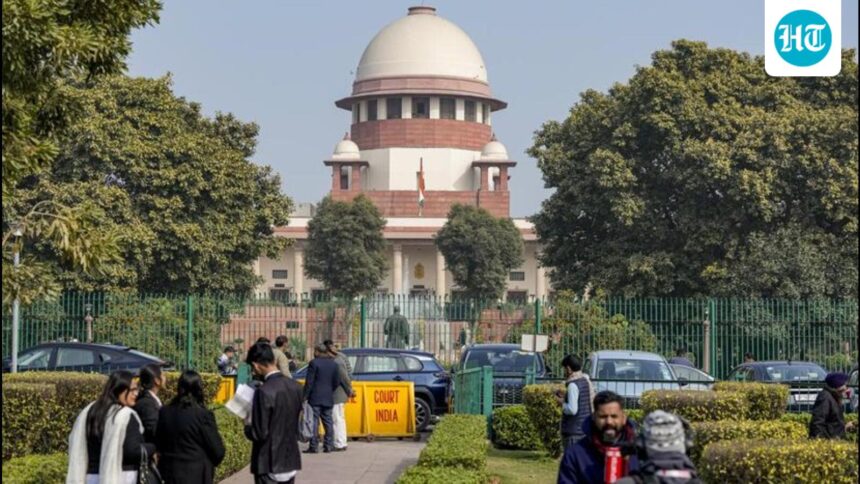
The Supreme Court on Wednesday stayed the Madras High Court’s order barring Tamilaga Vetri Kazhagam (TVK)-elect MLA Srinivasa Sethupathi from participating in the Tamil Nadu Assembly, including the confidence motion moved by Chief Minister Vijay, terming the Supreme Court’s intervention in an election dispute as “outrageous” and legally unsustainable.

A bench of Justices Vikram Nath, Sandeep Mehta and Vijay Bishnoi stayed the implementation of the Supreme Court’s interim order and stayed further proceedings before the apex court, observing that the writ petition itself should not be considered in the light of the constitutional scheme governing electoral disputes.
The Supreme Court’s intervention came even as floor test proceedings were underway in the Assembly. By the time the Supreme Court issued its order and directed its immediate upload on the Supreme Court’s website, Vijay had already won the vote of confidence. The final result was 144 votes in favor of the government, compared to 22 votes, while five members abstained from voting. The DMK walked out of the Assembly ahead of the confidence motion, with Leader of the Opposition and DMK MLA Udhayanidhi Stalin announcing that the party would boycott the proceedings.
The controversy arose from the Madras HC order passed on Tuesday barring Sethupathi from participating in the Assembly over a dispute related to postal polls in Tiruppattur constituency, where he defeated TVK candidate KR Periyakaruppan of the DMK by a single vote.
While appearing for Sethupathi, senior advocate Abhishek Manu Singhvi attacked the SC order as “grossly illegal” and submitted before the apex court that the order requires strong judicial redress. “This is a situation that requires restrictions,” Singhvi said.
Questioning the viability of the proceedings before the Supreme Court, the apex court asked senior advocate Mukul Rohatgi, representing Periyakarupappan: “How did you file a writ petition under Section 226?”
The body also sought clarification from the Election Commission of India (ECI), asking: “Who do you support?”
Singhvi pointed out that even the Election Commission of India had opposed the continuation of the writ petition before the Supreme Court and said that the only remedy available after the election results are declared is to file an election petition under the Representation of People Act.
“This is terrible to say the least… The Supreme Court says the remedy is to file an election petition, but it still accepts the Section 226 petition? This will negate the remedy provided by the Election Court,” the bench observed during the hearing.
Defending the Supreme Court action, Rohatgi said the dispute arose because two constituencies shared the name Tirupattur — one in Sivagangai district and the other in Tirupattur district, leading to an alleged mix-up related to postal balloting.
“This is constituency number 185. There is another constituency with the same name. I lost by one vote, and it later turned out that the postal ballot meant for my constituency had reached the other constituency. If it had reached the correct postal address, there would have been a tie,” Rohatgi said.
He also asserted that the case falls outside the normal framework of an electoral petition because the grievance relates to an alleged administrative error by the electoral authorities. “If the votes go elsewhere, there is no other provision and I have no remedy to file an election petition,” he added.
However, the Supreme Court was not convinced at this stage and stayed the implementation of the impugned order and further proceedings before the Supreme Court.
“Implementation of the impugned order is stayed. Further proceedings before the High Court will remain pending,” the bench directed, while issuing notice and granting two weeks to file counter affidavits.
It is worth noting that Singhvi also urged the court to ensure immediate release of the matter since the confidence motion was already in progress within the association. Accepting the request, the bench ordered the matter to be uploaded immediately on the Supreme Court’s website, stating that it was a matter of “prestige.”
The origins of the suit go back to Periyakaruppan’s petition before the Madras High Court alleging that election officials mishandled one postal ballot meant for Tirupattur constituency in Sivagangai district and mistakenly sent it to the Tirupattur constituency of the same name in Tirupattur district, where it was allegedly rejected rather than redirected for counting.
The Supreme Court on Tuesday held that the matter was an “administrative failure” by electoral authorities and justified limited judicial intervention under Article 226 to preserve electoral records and evidence. It had also observed that Sethupathi’s participation in the floor test could have consequences “beyond the constituency and impact the constitutional governance of the state”.