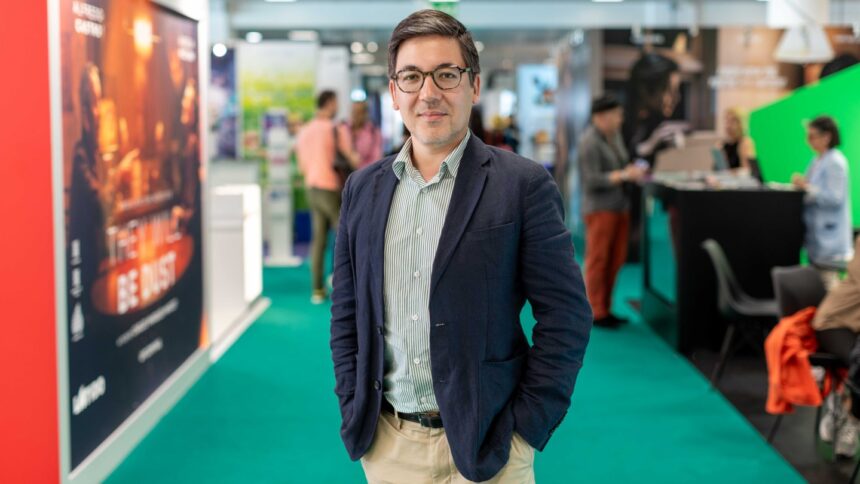
Guillaume Esmeul has spent the last few years quietly remaking the Cannes Film Festival in his own image — that is, in the image of someone who came about not through traditional film sales but through technological innovation and financing. He began his career in business development and digital media innovation roles at French network TFI, and had a stint at startup studio Wefound before succeeding Jérôme Paillard as head of the Cannes market, taking over as sole head in 2023.
Under his direction, the marketplace has expanded beyond its primary role as the world’s leading marketplace for buying and selling independent films, to include a sprawling schedule of 250 panels and events covering everything from private equity financing to artificial intelligence and, new this year, the Creator Economy.
Ahead of the 2026 edition, Esmuel sat down with… Hollywood Reporter To discuss where the most important market in the film industry is headed.
When I took over Marché, I was coming from a technology and innovation background rather than a traditional film sales background. What is your vision of what the market should become?
It took me a while to fully understand what Marché is, and I always use this explanation with my team: Marché has three markets in one. The first is the film sales market – the kiosks, the screenings, and all the networking between sales companies and distributors. But we are also a market for developing and financing film projects. The third market is the knowledge market. This year, we have organized or will host 250 events, including panel discussions and conferences, all during one edition of the Marché. It’s where I put all the key topics of the industry: innovation and AI, of course, but also the state of the industry, sustainability, and, for the first time this year, the creator economy.
Artificial Intelligence is the great hope and great fear of many in this industry. How do you deal with covering him at Marché?
If people have concerns, I think our role is to explain the issue and address those concerns. We like to explain how technology works, but we also host all discussions about its impact, including around intellectual property rights, as well as to explain the opportunities. I also want to have real, tangible use cases and not just discussions – very concrete examples of how this technology can be used in actual films. However, I think it is important to create a framework that respects what we stand for. We don’t want to talk about artificial intelligence replacing creativity; We want to talk about artificial intelligence and technology to enhance creativity and create new job opportunities. This is also why we are creating not just an “AI Summit,” but an “AI Talent Summit.”
Can you share any specific sessions from this year’s program that exemplify this approach?
We will be having a panel discussion with James Manyika [Senior VP and President for Research, Labs, Technology & Society at Google-Alphabet] And Darren Aronofsky. He’s a great film director and producer, and I think it’s interesting to see how he uses AI. They will speak together at the AI Talent Summit on Saturday morning. There will be many other discussions between film professionals, such as director Xavier Gens and Guillaume Duchemin, director of La Fémis. [the prestigious cinema school] And industry leaders from technology companies like Nvidia and OpenAI and top startups. It would be interesting to let them talk about what they really do. Because when you talk to them, you realize that there are actually a lot of humans involved in their projects. It’s far from the abbreviations we sometimes hear.
Why did you decide to incorporate the Creator Economy into the Marché Market this year?
In these recent years, there have been more and more interesting use cases. in france, Kaizen It is a very interesting one. The movie [a documentary about YouTube star Inoxtag attempting to climb Mount Everest] It was distributed by MK2, and they did huge numbers in cinemas. It demonstrated how a content creator can energize their community and bring a different audience to the theaters. But there’s another use case that I find pretty cool: Markiplier. He’s American, and he produced his own film. Iron lung. He self-distributed his film, which grossed no more than $50 million worldwide. This is very impressive, especially coming from outside the traditional industry. I think this is the right moment to talk about different kinds of bridges between the film industries and the creative economy, about bringing new talent from this world to film producers, but also about new marketing and promotional aspects, and about creators who can activate their communities to see their films.
To what degree do you hope Marché will become a platform for regulatory discussions around AI and IP?
The market is truly international – so there will be not only the European perspective, but also the American vision, and even the Asian vision. It’s very exciting to have this unique place where those visions can encounter each other. This year, there will be a very strong presence for Europe – the European Commission will come to Cannes, and it will be there at its highest level. The European Parliament also organizes events at the Marché. During the AI Talent Summit, we’ll talk about responsible AI and try to define what it means – because not everyone has the same definition. We will give way to some technology companies and startups that propose new approaches to defending intellectual property and authors’ rights.
Back to the core business: What is the biggest concern right now for buyers and sellers of traditional films?
It’s a global market – because in some regions, the box office numbers are not as great as they were before Covid. This means that some distributors find it difficult to buy films, or pay the same amount as before. But if your question is about what attendees expect from Marché, our job isn’t to sell square meters or show rooms, it’s about reducing business friction, and making things run smoothly so business can get done. Cannes is a crazy city, with buyers and sellers running from one meeting to the next, and sometimes ten minutes lost can mean a missed opportunity. We have therefore made the palace more accessible, become more flexible in organizing showings, and have specific initiatives for buyers. It’s really about making the Cannes experience seamless.
How can you measure the evolution of Marché under your watch?
Obviously we measure the number of participants every year. We reached record levels with over 40,000 professionals at the festival, including 16,000 registered with the Marché du Film. Since I arrived, we’ve also measured NPS, Net Promoter Score – where you take satisfaction surveys and only count people who answered nine or 10 out of 10, and subtract those who answered from zero to six. The sixes and sevens you throw. After my first market, we were at about 10. Then we went up to 20. Last year, we were at 33, which is a huge improvement. Outside of NPS, we are, and want to remain, the most important market for movie sales. This is our core business, and being a leader is something you have to stand up for. I would also like the Marché to be a laboratory for new business models, for new innovations, for new types of creativity.
Is there one conversation that gave you real optimism about the direction the film industry could be headed?
I remember a startup pitch I liked. “We want to be the Pixar of the AI era,” they said. Before Pixar, no one really believed in 3D animation. After Pixar, everyone was shooting 3D with new creative possibilities. So maybe someone can make movies using AI in a way that’s still authentic but just as disruptive — or maybe not. But the market is where we should be having this discussion.