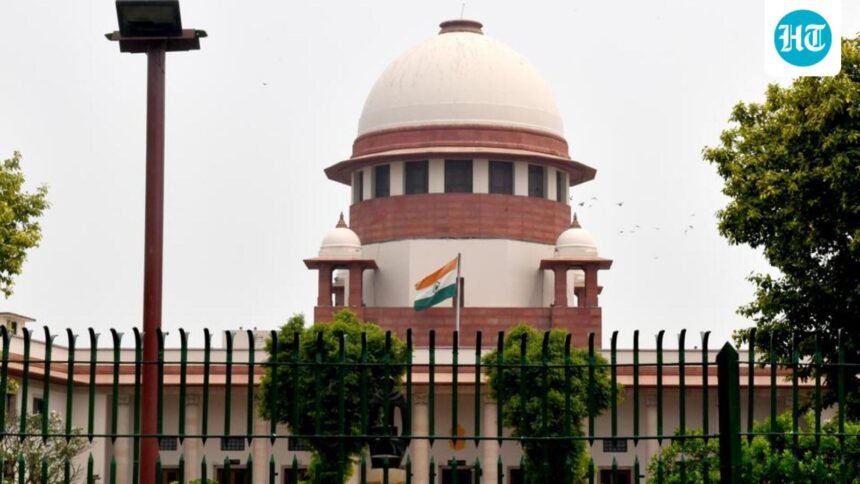
The Supreme Court on Monday urged high courts across the country to consider setting up grievance redressal committees at the High Court, district and taluka levels to amicably resolve tensions between the Bar and the bench, days after a contentious courtroom exchange in the Andhra Pradesh High Court involving a young lawyer sparked widespread outrage in legal circles.

A bench of Chief Justice of India Surya Kant and Justice Joymalia Bagchi issued this direction while closing the suo motu proceedings initiated on the basis of submissions filed by the Bar Council of India and the Supreme Court Bar Association over the incident involving Justice Tarlada Rajasekhar Rao of the Andhra Pradesh High Court.
The controversy arose during proceedings on May 5 during the hearing of a petition challenging the surveillance and passport seizure circular, where the judge rebuked a young lawyer who appeared in the case. Later, a video of the courtroom exchange was widely circulated on social media, showing the lawyer repeatedly apologizing and pleading: “Sorry… I’m begging for your grace, gentlemen.”
At one point, the judge was heard saying: “Have you decided to deny the motion by injunction?…Do you think you are a great big lawyer?…Call the police. Go and appeal.”
The court also issued a verbal order to detain the lawyer for 24 hours, although the directive was not implemented after the intervention of members of the Supreme Court Bar Association.
Referring to this incident, the Supreme Court said that institutional mechanisms are necessary to ensure that issues arising between judges and lawyers are addressed in a timely and amicable manner.
“We consider it appropriate to press the High Courts to constitute grievance redressal committees which should include members of Bar Councils and Bar Associations. These committees are being constituted at the district and taluka levels as well. This mechanism will ensure that issues that may arise between members of the Bar Association and the judiciary are resolved amicably, effectively, and in a timely manner,” the bench said, agreeing to a suggestion put forward by SCBA president and senior advocate Vikas Singh.
The court also stressed that judges must show “patience, compassion and a spirit of encouragement”, especially towards young lawyers entering the profession.
“Young law graduates coming from a wide range of institutions should be encouraged to join the Bar,” the body noted, adding that the responsibility for instilling discipline and ethics does not lie with the Bar alone, but equally with the body.
The court added: “The judiciary must remain aware that the strength and standing of the body at all levels depends fundamentally on the continuous care and development of the Bar Association.”
During the hearing, the CJI revealed that a report was sought from the Chief Justice of Andhra Pradesh High Court after the incident was brought to the attention of the Supreme Court.
According to the record presented to the court, the dispute arose from a dispute over the applicability of a judicial precedent during the session. The report said that the situation escalated after the judge got the impression that the lawyer deliberately hit his file on the stand, while the lawyer confirmed that the file slipped from his hands by mistake.
The Supreme Court noted that the exchange that circulated online was “taken out of context” and that the oral remarks were never incorporated into the injunction.
“It appears that the learned judge, during the proceedings, sought to draw the attention of the young lawyer to a decision supporting his case, while the young lawyer insisted on relying on another precedent… During the exchange, the case file fell on the floor – an event that was not intentionally triggered. However, the judge interpreted it as an act of impropriety,” the bench recorded.
The court said that ultimately no enforceable custody order remained and noted that the matter had already been resolved amicably at the High Court level.
The report further stated that Chief Justice Lisa Gill interacted with the young lawyer, who confirmed that the misunderstanding had been resolved and that no complaint had been filed before any forum.
Since then, the Andhra Pradesh High Court has constituted a five-judge committee to maintain cordial relations between the Bar Association, apart from setting up a separate grievance redressal mechanism.
At the conclusion of the proceedings, the Supreme Court said that the incident did not require any further action at its end.
At the same time, the authority warned against circulating clips of clips in the courtroom devoid of context.
“We make an unequivocal observation that the media has a vital role in this regard. Publication of videos taken out of context can cause undue bias. We therefore expect the media to play a proactive role with an increased sense of responsibility,” the court said, while also appreciating the role of legal journalists in reporting court proceedings responsibly.
The incident sparked strong reactions from legal bodies across the country. The Bar Association had issued a resolution expressing “deep concern and shock”, warning that humiliation or intimidation of young lawyers could have a chilling effect on the independence of the Bar Association. The BCI has also written to the CJI, saying such incidents create fear among young defenders and undermine confidence in the justice system.