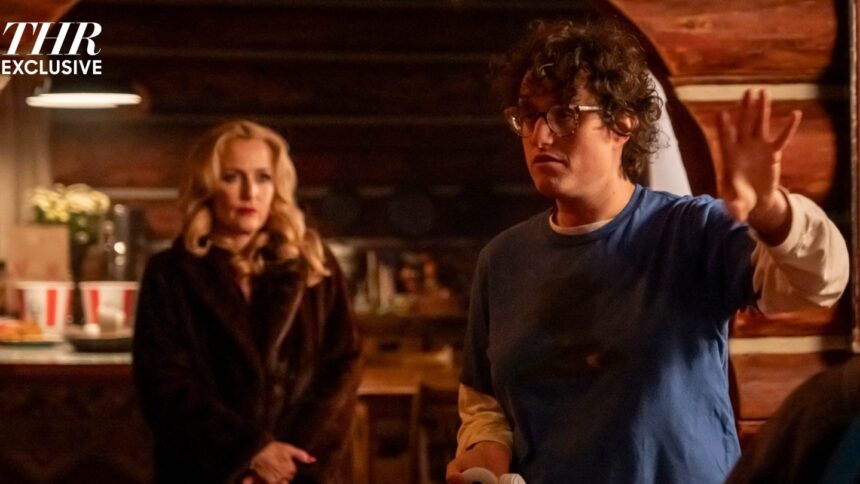
Jane Schönbrunn tends to shoot her films holistically, arriving on set each day with a strict formal philosophy of filmmaking. But while making their latest film, the director had no real plan for the sexual matters. This was strange since the title of the sexy reference, Teen sex and death in Miasma camphad been on Schönbrunn’s mind for years — and the story itself was, in the director’s own words, “about learning how to stop breaking up during sex.” This turned out to require an introductory lesson behind the camera. “I realized once we got into production that I was really avoiding, if not disengaging from, having to direct those scenes,” Schoenbrunn says now, in their first in-depth interview about Miasma camp. “Directing those scenes felt as intimidating as directing for the first time.”
It will premiere as Un Certain Regard’s opening film at Cannes before Moby releases it in theaters on August 7. Miasma camp It hardly feels like the first movie. Rather, it reveals a major up-and-coming filmmaker at his most confident and ambitious, albeit still brimming with the enormous personal expression of his first two films. We’re all going to the World’s Fair and I saw the glow of the television. Schönbrunn sees this third feature as a natural artistic development.
“I was very conscious TV glow Such a moment, for me as an artist and for me as a person, coming out of a very deep emotional catastrophe – the early stages of [gender] “Transitions are absolutely crazy and require feeling like your entire life is either ending or just beginning,” says Schoenbrun, who is nonbinary. “Once I got over the terror of coming out and starting transitioning, which is TV glow Since I was born, there has been a new terror — and perhaps a more pleasurable terror — of figuring out how to be in my body and have a healthy relationship with sex for the first time in my life.
Featuring haunting and ferocious performances from Emmy winners Hannah Einbinder and Gillian Anderson, Miasma camp It imagines the resurrection of the sleepy slasher franchise. The hilarious opening sequence races through the cultural lifespan of the titular series, which launched as a huge commercial success and cult hit before sequels generated diminishing returns, then faced all sorts of conflicting reads online that revived interest — while also exposing the property’s problematic roots. Enter Chris, an eccentric emerging director who might be mistaken for Schoenbrunn’s replacement, who is set to bring… Miasma camp Back from the dead – and giving her some wake-up-friendly image rehabilitation in the process – and Billy, the original MiasmaThe “final girl” who has since retired as a recluse, à la Norma Desmond. Chris travels to Billy’s cabin, which originally happened to be abandoned Miasma Often, to convince her to come back for the new film, only to come away with a completely different understanding of what it should be and who she should be.

The core of the narrative—the dynamic between “two people who are identical to each other,” as Schönbrunn puts it—ultimately came down to the director. They have started thinking about the environment before TV glow2024 release, after a longer interest in driving the slasher in their own way. Schoenbrunn watched all A Nightmare on Elm Street In fifth grade. They “lived and breathed it.” Screaming Movies through high school. “That was half my identity — there was something almost celebratory about renting a morgue and cheering on the most extreme or creative gory killing that could happen,” Schoenbrunn says. As they began to transition, they read about gender theory, which prompted a radical reframing of those comfortable childhood favourites.
“The image of the mutant monster kept coming up, whether it was Norman Bates or Buffalo Bill or Frankenstein as a constructed body, and there was this breed of mutant people who had really complicated feelings about those films,” Schoenbrunn says. “On the one hand, those are places where they saw representations that seemed somehow familiar or comforting to their own experiences — but also, those films are very transphobic and problematic.”
in Miasma campthe monster of the franchise is called Little Death, whose legend comes to consume Chris and spark her sexual awakening. The role is played by Jack Haven, the mutant star TV glow. “I want to continue collaborating with Jack for the rest of my life,” says Schönbrunn. “And the idea of them embodying the power of both an assassin and the androgynous embodiment of orgasm – if I want to see that shit, someone else will!”
Miasma camp It crams the gory thrills and scares of the classic Slasher game into a funnier, weirder, and richer deconstruction of their images and legacy. There are homages aplenty, as well as clever throwback flourishes – from the heavy use of matte backgrounds to the good news of TV glow Fans, comprehensive glimpses into the original (and, well, fictional) version. Miasma camp – and this only reinforces the barbed social commentary.
“This film was very consciously designed to be fun… and to attract a lot of people to have a discussion about sex, sexuality, and overcoming trauma,” Schoenbrunn says. “I don’t know of any other films — and certainly any other Hollywood films — that have this conversation in this way, from this perspective.”
***
TV glow It, for its part, was unlike anything else out there, working its way to widespread critical acclaim and nominations for five Spirit Awards including Best Picture. Schönbrunn felt the need to “cash in” on the success of this film, and was keen to push his limits as a film director and shift to a new tonal key. The industry shrugged in response. “Everyone but Moby has had a go at it, to be perfectly honest,” they say. “All the major studios and distributors passed on the film, and I think that’s because of the limits of what kinds of queer and trans stories are considered commercial or non-commercial.”
Schönbrunn felt determined to muster everything he could to combat this reality, in light of its aftermath.TV glow cache. They came from the independent, non-profit, small-budget worlds, and they knew “not to trust that the system would let me be free.” Rather than risk development hell for a budget that fit the scope of the film, they became feisty with those who believed in the vision. (Moby ended up backing the film along with Plan B.)
“When I look around in the post-woke, post-Biden era, I don’t see any other trans artists getting budgets, which is a huge shame,” Schoenbrunn says. “I shouldn’t be the only one making films at this level of budget.” They fully expect to prove those financing skeptics wrong: “I think this movie is going to be a hit.”

Chris’ character inevitably represents Schönbrunn to some extent. In crafting it, the director says Einbinder was a close collaborator: “The role is very personal for her. … I know it helped her grow and think a lot about herself and her own life. It was a kind of immediate love between us.” Then together they extracted Schönbrunn’s own experiences. In one scene, Kris poses as an updated, enlightened, gay version of herself Miasma The idea of a Zoom reboot has been rife with executives, which boasts similarities to a personal anecdote told by Schoenbrunn The New Yorker A few years ago (“I’d say it’s loosely based on a number of Zoom calls,” they say with a smirk). Chris’s personal and artistic epiphanies collide with party mandates.
“I don’t think it’s friendly – I don’t think I’m trying to do that studio“Schoenbrunn says Miasma campHis take on Hollywood. “The film represents the experience of someone trying to find creative independence and maybe losing their mind a little when their head hits the confines of the highest Zoom rooms in Capital.”
But within that frustrating journey, there is a liberation that brings us back to those bloody and vivid sex scenes. “I really hope they struggle culturally in that way Blue velvet“The sex scenes have been culturally conflicted, or the more erotic moments have been conflicted,” Schoenbrunn says This is a concern in my previous work. Within those scenes there are a lot of complex thoughts and feelings that a lot of people share but don’t talk about.”
Einbender and Anderson’s performances become even more explosive in these intimate encounters. “The reserve of emotional vulnerability that she can draw upon at any moment — I think only great actors can do that, and I’ve seen that many times, and her ability to fully enter into a space of dramatic performance is incredibly high,” Schoenbrunn says of Einbinder. As for Anderson? “It’s as if she’s like Jim Carrey at certain moments,” the director exclaims. “It’s very funny and strange and a little grotesque and a little sad – so far removed from our traditional notions of heightened sexuality, while still being incredibly sexy and strange.”
In fact, for a great Cannes premiere by an American director, nothing about it Miasma camp Traditional feel. The significance was not lost on Schönbrunn, as he made his first-ever trip to the festival as a director – having previously attended it a decade earlier in a very different capacity. “I was working a day job that I hated and in a body that I hated, and that’s where I decided to quit my job and figure out how to live a better life,” Schoenbrunn says. “I thought, ‘I need a better reason to be at Cannes.’ And lucky for us, they found it.
***
Teen sex and death in Miasma camp Premiering May 13 at the Cannes Film Festival. Stay tuned for more Cannes 2026 screenings and premieres.