On May 4, something seismic happened in Tamil Nadu, a state where cinema and politics often intersect. The two-year-old party, founded by a movie actor, built on fan clubs, and dismissed by seasoned political observers as an out-of-touch romantic, didn’t just win; It reshaped the political map of the state.

But Vijay’s TVK did not win enough that day until it finally claimed to have secured the required number with support from other parties four days later. However, there was no official invitation from the governor to form the government. Whether the calculations worked or not, the political volatility continued into Friday night.
The CPI(M), which is supporting Vijay, said the oath ceremony will be held on Saturday at 11 am. But official confirmation was awaited.
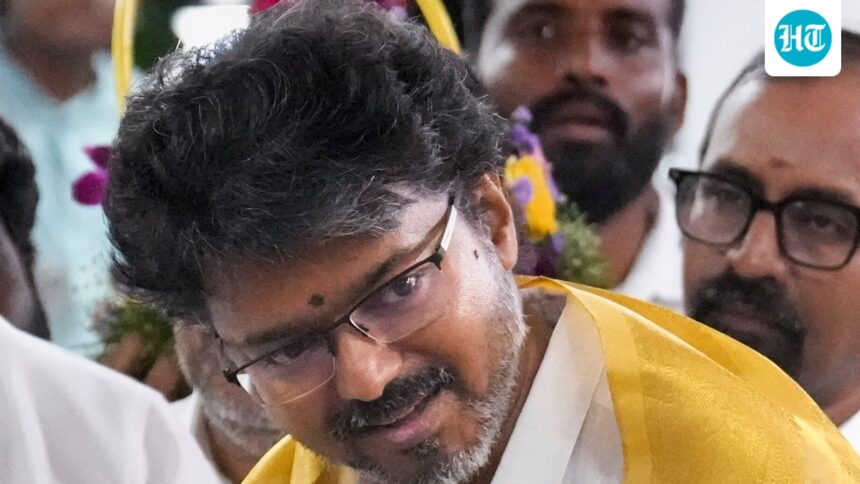
The Tamil Nadu Vetri Kazhagam (TVK), led by actor-turned-politician C Joseph Vijay, emerged as the single largest party with 108 seats, ending the decades-long stranglehold of the Dravidian duopoly – DMK and AIADMK – on Tamil Nadu politics. The incumbent chief minister, MK Stalin of the DMK, lost his seat in Kolattur, a constituency he had won three times before.
However, by the morning of May 5, Vijay’s victory already bore an asterisk. It had 108 seats, not 118. And 118 seats The simple majority mark in the 234-member House of Representatives is the important number when you want to govern. Technically, even 117 will do the trick for now.
It’s not just mathematics, it’s a political problem too
TVK contested alone in all constituencies. Vijay had repeatedly declared, in the months leading up to the elections, that he would not have any relationship with the AIADMK-BJP or the DMK-Congress. “Not publicly, not even behind closed doors,” he said of the BJP in particular. The DMK also represents the old forces that he said TVK was born to replace.
With no pre-election coalition partners, TVK had no automatic reservoir of support to draw upon When it decreased by 10.To complicate matters further, Vijay won from two constituencies, Perambur and Tiruchirappalli East.
The law requires him to vacate a lawmaker, reducing TVK’s actual number to 107 actually available lawmakers.
The first step: Congress broke ranks
The first party to flash was the Indian National Congress, which won five seats as part of the DMK-led Secular Progressive Alliance. In a meeting held late on the night of May 5, the Congress decided to support TVK but on a simple condition that TVK should never side with the “communal forces”, the BJP. TVK cited former Tamil Nadu CM K Kamaraj, a Congress supporter, as one of its ideological icons. Maybe that made the conversation easier.
The DMK was furious. At a meeting of the Legislative Party, he issued a resolution that he described as “a major betrayal.” “The India bloc is over. We will remake the alliance,” senior DMK leader TKS Elangovan said. The Congress-led India Bloc has managed to bring down the Narendra Modi regime’s numbers in the 2024 Lok Sabha elections.
However, here and now, the five MLAs in Congress have taken Vijay’s numbers to 112. There are still six less.
Left and VCK
The remaining calculations relied on the Left parties – the CPI(M) and CPI (Maoist), with two seats each – and the Viduthalai Chiruthaijal Katchi (VCK), which also got two seats. All three were still officially part of the DMK-led SPA. Supporting TVK would mean bypassing an ally already angry about Congress’ exit.
The CPI Executive Committee weighed the “pros and cons”. CPI(M) State Committee meeting was held. VCK’s Thul Thirumavalavan called a high-level committee meeting online and announced that the party’s decision would be issued on Saturday. By Friday night, there was talk that the VCK wanted the deputy prime minister’s post.
VCK’s Thirumavavalavan also commented that if TVK, which opposed dynastic politics, allied with Congress, it would be contradictory. However, the VCK’s current ally DMK was also dynastic; MK Stalin is the son of former CM M Karunanidhi, who was a famous film script writer.
For Vijay, the scenario has become more complicated.
The term of the current Tamil Nadu Assembly is scheduled to end on May 10. If a government has not been formed by then, the governor could impose president’s rule – effectively centralized rule run by the BJP in a state where the BJP won exactly one seat.
After 3 meetings
Governor Rajendra Arlikar added the major layer of tension. Even after the Congress extended support, taking TVK’s total membership to 112, it did not call for Vijay to form the government, stating that 112 remained short of a majority.
Critics have pointed out that the Constitutional Convention requires the governor to invite the largest single party to try to form a government and then achieve a majority in the House of Representatives – not as a precondition for receiving an invitation.
The Secretary General of the Communist Party of India, Dr. He called the delay a violation of established parliamentary practices. Congressman Jeppe Mather claimed there was a “hidden agenda.”
Vijay met the governor three times in three days. On Friday afternoon, May 8, it appeared that the magic number had been reached.
CPI(M) State Minister M Veerapandiyan and CPI(M) State Minister P Shanmugam held a joint press conference and announced their support for TVK. “With an aim to thwart the BJP’s objective, the CPI(M) and CPI(M) have decided to extend support,” Shanmugam said. They said VCK’s Thirumavavalavan told them he would agree with their decision. The IUML, along with two MLAs, was reportedly willing to support Vijay.
The final outcome
Now the calculations are like this according to TVK supporters – TVK (after Vijay vacates one of his two seats) 107; Congress 5; two each from CPI and CPI(M); For a total of 116.
Two VCKs can reach 118. The IUML also has two, and at one point were reported to have supported Vijay; Only to later say it was common.
The majority mark in the Assembly will now be 117 with 233 members (Vijay won two seats, as mentioned before).
There was a wait for a clear communication from Lok Bhavan, as of 10.30pm on Friday.
The bigger picture
There is a certain political irony woven into this entire episode.
Vijay explicitly built TVK as an alternative to the Dravidian old guard and as an ideological opponent to the BJP. He won without a single alliance partner. To govern, he needed the support of every important former ally of the same party that had defeated him.
Meanwhile, the DMK finds itself in a position it has not held for decades. Now she is in the opposition, abandoned by some of the allies she has fostered over the years, and watches as they try to help a rival seize power.
Whether the process of political reorganization in Tamil Nadu is permanent or not is a question that will determine the politics of the state long after Vijay takes oath, whenever that happens. For now, the math may finally work out. The government will be formed at some point. Thalapathy – the ‘leader’ – may have to wait a little longer to take over the chair. Unless there is another twist in this tale.