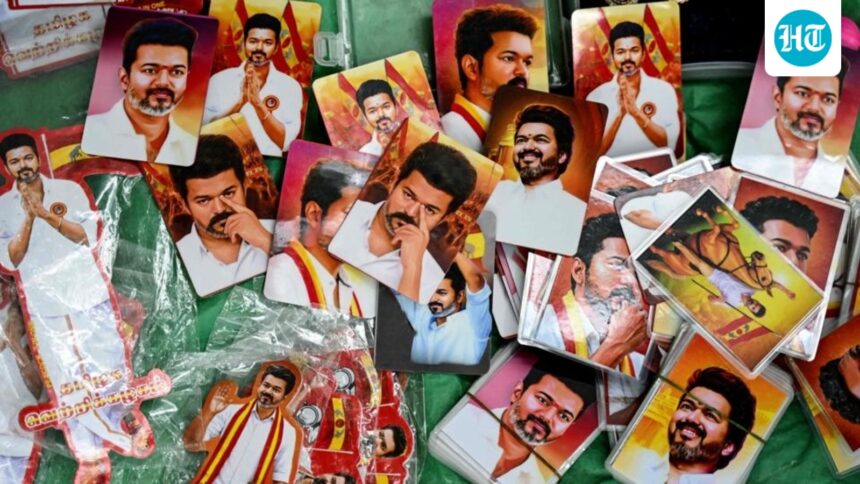
‘Thalapathy’ Vijay’s successful electoral debut has dramatically turned into a tussle for majority as fractured governance thrusts Tamil Nadu into an intense battle to form the government with minor parties emerging as the real power brokers.

The 234-member Tamil Nadu Assembly passed a suspended ruling with the Tamil Nadu Vetri Kazhagam (TVK) emerging as the single largest party with 108 seats – 10 short of the 118-seat halfway mark needed to form the government. Track all updates about Tamil Nadu government formation here
With the Congress extending support to TVK, Vijay currently has the support of 113 MLAs, which is still five votes short of the majority mark. Efforts to muster the remaining required number of seats have also created a ruckus between arch-rivals AIADMK and the DMK alliance – which in one scenario could also lead to the Congress and the Bharatiya Janata Party (BJP) being forever rivals under the same association.
The Congress and the DMK were allies under the All India Bloc of opposition parties, while the BJP allied with the AIADMK in the 2026 Tamil Nadu elections. However, the DMK criticized the Congress’ move to extend support to TVK.
Number of party seats
TVK-108
Dravida Munnetra Kazhagam (DMK) – 59
All India Anna Dravida Munnetra Kazhagam (AIADMK) – 47
Indian National Congress (INC) – 5
Patali Makkal Katchi (PMK) – 4
Indian Union Muslim League (IUML) – 2
Communist Party of India (CPI) – 2
Vedutalai Cheruthaigal Katchi – VCK 2
Communist Party of India (Marxist) – CPI (M) – 2
Bharatiya Janata Party (BJP) – 1
Desiya Murpukku Dravida Kazhagam (DMDC) – 1
Ama Makkal Munnetra Kazhagam (AMMKMNKZ) – 1
If the far-fetched and implausible scenario of an AIADMK (47) and DMK (59) alliance becomes a reality, the duo will still need 12 seats to prove a majority — necessitating the support of the other single-digit winners, all of whom make up the 20 seats.
However, there are many other parties that can lend support and help the implausible AIADMK-DMK alliance reach the majority mark before the need arises for the BJP and Congress to come into the same fold.
The ruler seeks to prove the majority
Amid the uncertainty, Vijay made two unsuccessful trips to the Governor’s House or Lok Bhavan. Rajendra Vishwanath met Arlikar for the second day in a row on Thursday as the constitutional question of who should be invited to form the government moved to center stage.
According to people familiar with the matter, the governor asked TVK to show support from at least 118 MLAs before extending the call to form the government. Lok Bhavan has also reportedly sought clarification on additional parties willing to support Vijay.
These developments have reignited the long-standing constitutional debate over whether the single largest party should automatically get the first opportunity to form government or whether the governor can obtain prima facie evidence of majority support before issuing an invitation.
Several Supreme Court rulings – including the landmark S.R. Bommai v. Union of India – have held that majority must ultimately be tested in the House, while also allowing governors limited discretion to assess whether the claimant appears capable of forming a stable government. Read the full report here
Small parties become kingmakers
Amid the fractured governance that has led to intense political speculation about a possible post-poll understanding between arch-rivals DMK and AIADMK — an almost unthinkable scenario in Tamil Nadu’s highly polarized Dravidian political history — neither party has officially acknowledged any talks.
DMK spokesperson TKS Elangovan on Thursday evening denied the possibility of the two parties coming together, but added that the decision rests with the party president, MK Stalin. If Stalin takes such a decision (to support the AIADMK), the DMK will accept it. He added that so far this decision has not been taken, adding: “The leader’s decision is our decision.”
In many ways, the biggest election winners are the smaller regional and ideological groups who are now positioned as kingmakers.
The PMK’s four MLAs, along with the two held by the IUML and the CPI, have gained immense political importance. Their support could determine whether Vijay gets the first chance to form the government or whether an alternative coalition is formed.
Even the Congress, despite winning only five seats, became central to the power struggle by providing TVK with its initial support base.
These unusual calculations have transformed parties that normally occupy the political margins into crucial stakeholders in government formation negotiations.
Constitutional gray area
The state of Tamil Nadu now finds itself in a constitutional gray area that is often witnessed in hung assemblies across India.
On the one hand, TVK can argue that as the single largest party, it deserves the first chance to prove a majority on the Assembly floor. On the other hand, the governor may assert that some clear evidence of majority support is necessary before an invitation can be extended.
Previous precedents from states such as Uttar Pradesh, Jharkhand, and Maharashtra showed that rulers often exercised discretion differently depending on the political context, leading to frequent legal and constitutional disputes, as detailed in an earlier Hizb ut-Tahrir report.
For now, all eyes remain on whether Vijay can secure the last few numbers needed to cross the majority mark – or whether Tamil Nadu may witness one of the most unexpected coalition experiments in its political history.