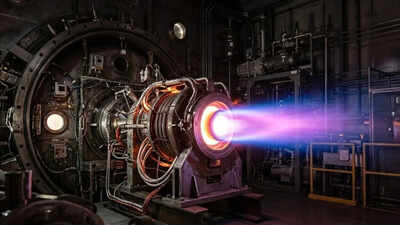
NASA’s Jet Propulsion Laboratory recently achieved a major breakthrough in space travel technology. They have successfully tested a lithium-fueled magnetic plasma propulsion (MPD) engine, creating a 120-kilowatt U.S. domestic power production milestone.
Unlike conventional rockets, this engine uses electromagnetic fields to accelerate ionized lithium plasma, providing the propulsion needed for missions carrying heavy payloads. As NASA prepares for its “Moon to Mars” mission, this advance is proving essential for nuclear electric propulsion systems. It could reduce travel time and increase charging capacity, paving the way for human exploration of Mars.
Time to travel to Mars That could change forever with NASA’s new plasma propulsion system
The latest experiments at NASA’s Jet Propulsion Laboratory have focused on a lithium-based magnetodynamic propulsion (MPD) engine.
This technology converts electrical energy into propulsion by forcing ionized gas, or plasma, through a magnetic field. During testing, the temperature of the central tungsten electrode in the thruster exceeded 5,000°F. As a result, it produced a dense, fast-moving plume of lithium vapor. Efficiency here is measured by specific impulse, which determines how much propellant is used efficiently, such as improving mass flow efficiency.
This makes it ideally suited to handle the massive payload requirements of a manned Mars mission.
Why does Mars exploration require megawatt-class power?
According to the report from NASA’s Jet Propulsion Laboratory, testing 120 kilowatts is a big step forward, but missions to Mars will need much more power, about 2 to 4 megawatts. JPL testing shows that scaling up electromagnetic propulsion is possible. It uses lithium as a fuel, which helps prevent engine parts from wearing out quickly.
This makes the system more reliable for long space missions.
NEP efficiently transports heavy life support systems
NASA is investigating nuclear electric propulsion (NEP) to generate the power needed for electromagnetic propulsion in regions far from the sun. Instead of relying on sunlight, a small nuclear reactor continuously supplies electricity to the MPD. This setup is currently viewed as the best way to efficiently transport heavy equipment and life support systems to Mars while using less propellant.