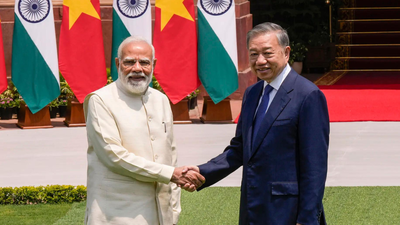
Prime Minister Narendra Modi with Vietnamese President Tu Lam
India and Vietnam on Wednesday agreed to strengthen their bilateral ties, aiming to take ties into an “enhanced comprehensive strategic partnership” while outlining an ambitious roadmap for trade, defense and technology cooperation.The decision came after talks between Prime Minister Narendra Modi and Vietnamese President Thu Lam, where both sides emphasized deeper consensus across strategic and economic areas. The joint statement said the upgrade reflects a shared commitment to “shared vision, strategic convergence and substantive cooperation.”As part of the economic push, the two countries set a new bilateral trade target of “US$25 billion by 2030”, signaling a desire to expand engagement between two of Asia’s fastest-growing economies.
The two sides also agreed to expand investment flows across sectors such as high-tech manufacturing, renewable energy, logistics, electric vehicles and digital services.Prime Minister Modi also announced developments in building bilateral relations, adding: “Priority will also be given to strengthening cultural ties.”
At a press conference, Foreign Ministry Minister for Middle East Affairs P Kumaran emphasized the economic focus of the visit, saying: “We agreed to set a new trade target of US$25 billion to achieve by 2030.”
Market access for agricultural commodities saw progress, with both sides welcoming the approval of Indian grapes and Vietnamese durian, while committing to the rapid arrival of other products including pomelo and pomelo.
He watches
Improving relations between India and Vietnam | A $25 billion trade boost, a UPI link and a big strategic signal for China
Supply chain flexibility and diversification were also part of the discussions, with Vietnam expressing its willingness to expand imports from India to support the local manufacturing and export system.
The two countries also agreed to enhance cooperation in the digital economy, in particular by enabling small and medium enterprises to integrate into global value chains through e-commerce platforms.The two sides also agreed to enhance defense procurement and industrial cooperation, reflecting the growing strategic convergence in the Indo-Pacific region.Maritime cooperation emerged as another key pillar, with both countries emphasizing the importance of security and domain awareness in the region.
Vietnam has welcomed India’s offer to host its liaison officer at the Indian Ocean Region Information Fusion Center in Gurugram.Cooperation in emerging technologies is also set to expand, covering areas such as digital public infrastructure, artificial intelligence, 6G, space and critical minerals. A series of agreements, including one between the Reserve Bank of India and the State Bank of Vietnam, aim to promote financial innovation and enable cross-border digital payments through QR code-based systems.India’s development partnership’s footprint in Vietnam was also highlighted, where 66 quick-impact projects were implemented in most provinces, sparking appreciation for its impact at the grassroots level.