

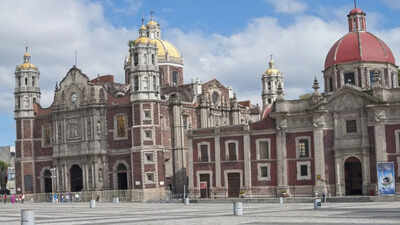
Mexico City has recently received a lot of attention for its disturbing behavior that cannot be explained by usual urban factors. According to recent observations made using satellites, some areas in Mexico City have begun to sink at an alarming rate.
Although a catastrophic subsidence did not occur in Mexico City, the phenomenon has become more severe and noticeable in some specific areas. There is no doubt that this process is linked to the existing water problem, which affects millions of people in Mexico City.The landing in Mexico City does not lead to catastrophic consequences all at once. However, the city began to change gradually and irreversibly.
Satellite images provide a better understanding of how the city’s surface is moving. However, they also indicate the complexity of the interaction between hydrological and geological processes in Mexico City.Scientists claim that effectively addressing the problem requires implementing new water management policies and developing plans for sustainable urban development. If nothing changes soon, Mexico City will see another decline.
How the ancient lake still influences Mexico City today
Mexico City was initially built on an ancient lake basin; Therefore, this accounts for most of the current vulnerabilities. The soil in this area consists of loose and highly compacted clay layers, making it vulnerable whenever changes in pressure occur. Over time, the area becomes vulnerable to groundwater abstraction due to this inherent characteristic.This is because water is removed from the underground aquifer, creating empty spaces that tend to collapse, causing the Earth’s surface to sink.
This does not affect the entire area, but only certain neighborhoods. It is suggested that this causes additional stress on buildings and structures.
Shows NASA radar Mexico City is sinking In precise detail
Advanced satellite technology has made it possible to monitor these changes with surprising precision. Radar instruments used for Earth observation missions can detect ground motion down to millimeter levels. This allows scientists to track how the city has changed over time rather than relying only on reports of superficial damage.Recent data suggests that some parts of Mexico City may be sinking at rates close to 0.8 inches per month. This may not seem exciting in the short term, but over the course of a year, it will increase dramatically. Changes are often invisible day to day, but they accumulate in ways that can affect entire neighborhoods.Experts say this type of monitoring is important because it reveals patterns that may go unnoticed until the damage becomes severe.
Why is Mexico City’s water system under pressure from below?
At the heart of this issue lies the city’s dependence on groundwater. Much of Mexico City’s drinking water comes from an ancient aquifer system beneath the surface. For decades, this resource has been used extensively to support the city’s growing population.However, continuous extraction has created an imbalance underground. Since water is removed faster than it can be naturally replenished, the soil’s supporting structure weakens.
This creates pressure, causing the ground above to sink.
Cracks, tilts and visible traces of sinking land
The effects of subsidence have become increasingly evident in daily life, as roads in some places are no longer level, and cracks appear in the ground. Some structures have become slightly tilted due to subsidence, as they respond to the shifting ground.There is also pressure on infrastructure, as underground pipelines and transportation and drainage systems have to constantly adapt to accommodate changes in ground level.
In some cases, maintenance may be required more often than in other larger cities.One area being carefully monitored for any signs of change is Benito Juarez International Airport. Since airport runways must be perfectly level, slight changes in the ground can cause problems.
How Mexico City’s water demand exacerbates the problem
This problem is directly related to the water shortage in Mexico City. The city hosts more than 20 million people and its water needs are very high.
As groundwater resources continue to be depleted, concerns are growing about the sustainability of water availability.There were warnings of what is known as “Day Zero.” This involves reaching the critical point of water deficit, which means that water from taps stops reaching certain segments of the population. Although it does not appear to be an imminent danger, it is often cited as a consequence of current trends.Since the matter is related to the problem of water consumption, the matter becomes more complicated. Removal of groundwater leads to land subsidence while the latter makes water distribution difficult.