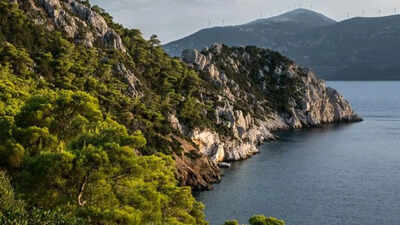
For years, the Methana Volcano in Greece has been classified as a dormant volcano, as it always appears peaceful and inactive due to its proximity to the Saronic Gulf in the vicinity of Athens.
It was always assumed that it had shown no signs of volcanic activity for hundreds of years, but scientists’ current findings have proven that was just a misconception. Geological studies reveal that there were times when the volcano maintained a calm surface for decades, during which time magma accumulated beneath the Earth’s surface.
Methana volcano in Greece awakens again after 100 thousand years of hidden magma activity
The last recorded volcanic eruption of Methana occurred in about 250 BC.
It has been mentioned in many ancient Greek texts, and since then there has been no surface activity of the Methana volcano. As such, their relative calm has led to the assumption that they pose no threat to humans.According to the study published in Science Advances, entitled “The volcano reawakens after more than 100,000 years of ‘silent’ magma reservoir growth,” modern scientists claim that this idea is wrong. Scientists from ETH Zurich conducted a comprehensive study of the geology of Methana and discovered something completely unexpected.
Over the past 700,000 years, Methana volcano has gone through several phases of volcanic activity, separated by long periods of calm.One of the most interesting discoveries is the period when Methana showed no activity on the surface for about 100,000 years, but it was not quiet inside the Earth.
What zircon crystals reveal about hidden underground methane activity
To understand the history of Methana, studies were performed on more than 1,250 zircon crystals obtained from ancient volcanic rock flows.
These crystals develop in magma and can retain information about geological processes for a long time. Studying the process of decay of radioactive uranium allows us to estimate the time of the explosion.It turns out that even in those times when there were no volcanic eruptions, zircon formation was active. It indicates the presence of magma movement under the volcano. Scientists assume that Methana was not inactive during that period, but rather moved to a state in which the accumulation of magma occurred underground, but did not rise to the surface.
Why can magma stay trapped underground?
Methana lies above a subduction zone, where one plate moves under another. Melting of some parts of the sea floor creates magma, which then moves toward the surface. Unlike other magmas, this magma is exceptionally full of water.When very watery magma moves upward, gases begin to form due to the decrease in pressure. In many ways, magma is similar to soda because the gases will create bubbles, making it very thick.
Magma does not rise to the surface of the Earth; Instead, it gets stuck inside the ground. As a result, magma chambers are created deep within the volcano.
Methana’s study suggests that some “extinct” volcanoes may still be active underground
Typically, dormant volcanoes are defined as those that have not erupted within the past 10,000 years. The history of Methana poses a challenge to this definition. It takes up to 100,000 years before a volcano enters a period of silence, indicating that periods of silence do not mean that a volcano is extinct.It has been speculated that there is a possibility that volcanoes that have been defined as extinct may actually have active magma chambers beneath their surfaces. This magma chamber could simply be at rest and require certain conditions to erupt.