In 1859, Charles Darwin’s theory of evolution was put forward in his book On the Origin of Species. In this theory, Darwin proposed that evolution occurred gradually, even though complete fossils do not exist.
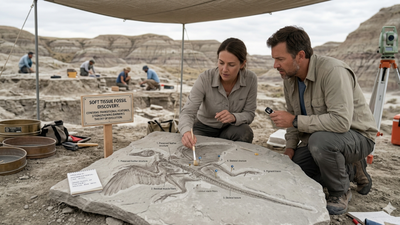
In modern times, scientists have found evidence of evolution from a 150 million-year-old fossil showing soft tissue, which Darwin predicted in his theory of evolution. The findings from this fossil contribute significantly to evolutionary science by providing new information about fossilization, prehistoric organisms, and evolutionary processes. Key terms in this topic include Darwin’s theory of evolution, the discovery of soft tissue fossils, evidence from the fossil record, and a 150 million year old fossil.
Darwin’s predictions Fossil record gap
In On the Origin of Species, written by Charles Darwin in 1859, he did not suggest that the fossil record was completely comprehensive. In fact, he highlighted what might be considered the major weakness of his theory, but he did not try to cover it up. Darwin realized that if evolution progressed gradually, there would be an abundance of transitional forms. However, the insufficient fossil record known at the time has not yet confirmed this.
books:“Why, if species have descended from other species by minute degrees, do we not everywhere see innumerable transitional forms?”—Charles Darwin, On the Origin of Species (1859)Instead of questioning his theory, Darwin pointed out the fact that the fossilization process is not perfect and is highly selective. Therefore, there may not be any trace of certain objects, which does not mean that they did not exist before.
Later, numerous discoveries proved Darwin right and filled in some gaps in the process of evolution.
The importance of a A 150 million year old soft tissue fossil
The discovery of a 150-million-year-old fossil containing soft tissue is remarkable, as soft tissue generally cannot withstand fossilization processes. Only hard tissues such as bones, teeth or shells remain while other biological components decompose quickly after the death of the organism. The result is therefore remarkable, and scientific discoveries have been made from similar cases. Research entitled “Soft Tissue and Cell Preservation in the Skeletal Elements of Vertebrates from the Cretaceous to the Present”:“The preservation of soft tissues in deep time allows for unparalleled insight into the biology and evolution of extinct organisms.”This discovery may have been possible due to favorable environmental factors, such as rapid burial and lack of oxygen, which would slow the decomposition process and allow mineralization to occur. Scientists can now observe what was previously inaccessible, such as microscopic tissues and possible molecular remains.
How do soft tissue fossils harden? Evolutionary biology
Soft tissue fossils contribute much more to our knowledge of ancient creatures than bones do.
The former helps us understand the appearance, behavior and physiology of organisms in a way that bones do not entirely cover. Moreover, for example, soft tissue fossils may tell us something about the nature of skin, muscles, or other physiological functions.The importance of this type of discovery was emphasized in a report by the Department of Surgery and Cancer at Imperial College London:“Extraordinary preservation can shed light on biological data that may be completely absent from the fossil record.”Scientists use results obtained from comparing preserved specimens with living organisms to trace evolutionary links. Thus, the results support and enrich the theoretical foundation of evolutionary science.
Recent discoveries confirm Darwin’s theory
Finding preserved soft tissue in such an ancient fossil serves to confirm one of Darwin’s original predictions: that additional evidence would prove his theory correct. While Darwin did not anticipate developments in technology that would enable scientists to analyze fossils at the microscopic level, the basic premise of his theory still holds true, and the fossil record will become more detailed over time.As Dr. Mary Schweitzer, a pioneer in the field of molecular paleontology, notes:“Such results suggest that biological materials may be preserved for much longer than previously expected.”Such discoveries challenge long-held beliefs about fossilization, implying that the fossil record is capable of preserving a great deal of biological material.
Evolutionary theory has been supported by fossil evidence
More than 150 years after Darwin proposed his theory, fossils such as a 150-million-year-old soft tissue fossil provide evidence that further confirms Darwin’s theory.
The gap in the fossil record, once considered a weakness in evolutionary theory, is now one of the most exciting areas of scientific exploration and validation.In addition to expanding our knowledge of extinct species, the 150-million-year-old soft-tissue fossil also shows the continued applicability of Darwin’s theory. As scientific technology continues to develop, the evidence for the accuracy of Darwin’s theory becomes increasingly clear.