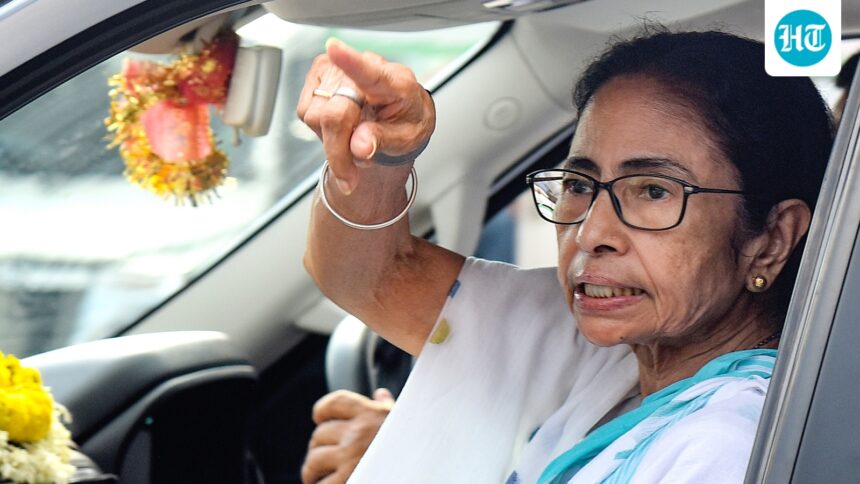
TMC chief Mamata Banerjee, beloved by her supporters as Didi, has failed to hold on to her citadel, which is finally within reach of the BJP.

A woman in a male-dominated field, a sari-clad fighter and the Bharatiya Janata Party’s (BJP) biggest impenetrable barrier in West Bengal, Trinamool Congress (TMC) chief Mamata Banerjee is a political leader who has battled anti-incumbency sentiment and an aggressive campaign by rivals three times in a row. But in the 2026 West Bengal Assembly elections, luck and the people’s mandate seem not to be on her side.

The TMC chief, nicknamed ‘Didi’ by her supporters, has failed to hold on to her citadel, which is finally within reach of the BJP, for a fourth consecutive term. Not only did Mamata Banerjee lose West Bengal to a party she called an outsider, she also lost her stronghold of Bhabanipur to the BJP’s Suvendu Adhikari – her former close aide who fought her from her seat. Track the latest on the 2026 Assembly elections here
Mamata Banerjee’s party is set to be on the other side of power in West Bengal, a state where she is known to have built a strong cadre that has helped keep the BJP in opposition for more than a decade.
Personality built on challenge
Mamata Banerjee, the founder of the All India Trinamool Congress, who built her political persona on defiance – be it taking on Singur with the then ruling government in 2006-08 or taking on the Central government, became prime minister for the first time in 2011, ending the Left Front’s 34-year rule.
But this election was no ordinary contest. Mamata’s biggest rival was the aggressive BJP which was leaving no stone unturned in its bid to win the state this time, not just as the opposition but as the ruling party.
The BJP waged a loud campaign, deploying senior leadership and significant resources. However, Banerjee turned the contest into a deeply personal battle, portraying it as a battle between Bengalis versus “outsiders,” and identity versus imposition. The call to keep the BJP out of the state included a warning to people that if the party came to power, it would make access to non-vegetarian food difficult – something that for many Bengalis is not just food, it is an emotion.
Born to a Bengali Hindu family in Kolkata in 1955, Mamata Banerjee comes from humble roots. Her father, Promleswar Banerjee, was a freedom fighter who died due to lack of medical treatment when she was 17 years old. Mamata Banerjee’s mother, Gaitri Devi, was a housewife who died of age-related illnesses in 2011 at the age of 81.
Based on publicly available information, Mamata Banerjee is one of eight siblings. She has six brothers, and according to various reports, she is either the only sister or one of the few sisters.
Congress to the NDA, it was done there
Mamata Banerjee began her political career in the 1970s, and includes her beginnings with the Indian National Congress through a stint with the National Democratic Alliance (NDA) – now her biggest rival – with whom she served as a Union minister.
In Congress, where she began her political career, she quickly rose through the ranks and positioned herself prominently in Bengal’s political scene during the 1980s.
She became one of India’s youngest parliamentarians after defeating veteran communist leader Somnath Chatterjee in Jadavpur constituency in 1984, marking the biggest milestone in her early career marked by grassroots activism, a combative political style, and strong opposition to the long-standing Left Front government, led by the Communist Party of India (Marxist).
In 1997, due to growing disagreements with the Congress leadership, Banerjee broke away marking the biggest turning point of her career by floating her own party, the All India Trinamool Congress (AITC or TMC). It has positioned itself as the main rival of the Left Front in the state.
To enhance her profile at the national level, she joined the NDA and served as Railway Minister in Prime Minister Atal Bihari Vajpayee’s government from 1999 to 2001. During her tenure, she focused on expanding rail connectivity and introducing new trains, which particularly benefited eastern India.
The following years have provided Mamata Banerjee with some of the biggest talking points of her career. Singur, a town in Hooghly district, became a major political flashpoint in 2006 over the acquisition of land for a Tata Motors plant.
The protests led by Mamata Banerjee eventually led to the withdrawal of the project, reshaping the political landscape in West Bengal.
Banerjee’s political strategy has evolved over time, and she has changed her alliances several times. This included periods of collaboration with the Congress-led United Progressive Alliance, during which she served as Railway Minister again, from 2009 to 2011.
But the primary focus on removing the left-wing government finally showed results in 2011, when it achieved a historic victory in state elections, removing the left from power after 24 consecutive years – one of the longest-serving democratically elected communist governments in the world.
Since then, no opposition party or alliance has been able to remove Mamata Banerjee from power.
Mamata Banerjee contested the state elections in Bhabanipur and Nandigram.
She won from Bhabanipur in the 2011 by-election, which she contested as a Lok Sabha MP, then in 2016, and again in 2021 (by-election).
She contested from Nandigram in 2021, but lost to Suvendu Adhikari — her close aide who joined the BJP from the TMC before the elections — by a narrow margin.
As Leader of the Opposition and Chief Minister, Mamata Banerjee has cultivated an image of a big sister – ‘Didi’ – to the people of West Bengal. Its governance style is often described as direct and people-centred, although it has also attracted criticism over issues such as political violence and administrative centralization.
Factors behind TMC’s defeat
Several factors have been attributed as reasons for TMC’s crushing defeat in West Bengal, including a major shift in the BJP’s strategy after its defeat in 2021 which included efforts by the party to shed the “outsider” perception that had previously damaged it, and reposition it as a more homegrown force rooted in Bengal’s cultural identity.
Party leaders cited in an earlier HT report credited the party’s local campaign, which used slogans like “Joy Ma Kali” and “Joy Ma Durga” instead of “Joy Shree Ram” and focused on booth-level management, for its victory.
While the BJP was able to capitalize on growing dissatisfaction with governance and counter the TMC’s traditional welfare advantage, the scale of the defeat for Mamata Banerjee’s party was driven as much by accumulated governance fatigue as by the sharp political transition.
Over fifteen years, allegations of corruption, weak law and order, and economic stagnation have steadily eroded the Trinamool Congress’s credibility, especially among the urban, middle-class, and business communities. Analysts cited racketeering, crime, and lack of industrial growth as persistent concerns that eventually translated into votes against the incumbent. This discontent rippled across communities, with Hindu and Muslim voters showing signs of drift, reflected in the collapse of the TMC’s vote share and the BJP’s gains in urban centers like Kolkata. There was a significant increase in voter turnout, aided by the process of cleaning the lists Election campaign and increased voter mobilization will amplify this anti-incumbency wave.
Meanwhile, the TMC’s long-standing reliance on uniting minorities has led to counter-polarization among Hindu voters, while sections of Muslim voters have splintered towards smaller parties such as Humayun Kabir’s AJUP and Nausad Siddique’s ISF, weakening its base in hotly contested seats.
The BJP has used this change to its advantage by mobilizing migrant workers, targeting women voters with promises of higher direct utility to counter the hugely popular Lakshmir Bhandar scheme led by Mamata Banerjee, and capitalizing on emotional issues along with governance failure.
Crucially, the election revealed a structural weakness within the TMC – its heavy reliance on Mamata Banerjee’s personal appeal without a similarly strong organizational or ideological backbone – that made it vulnerable when public sentiment shifted decisively.
An earlier HT report quoted political analyst Debasish Dasgupta as saying: “It is a party that depends entirely on Mamata’s image rather than its organizational strength. It also relied heavily on the perks of power and did not have any ideological base.”
As mentioned in the previous report mentioned above, several TMC leaders, who refused to reveal their names, admitted that Banerjee’s drive to make Bengal opposition-free during her first term became her downfall – fracturing the Congress alliance during 2011, pushing the BJP into the political vacuum, and initiating the polarization that ended on Monday, May 4.
While Prime Minister Narendra Modi hailed the BJP’s victory in Bengal on Monday, Mamata Banerjee simultaneously promised a “recovery”, calling the party’s victory “immoral” and through “vote plundering” on a massive scale.