

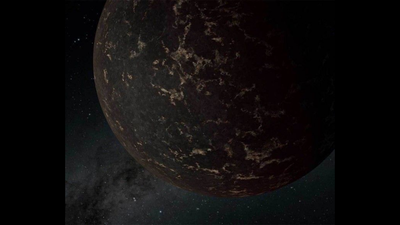
According to Kepler’s observations, the most abundant types of planets in the Milky Way are super-Earths. These planets are larger than Earth but smaller than Neptune, and have been observed in many planetary systems in the galaxy.
Super-Earths range in size from 1 to 4 times larger than Earth and are found in many solar systems. They vary in composition from rocky to gaseous, which is important in studying planetary formation and potential life. Data on their transits, orbits, and sizes indicate that these planets are among the most common results of planetary formation.
What are giant planets and why are they so common?
Super-Earths are those planets that have a mass greater than that of Earth but much less mass than ice giants like Neptune.
Although super-Earths do not necessarily share the same composition or atmosphere as Earth, their size appears to be a very common category among discovered exoplanets.The discovery of NASA’s Kepler mission revealed the existence of planets in astonishing numbers throughout our galaxy. Planets with radii between one and four times the radius of Earth are very common throughout the Milky Way.However, these planets are not commonly seen in our solar system.
That’s why scientists believe their formation in other systems is normal, because the growth process in a protoplanetary disk can be very efficient, but it’s not always large enough to form gas giants.
Insights from the Kepler mission and exoplanet surveys
The effectiveness of the Kepler Space Telescope is its ability to find planets via the transit method, detecting fluctuations in a star’s brightness when a planet crosses its path. This method is responsible for thousands of discoveries of exoplanets, among which super-Earths are particularly abundant.For example, a study titled “Kepler’s False Positive Rate and Planetary Formation” notes that “little planets are everywhere around Sun-like stars.” In other words, super-Earths are common in planetary systems.More specifically, according to another source in the Annual Review of Astronomy and Astrophysics, based on their occurrence rate, “most stars host at least one planet of this size.”In conclusion, it can be safely assumed that the galaxy consists of many planetary systems different from our own.Formation of planets and the role of protoplanetary disksThe prevalence of super-Earths is closely related to their composition. In the early stage of the star system, a rotating disk made of gas and dust, referred to as the protoplanetary disk, surrounds the budding star. In such a disk, a collision occurs between particles, which leads to an increase in their mass.The development of super-Earths appears to involve less stringent criteria than the formation of gas giants.
As an article in Nature points out, efficient solid accretion would necessarily lead to the formation of planets, specifically super-Earths, in the case of intermediate-mass disks. Furthermore, the phenomenon of migration involving the inward/outward motion of planets in the disk may collect those planets into small orbits around stars.
What does this mean for Habitability And future research
The abundance of super-Earths also means they have a lot to say about the chances of finding alien life forms.
Not all super-Earths are habitable; However, those with conditions favorable to life may contain liquid water based on the composition of their atmosphere and the distance between their orbits and the stars around them.Modern astronomy uses sophisticated instruments to study super-Earth atmospheres, including the recently launched James Webb Space Telescope. The purpose of this is to detect chemical indicators in their atmospheres that prove or deny the presence of life on some of them.In conclusion, the findings that super-Earths are the most common planets in the universe have changed our perception of planets in the universe. Although there may be Earth-like planets in the universe, they are part of a more expansive universe that contains planets that may be similar to our planet but are not necessarily like our planet.