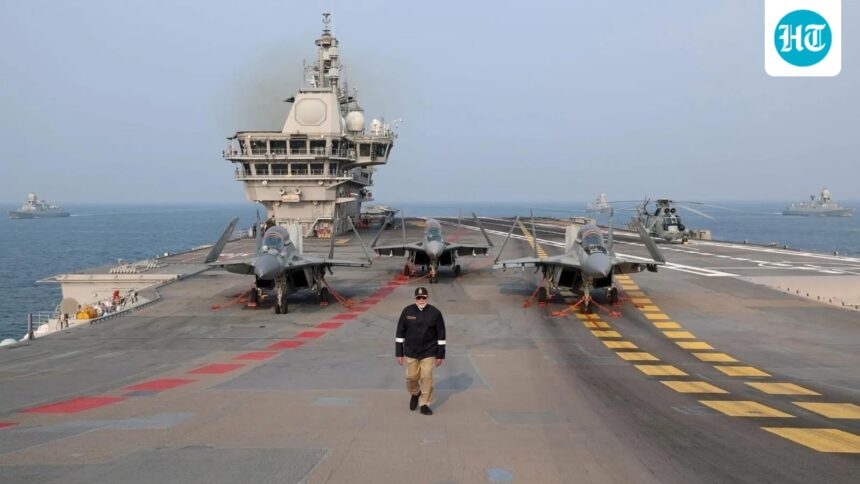
Although the Tri-Service Andaman and Nicobar Command was established by the Vajpayee government a quarter of a century ago, India’s military doctrine has been land-centric with the Indian Army being given priority, while the other two services are unfortunately seen as force multipliers.

While China, India’s main adversary, changed its military doctrine from land to sea in the early 2000s, New Delhi began seriously considering its maritime security after 2014 with PLA maritime surveillance ships, ballistic missile trackers, warships and submarines conducting raids in the Indian Ocean Region (IOR) with logistics facilities in Cambodia, Sri Lanka, Maldives, Iran and the east coast of Africa. Today, an average of six to seven PLA ships are in the IOR each month, with carrier-based task forces entering the region during this decade.
Since the Chinese People’s Liberation Army is building one ship every seven days, India has no options but to develop long-range capabilities in the territory of its islands of Lakshadweep and Andaman and Nicobar. Only then can India impose a policy of sea denial, deterrence in access to the sea, as well as build its influence in the IOR against any potential competitor. Apart from maritime security, the Indian island territories have huge economic potential for the country with world-class transshipment hubs on the east and west coast of the country.
It was India’s first Chief of Defense Staff (CDS) General Bipin Rawat, along with national security planners, who envisioned turning Campbell Bay in Great Nicobar into a shipping hub as well as a military base for India in order to provide first strike capability against any rival as well as protect the hinterland far from home.
With Andaman and Nicobar Island on access to all major entry routes into Southeast Asia and Lakshadweep and Minicoy islands on the main sea lane of connectivity to Asia and beyond, General Rawat wanted to expand the bases at INS Jatayu in Minicoy, INS Baaz in Great Nicobar and INS Cohasa in North Andaman so that India would have the capacity to protect its own backyard as well as inflict pain on any adventurer on its land borders by imposing a naval deprivation on India. Trade in oil and goods coming from West Asia.
While the Modi government has responded in writing to the environmental concerns raised by Congress leader Rahul Gandhi in Greater Nicobar, the fact remains that the island territory provides India with a strategic stronghold for key sea lanes of communication towards the Straits of Malacca, Sunda, Lombok, Umbi and Wetar in Indonesia.
The only concern here is that the expansion is not happening as quickly as envisioned due to bureaucratic delays, competition between services, and land acquisition issues on both islands. Even the Agatti Airport expansion project has been stuck due to land acquisition over the past decades, with the majority merely paying lip service rather than pushing the project.
General Rawat wanted the Greater Nicobar Area to be a transshipment hub so that large ships would not have to wait in the Chinese ports of Colombo or Hambantota to enter the Strait of Malacca. He wanted to develop INS Baaz so that Indian deterrence and surveillance would extend all the way up to the east coast of Australia.
Given that US President Donald Trump wants to play the role of lone ranger in West Asia and appears to be the least interested in the Quad, India under Modi has no options but to independently develop its IOR capabilities, as both Australia and Japan are committed to the AUKUS agreement with America. India today has a strong naval deterrent, at least in the IOR region, through the deployment of three nuclear ballistic missile submarines – INS Arihant, Arigat and Aridaman – and a fourth submarine, INS Arisudan, which will be commissioned next year.
Apart from Arihant, the remaining three submarines are designed only to carry K-4 ballistic missiles with a range of up to 3,500 km, and will operate in the Indo-Pacific region during this decade. India has also deployed long-range missiles in its island territories to ensure a strong response to any adversary. For India, the urgent need today is capacity building and leveraging, not environmental activism.