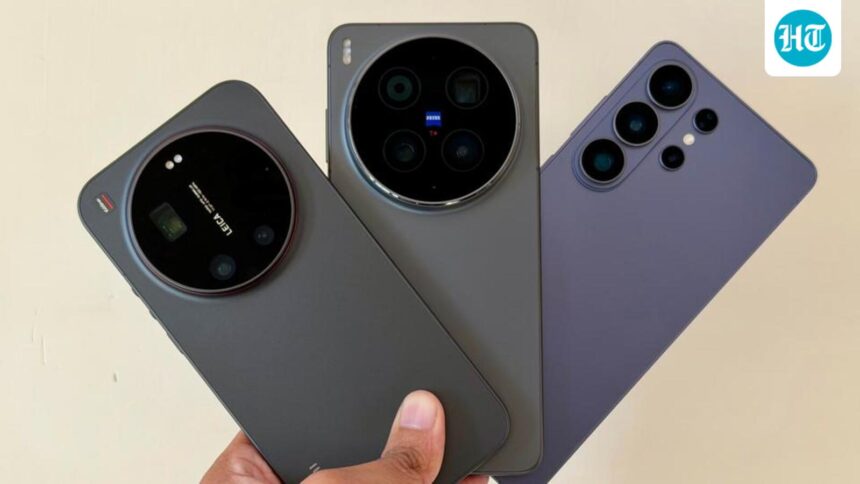
India’s smartphone market will write a new chapter this summer as some Android phone makers are belatedly finding the confidence to launch expensive flagships. While Samsung and Xiaomi have been doing this consistently, Vivo and Oppo are bringing their top-tier ‘Ultra’ phones to the country, for the first time. There are three developments that confirm this path. First, major Android phone makers believe that consumers’ perceived sensitivity to price does not pose a threat to sales. Secondly, a vote of confidence in the Indian economy, while enhancing purchasing power. And finally, to monetize a cultural shift that sees phones increasingly intertwined as status symbols and aspirational purchases.

Ultra phones will be expensive propositions. The Samsung Galaxy S26 Ultra has been priced $1,39,999 onwards. Xiaomi presented the impressive Xiaomi 17 Ultra phone ( $1,39,999) soon after its global launch. They will be joined this week by the Vivo X300 Ultra and, later this month, Oppo’s Find X9 Ultra, quadrupling the selection on par with global markets – their predecessors were never launched in India.
There’s no confirmation of price yet, but estimates peg a premium over the X300 Pro ( $1,09,999) and Find X9 Pro ( $1,09,999) respectively. For context, the Vivo X300 Ultra is on sale in Europe for €2,000, which at current conversion works out to around €2,000. $2,22,000 for the 16GB + 1TB variant.
“The current wave of ‘Ultra’ flagship Android phones underscores a clear structural shift in India’s premium smartphone market, driven by sustained differentiation, expanding affordability through financing, and longer replacement cycles that collectively support higher price ranges,” notes Prabhu Ram, Vice President, Industry Research Group, CyberMedia Research (CMR).
Their insight is that smartphone camera quality remains one of the top three purchasing considerations for Indian consumers.
“There is a definite shift in how users interact with their devices. They are no longer casual photographers or mere consumers of content. They are constant creators, storytellers, and visual lovers. Not in a professional sense, but in behaviour,” points out Bigam Danish, Head of Products and GTM, Vivo India.
The reason Vivo and Oppo are finally playing their cards is to make up for lost time. “The” is more than $The 1 lakh segment is still dominated by two global brands, Apple and Samsung. Among the four Ultra models, Samsung leads in sales volume driven by current and previous generation Ultra models. “The sales gap with Chinese counterparts is huge,” says Abhilash Kumar, Senior Research Consultant (Director), Smart Analytics Global (SAG).
Data shows that even as India’s smartphone market has stabilized in previous quarters, there is continued demand for premium devices. CMR’s India Mobile Market Review 2025 indicates a “structural transition”, particularly benefiting Samsung, Apple and OnePlus. Vivo and Oppo, which rely on affordable phones for market share, want to break these restrictions.
“The Indian smartphone market is witnessing a shift in how consumers evaluate devices, with an increasing focus on camera capabilities, performance and AI-driven features,” says Tarun Pathak, Research Director, Counterpoint Research. In April, they reported the weakest smartphone shipment quarter in India in six years, on the back of lower demand and higher bill of materials. Vivo (21% share) leads the market shares, followed by Samsung (18%), Oppo (12%) and Xiaomi (8%).
Within an ultra-luxury quintet, the experience is structured very differently. Leading specifications, including top-tier chips, plenty of memory and storage despite an age of shortages, powerful cameras including a large sensor and image processing improvements, as well as improved designs.
The Ultras are also not a response to rumors of a foldable iPhone Ultra, expected later this year.
A hardware arms race, with cameras in focus
In order to deliver an “Ultra” experience of value, phone makers still rely heavily on camera companies to provide the expertise. Xiaomi works with German photography giants Leica, Vivo works with German optics company Zeiss, while Opp relies on the ingenuity of Swedish camera makers Hasselblad.
The Smartphone Insights 2026 report released this week by Counterpoint Research and Flipkart indicates that 45% of smartphone buyers will pay more for performance, and 57% of them are willing to buy a more expensive phone to get a better camera. Just like Samsung and Xiaomi, Vivo and Oppo hope buyers will find value from the experiential extras represented by the ‘Ultra’ flagship.
“In the camera space, Apple and Samsung offer comprehensive, if not class-leading, camera systems, and consumers often choose them for the overall proposition. However, a niche segment still leans toward Ultra devices from Chinese phone makers, given their superior camera capabilities and additional accessories,” says SAG’s Kumar.
“We are interested in helping users take photos that are as close to real life as possible. We want to keep getting closer to what the human eye sees – in dynamic range, detail and realism. A large part of the industry is focused on making photos look ‘prettier’ through digital processing,” Anuj Sharma, chief marketing officer, Xiaomi India, told HT. It confirms the trend of Xiaomi and Leica, which believe that pure physics always trumps software.
The LOFIC sensor, or Lateral Flow Integration Capacitor sensor, has been optimized to prevent over-lighting in the frame – resulting in better dynamic range in bright and low-light scenarios. Sony, Samsung and Apple are expected to equip sensors with a similar philosophy for dealing with light in the coming months.
Oppo is touting the Hasselblad’s flagship mode and super-sensing 10x optical zoom capabilities, while Vivo points to its elaborate shooting mode combination and advanced image stabilization.
“The new Ultra flagships are long-term strategic bets designed to create a strong halo effect across their portfolios and serve as growth vehicles in a challenging macro environment,” says CMR’s Ram.
Both companies see a market for add-on photography kits, which are expected to be fairly expensive. Prices have not been confirmed yet. This ecosystem game is an attempt to find a foothold where the flagship Apple iPhone and Samsung Galaxy phones still dominate.
Vivo will offer a 200mm focal length Telephoto Extender Gen 2 and an equivalent 400mm Extender Gen 2 Ultra lens. Oppo is also expected to put a 300mm teleconverter on sale. Focal length is the distance, measured in millimeters, between the lens and the image sensor – a longer focal length means higher magnification over a longer zoom distance.
For potential pricing context, Vivo’s 400mm Extender Gen 2 Ultra lens kit is on sale in Europe for €400 (about $44000). Oppo’s previous teleconverter kit for the Find X9 Pro sold for approx $39,999.
Xiaomi’s approach negates the need for often cumbersome lens accessories, with the world’s first 1-inch LOFIC sensor from Leica and a 200MP continuous optical zoom. In HT tests, the 17 Ultra delivers detailed images, in handheld mode, at up to 120x zoom.
This depicts an era in which Android phone makers will increasingly innovate to differentiate themselves. Camera sensors, computational photography, and accessory ecosystem are on the list.
(Vishal Mathur is technology editor at Hindustan Times. When he’s not understanding technology, he’s often searching for an elusive analog space in a digital world.)