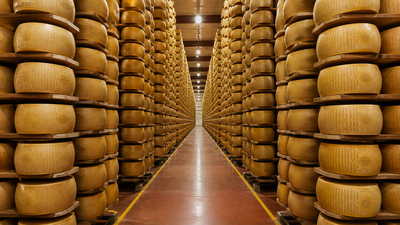
What is a country’s most valuable assets – gold, silver, currency? In Emilia-Romagna, northern Italy, the answer is much less conventional. Here, vast, climate-controlled warehouses store one of the region’s most exotic forms of wealth: hundreds of thousands of wheels of Parmigiano-Reggiano cheese, which slowly age and increase in value over time.The buildings appear to visitors like silent cathedrals of cheese.
For Italy’s dairy industry, it is a financial lifeline.Parmigiano Reggiano is a strictly controlled cheese. It can only be made in a certain region of Italy using only three ingredients: milk, salt, and rennet. Each wheel must be at least 12 months old before being sold. According to CNN, many are kept for 24, 36 or even 40 months.However, this long waiting period creates a cash problem for producers. Farmers must be paid monthly, and feed, labor and energy costs continue daily.
But cheese only brings money later.To solve this problem, Credem Bank accepts cheese wheels as collateral for loans.“In Italy about 4 million wheels of Parmigiano Reggiano are made, and we keep 500,000… and allow customers to use the wheels as collateral to obtain financing,” Giancarlo Ravanetti, who runs the bank’s cheese warehouse business, told CNN. He added that the system handles “about 2,300,000 wheels annually,” worth “about 325 million euros ($382 million) of Parmigiano Reggiano.”
Inside the cheese cellar
When wheels arrive at the warehouse, they are scanned and recorded in a digital system with details such as production date and origin. Only then are they placed on wooden shelves inside the large storage halls.In the warehouse, conditions are strictly controlled. Temperature, humidity and air flow are regulated. Staff inspect the wheels daily to ensure there are no cracks or damage.After 12 months, the Parmigiano Reggiano consortium performs a tap test, hitting each wheel with a hammer to check its quality.
Only wheels that pass are marked with the official fire-marked seal.Once approved, the wheels can be used as collateral for the loan. The warehouse acts as a guarantee that the cheese is present and in good condition. Ravanetti says the bank has been running this system for more than 100 years without losing money.The Parmigiano Reggiano Federation oversees the entire system. It includes about 300 producers and more than 2,000 dairy farmers.
Spokesman Fabrizio Raimondi said it represents “about 50,000 people” and an industry with “over $4 billion in sales.” The group inspects quality, protects the brand, and stops counterfeit products. “These sealants can assure the consumer that this is the real material and that the quality is good,” he says.Most producers work through cooperatives. Paolo Ganzerelli, of Italian cheese maker Granter, noted that although this system is important, it also represents a financial challenge.
Granterre is owned by producer cooperatives, so it must pay farmers quickly even though the income from the cheese comes later.“Without this system of influence, the world of Parmigiano Reggiano could not exist,” he said.Making cheese is also expensive. Cows must be fed locally grown food, and milk quality varies by region. Costs have risen sharply in recent years.“The cost of producing cow feed, the cost of everything, has increased a lot…energy, transportation, logistics – everything is more expensive now,” Ganzerli said.
High demand for Italian cheese
In 2025, Parmigiano Reggiano exports exceeded domestic sales for the first time, reaching 50.5% of total sales worldwide.International demand increased by 2.7%. Sweden grew by 8.8%, the United Kingdom by 7.8%, and Spain by 2.5%. The United States, the largest export market, achieved growth of 2.3%, but remains unstable due to new tariffs. “There is regulatory uncertainty, and many operators are waiting before submitting new applications,” Raimondi said.In Italy, sales fell by 10% in 2025 as higher prices led people to buy less.
However, most families still continue to buy it. Prices rose strongly, with 12-month wheels reaching €13.22/kg and 24-month wheels reaching €15.59/kg. Production also increased to 4.19 million wheels.Cheese is viewed as healthy because it is lactose-free, high in protein, and contains no additives, Ganzerli says. But he warns that if prices rise too much, people may turn to cheaper cheeses such as Grana Padano.Producers typically get 60-80% of the wheel’s value up front by using it as collateral.
New blockchain systems now also allow cheese stored on farms to be used for loans. The consortium is also trying to boost tourism, with the aim of increasing visits from 85,000 to 300,000 by 2029.The Parmigiano Reggiano industry is now a €4 billion industry supported by around 300 dairy companies. It depends on traditions, strict rules and financial systems that work together.In silent warehouses, the wheels continue to slowly age, turning time and patience into value.