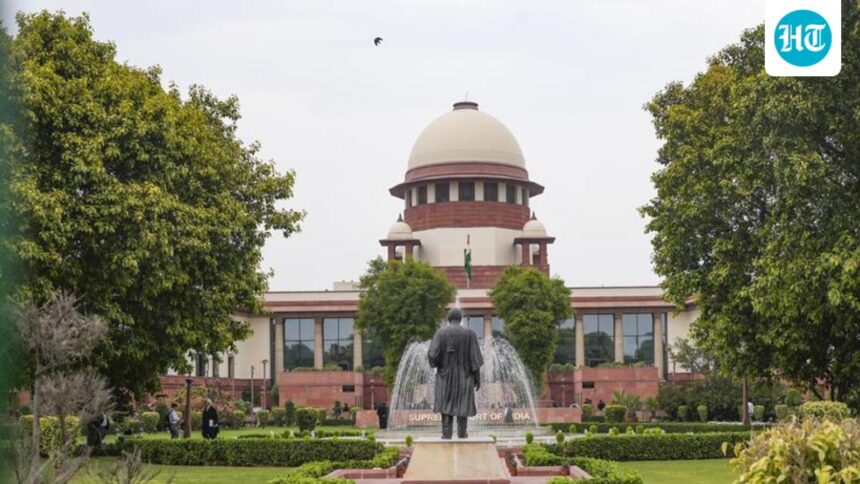
The Supreme Court is scheduled to hold a special session on Saturday to hear a petition filed by the All India Trinamool Congress (AITC) challenging the Calcutta High Court order that dismissed their petition against the Election Commission (EC)’s direction to deploy Central government and PSU staff to count the votes cast in the West Bengal Assembly elections.

The Supreme Court dismissed the AITC’s plea on Thursday, saying there was no violation of law in the poll panel’s decision to appoint central government and public sector employees (PSU) supervisors and assistants in the counting process, instead of state government employees.
Filing an urgent appeal on Friday, AITC contacted Chief Justice of India (CJI) Surya Kant to request the formation of a bench of judges on Saturday as the counting of votes in West Bengal is scheduled to take place on May 4. Voting to elect the 294-member assembly was held in two stages on April 23 and April 29.
A bench of Justices PS Narasimha and Joymalya Bagchi will hear the petition filed by advocate Sanchit Garga against the Election Commission of India, West Bengal’s chief electoral officer (CEO) and the state’s additional chief executive who passed the order under challenge on April 13. Senior advocate Kapil Sibal along with other senior lawyers is expected to argue the petition before the Supreme Court.
Recognizing the bias and potential distortion of equal opportunity, the AITC questioned such a requirement without disclosing any reason or criteria. The order stipulates that “at least one of the counting supervisor and counting assistant at each counting table shall be an employee of the Central Government/Central Account Support Unit,” the party said.
According to the petition, such a directive would “significantly” change the composition of staff at counting tables by disproportionately increasing the presence of individuals subject to central government control. “This creates reasonable concerns of bias, undermines the impartiality of the counting process, and disturbs the level playing field between the competing political parties… given that its main political opponent, the Bharatiya Janata Party (BJP), is the ruling party at the Centre, and thus exercises administrative control over the central government/public sector staff.”
The AITC argued that such an arrangement applies to other countries and that the Additional Chief Executive who issued the directive had no jurisdiction to issue such a directive.
According to the Counting Agents Manual, 2023, the AITC said that each counting table already has micro observers, who are always employees of the Central Government/Central PSU. The current directive would introduce an additional layer of central government employees as counting supervisors or counting assistants, which the AITC has objected to.
The Calcutta High Commission, in its April 30 order, dismissed fears of bias as “impossible to believe” and asked the party to challenge it in an election petition after the results were announced. Further, the HC held that the Election Commission of India has the power to appoint counting officers from either the Central or State Government, which cannot be questioned by the court.
The AITC said its “concerns stem from legitimate concerns of institutional control and structural bias,” and urged the Supreme Court to grant relief by addressing their concerns. The party has also sought an interim direction to continue with the Election Commission of India’s directions.