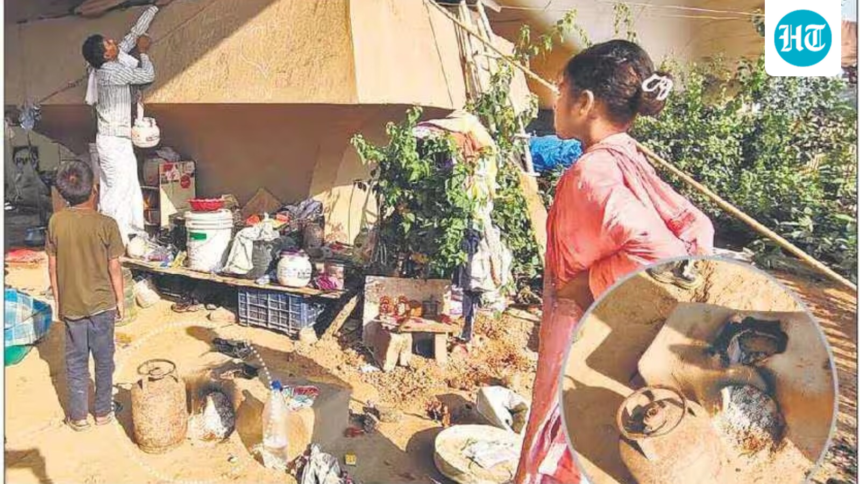
NEW DELHI: In a cramped rented room in northwest Delhi’s Prem Nagar, 25-year-old painter Chandan Poddar is doing the math again. He wins $18,000 per month and shares living space with nine other migrant workers. Together, they spend close together $3,000 on a 5 kg LPG cylinder, which is enough for about 10 days. Now, with the price of small cylinder rising by approx $300, the financial statements no longer make sense.

On Friday, rising international energy prices amid the West Asia crisis led to a sharp 47.8% increase in the price of commercial liquefied petroleum gas used by industries and migrant workers from China. $2,078.50 per 19 kg cylinder $3,071.50, industry executives said. The price of 5kg free trade LPG (FTL) will also rise by this percentage, they said.
For migrant workers, street vendors and low-income families, the smaller cylinder was a lifeline. It has a cheaper initial cost than the standard 14.2kg drum, and is more accessible to those without formal connections.
And throughout Delhi’s working-class neighbourhoods—from the Chila Khedr along the Yamuna floodplain and the JG clusters near Chanakyapuri to the urban villages of Shahpur Ghat and Garhi—the sharp rise in costs is sparking quiet but widespread distress. “It seems we are forced to return to our villages,” Poddar said. “We work for daily wages and cannot afford to waste an entire day trying to refill the small cylinder every few days. The larger cylinder is out of the question.”
In Chanakyapuri, outside a cluster of four one-room huts near Kevinters Lane, 60-year-old Kushila Devi surveys her family’s cooking arrangements. There is a traditional wood-fired cholha next to a small LPG stove.
“We will have to go back to firewood. I will teach my daughters-in-law how to cook food on the chulha. They only use the stove and drum,” she said.
And along the banks of the Yamuna in Chilla Khader, the transformation is already evident. In many homes, unused 5kg cylinders were scattered with dust, while fires burned steadily nearby.
“Why should we spend so much?” asked Sabal Mahto, a vegetable farmer in the area. “The weather is hot and dry, so wood is readily available. Cylinders are expensive, and even refilling them takes a long time.”
The impact extends beyond families, to livelihoods. In Garhi village, Kundan Kumar was served meals and paid $20,000 per month as a bulldozer driver. But as the cost of LPG rose, the meals stopped and his salary increased slightly $1000.
“How could I cook all the meals at home at these costs? It didn’t make sense,” Kumar said. He quit his job and now takes up an odd job near home, relying on a small cylinder for basic cooking. With the recent rise in prices, even this fragile arrangement is under pressure.
Street vendors, who form the backbone of Delhi’s informal food economy, face similar pressure.
Shiv Nath Prasad, 50, has been running a food stall on Lajpat Nagar Road for two years. It needs a new 5 kg drum every five days. “Last month was the hardest because of the gas shortage,” he said. “I have managed to avoid raising prices so far, but now I may have to. If I do, I may lose customers.”
Students are also starting to feel upset. Ishaan Arora, who runs PG in North Campus, said the LPG shortage left them no option but to switch to induction stoves for residents. “Buying cylinders has become a challenge, with reports indicating black market prices have risen to almost 100% $5000 for local cylinders. However, raising rents is not actually an option. Tenants could easily move elsewhere, which would put the company under greater financial pressure.