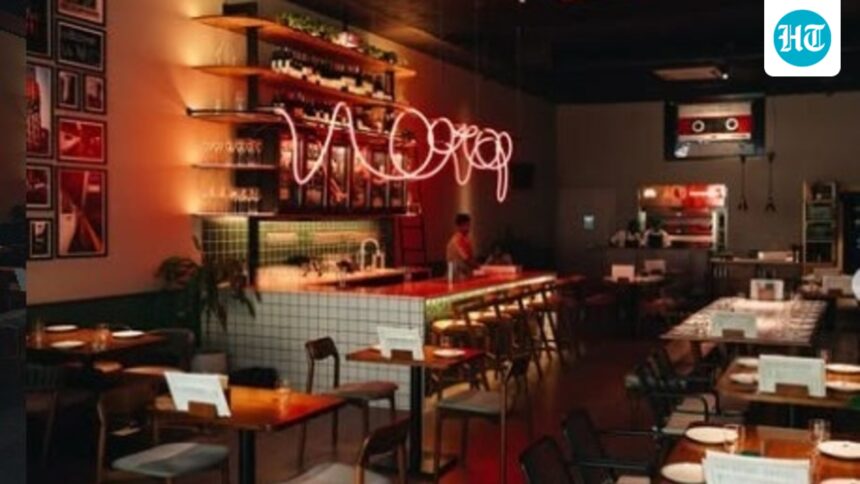
On a Sunday afternoon, 23rd Street Pizza is filled with a crowd of young people ordering salads, chips, and of course, pizza. Sitting at my table was a couple who said they were Gujarati and grew up in Bengaluru. They ate out five to six times a month, mostly trying non-Indian foods. The 23rd Street Pizza with New York style pizza and pictures of the Big Apple on the wall was one of their favorites.

I was there to try different restaurants as part of the new Restaurant Week India (RWI) 2026. For ten days in April, participating restaurants charge a flat fee of approx $1500 per person for prix-fix menu (fixed price) with selected items. Diners get an appetizer, main course and dessert. Three cities are participating this year – Delhi, Bombay and Bangalore. For restaurants, this is a way to expand their customer base. As for young people, it is an opportunity to try new restaurants. When held annually, cities that host Restaurant Weeks create buzz around them and attract tourists as well.
In Bengaluru, 17 restaurants including Komal, Kopitiyam Lah, Kaba Chaka Kandhari, Moro, Lupa, 23rd Street Pizza, Middle Room, Bistro Cameo, Olive Beach, Bar Sama, Pizza No Cap, Fervour, Fireside, Woodside Inn, Tijouri, Spice Terrace and The Hood are participating.
The urgent question that arises, of course, is how are these restaurants selected? asked Aatish Nath, co-founder of Restaurant Week India. “The honest answer is we eat our way onto the menu,” he replied. “There is no application, no fees, no committee voting on spreadsheets… (but based on) a very simple question about each kitchen under consideration: Does this place have something to say?”
Restaurants get to keep the money they make during Restaurant Week, because the parent organization operates on a sponsorship model. However, not all restaurants want to join, as some consider it a loss of revenue since they set a fixed price. “It is usually the restaurateurs and restaurant owners who have lived or worked abroad who understand its potential and end up joining it,” Nath said.
Bengaluru is a particularly interesting city because it is arguably India’s ‘third place’. If Delhi is about power and Mumbai is about money, dining in Bengaluru is about value for money. He does things quietly, without bragging or announcing himself too loudly. In fact, the opposite. More and more places in Bangalore are emerging as secret spaces that only city dwellers know about cognoscenti. Naru, the noodle bar where you have to wait with your lightning fingers on a certain day in order to register a reservation, is a good example of this city. “Restaurants in Bengaluru are hard to impress, in the best possible way, and that makes them the most rewarding audience in the country to cook for,” Nath said.
In contrast, diners in Mumbai are certainly worldly, but they respond to the energy of a newly opened restaurant. They have money to spend and fear of missing out (FOMO) when it comes to dining at the newly designated spot. Mumbaikars are willing to overlook the restaurant’s shortcomings just to be part of the hype. Diners in Delhi, Nath said, prefer heirloom over everything else and bring a certain authority to the table; They know what they want, what they get, and they’ll tell you both.
In Bengaluru, we don’t flaunt our wealth or knowledge. My friend Avinash has eaten his way through Tokyo and can pick apart every Japanese restaurant in the city. Another friend, Himanshu, is obsessed with design and is tired of imitating the West. Shree loves eating out and knows exactly where to take her friends at 1:00 AM for the perfect cocktail and snacks.
At 23rd Street Pizza, I watched a table of diners discuss the fermentation process while drinking kombucha. What this knowledge and passion produces is undoubtedly the most exciting food culture in the country. As Nath said, “Because when a kitchen knows that the people sitting in front of it care about it — not performatively, but sincerely — it cooks differently.”
Over the last 20 years, I’ve noticed Bengaluru building this culture largely without the hype that Delhi and Mumbai attract. Despite its growing food scene, Bengaluru is slow to follow global trends. Instead, it sets its own rules. This gives the city a restaurant culture, where cooking and dining are done with depth and authenticity, a rare combination.
(Shobha Narayan is an award-winning author based in Bengaluru. She is also a freelance contributor who writes about art, food, fashion and travel for a number of publications.)