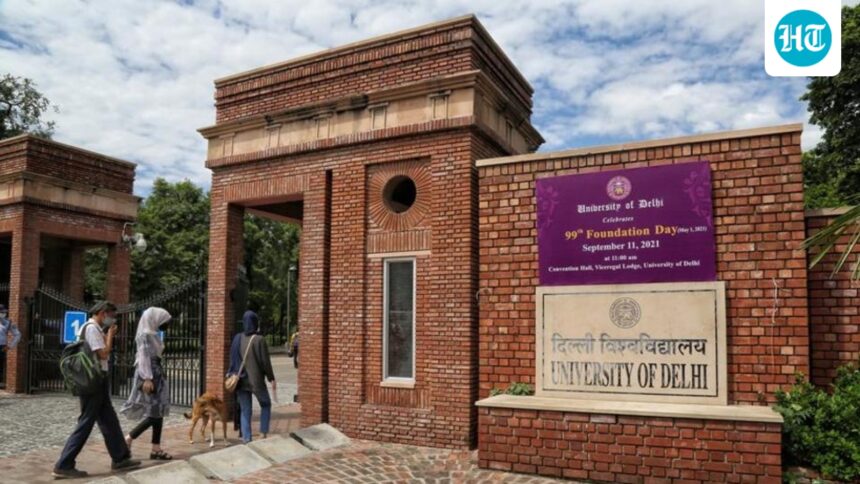
Delhi University’s Executive Council (EC) on Wednesday decided to form a committee to study a proposal to introduce ‘Semester Away Programme’ (SAP), which would allow students to spend one semester of their studies at a foreign higher education institution.

The decision was taken at a meeting of the Executive Council chaired by Vice Chancellor Yogesh Singh. According to a press note, the committee, which will be headed by Dean of Colleges Balram Pani, will consult all stakeholders.
The SAP programme, which aims to provide undergraduates with global exposure, is part of the Undergraduate Curriculum Framework 2022, which was approved by the Academic Council earlier this month.
Read also: Supreme Court rejects application for new hate speech legislation
In other decisions, the European Commission decided to form a separate committee to study issues related to recruitment at St Stephen’s College. The committee, headed by Professor Inder Mohan Kapahi, was formed after the university noticed that the college’s shortlisting criteria were not in line with the university’s regulations. “According to EC members, the college has been shortlisting 70 candidates for each unreserved vacancy, while the norm adopted is 40 candidates for each vacancy and 20 candidates for subsequent vacancies,” the statement read.
The board approved the proposal to allow students to earn up to 5% of their total credits through module-based courses offered on online platforms such as Study Webs of Active Learning for Young Aspiring Minds and other massive open online courses. The Council stated that each department will form a committee of faculty members to determine the details of the courses offered electronically through the approved platforms.
Read also: Committee to study the feasibility of converting subsidized colleges into private universities
“For four-year undergraduate courses, students can take up to eight credits, two-year graduate students can take up to four credits, while one-year graduate students can take up to two. Doctoral scholars can take up to four credits,” the statement said.
The European Commission has approved recommendations to restructure undergraduate program groups for the 2026-27 academic session, allowing colleges to review subjects with low demand or vacant seats and consider merging them with other subjects such as Urdu, Arabic, Persian, Bengali and Telugu.
Also Read: ‘You’ve been hacked’: Porn videos interrupt Delhi HC hearings three times; Investigation on
“No new programs will be offered, and no existing programs will be discontinued. The capacity will remain unchanged, although additional seats may be added if adequate faculty and infrastructure are available,” the statement read.
The Council also approved the allocation $Rs 174.20 crore to construct a new building at Maurice Nagar for the Institute of Medical Nanoscience.
In addition, the university will establish a “Center for Advanced Study in Buddhist Studies” under the supervision of Pradhan Mantri Jan Vikas Kariyakram. According to officials, the Ministry of Minority Affairs has granted approval for the first phase of setting up the centre.
The university has also approved revised construction plans for two academic buildings at the Delhi School of Economics on the North Campus. The review reduced the number of trees scheduled to be cut from 67 to 33, while keeping the project within the previously approved cost of 33 trees. $246.80 crore, according to the official statement.