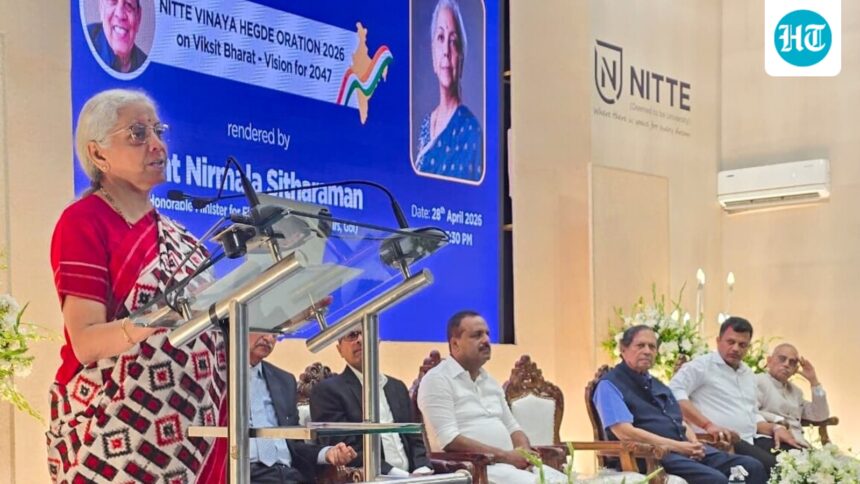
India’s path to developed nation status by 2047 must be driven by inclusive growth, strong institutions and broad-based skills, Union Finance Minister Nirmala Sitharaman said on Tuesday.

Addressing the ‘Viksit Bharat – Vision for 2047’ event at NITTE University, she said progress must go beyond headline numbers and reach small towns, rural areas and first generation learners. She added that growth must be broad-based and participatory, with benefits shared among all segments of society.
Read also: India points to mitigation gap by rich countries in 2031-35 climate plan
“Fixit Bharat is not the responsibility of the government alone. It is a national partnership between the Union, states, local governments, businessmen, industry, academia, professionals and every citizen. The government can build the platform, but the energy, ideas and discipline of 140 crore Indians will build Fixit Bharat,” she said.
Sitharaman said that a developed, stable, democratic and pluralistic India – the world’s largest democracy and a bridge between East and West, Global North and Global South – is not only good for India, but for the entire world.
Sitharaman said that India’s first decades after independence were spent rebuilding the nation despite challenges and mistakes.
“We can choose to be among the best economies in the world. We can choose to give every Indian child clean water, quality education, affordable healthcare and their chance to prosper. That choice is Vixit Bharat,” she said.
“We are no longer asleep. India is awake… Today, we are the fastest growing major economy in the world,” she said. As 2047 approaches, she said India must choose between a routine growth path that risks falling into a “middle-income trap” or a more ambitious path.
Also Read: ‘Chintan Shivir’ sets time-bound roadmap for Viksit Bharat 2047
However, she cautioned that India should not confuse progress with completion.
India’s demographic dividend will translate into growth only through sustained investment in education and skills, she said, urging institutions to align with industry needs and focus on employability and entrepreneurship.
“Access to affordable vocational training and continuous skills improvement is crucial,” she said, highlighting the need to support first-generation entrepreneurs.
“Fixit Bharat”, not just a developing country, should be India’s goal, Sitharaman said, noting that aspirations have shifted towards excellence, quality education, healthcare, jobs and a clean environment.
“It wants to compete globally and succeed with confidence, because in a rapidly changing global order, economic strength is the bedrock of strategic independence,” she said.
Sitharaman stressed that the Fixit Bharat project is not just about GDP, it is about people’s lives, citing farmers and grassroots communities as key to the vision.
She also spoke about the role of traditional sectors such as handicrafts and small enterprises in job creation, calling for improved technology, training and market access.
Describing India as a reliable global partner, she urged expansion of manufacturing, services and exports, and deepening integration in global value chains.
“The focus should be on capacity building, innovation and ensuring that development reaches every region,” she said, adding that empowering youth would be key to achieving India’s Vision 2047.