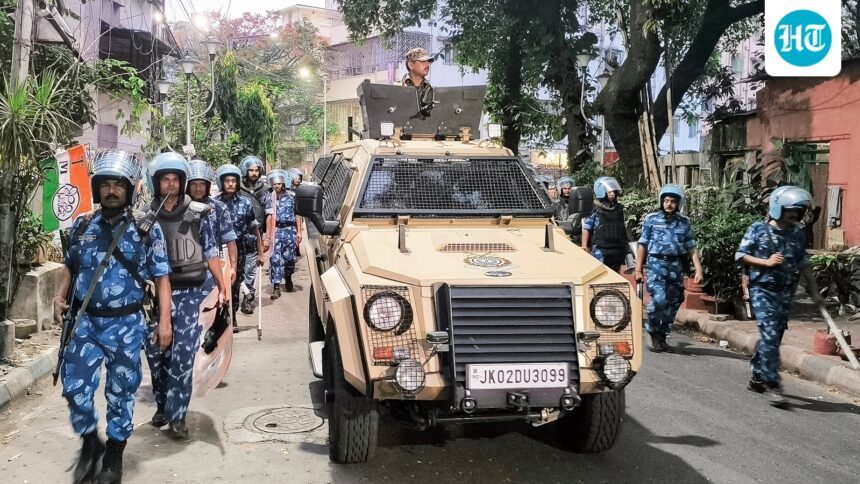
West Bengal is like a country under siege. With over 2,000 companies of paramilitary personnel, the Election Commission of India (ECI) has deployed unprecedented security measures and reshaped the state bureaucracy, something not seen in any other poll in the state in recent memory. An extensive private review of electoral rolls has left millions under scrutiny, fueling allegations of selective exclusion. The first phase of voting on April 23 witnessed a large turnout. While the Trinamool Congress (TMC) interprets this increase as evidence of continued public confidence in Mamata Banerjee, the Bharatiya Janata Party (BJP) sees it as silent anti-incumbency.

Can the BJP turn around its steady rise and finally break through the electoral wall in West Bengal? Her path to power is difficult, but not impossible. The TMC won 48% of the votes and the BJP 38% in 2021. This translated into the TMC winning nearly three-quarters of the seats. A 10 percentage point swing is difficult in an Indian election, but it has never happened before.
More importantly, the BJP could come close to a majority, or even overtake the TMC despite lagging behind in overall vote share. The Transitional Military Council won nearly a third of its 215 seats, by a margin of more than 20 percentage points. This suggests that the overall voting advantage was concentrated in a limited group of electoral districts. For the BJP, this means writing off nearly 100 such seats and focusing on the remaining competitive seats where a 5-7 percentage point swing could make a difference.
The BJP faces a structural challenge as Muslims make up nearly 30% of the electorate and are geographically concentrated. They support the TMC overwhelmingly, except for some pockets in Malda and Murshidabad where the Congress could be competitive. The limited success achieved by Islamist-oriented parties in Bengal suggests that fragmentation of this base is unlikely. The BJP’s prospects thus hinge on an over-performance in Jangalmahal and North Bengal, coupled with strategic progress in Greater Kolkata, the TMC’s stronghold. This can only happen if the fears generated by the Islah Party lead to deeper Muslim unification, which in turn leads to further polarization among Hindu voters.
Voting patterns among women constitute another aspect. According to post-poll data from Lokniti-CSDS, the gap between the TMC and BJP among male voters was about six percentage points in 2021, but almost double that among women. This gap was largely driven by the poor and lower middle class. Banerjee’s welfare structure has created a solid women’s support base.
Is there dissatisfaction among female voters about the handling of the RG Carr case? Can safety and security issues trump welfare receipts? Reports suggest that while Banerjee remains popular, there is growing discontent against the local party machinery. Anti-incumbency sentiment was expressed in a silent murmur of “ektu poriborton “(Small Change)” explains why the TMC framed this as a contest between Delhi and Bengal, a battle in which Hindutva is pitted against Bengali cultural identity. This strategy of relying on macro narratives to contain discontent at the local level over corruption and union policies exposes the weakness of the TMC.
Through this lens, two scenarios emerge for the BJP in 2026. The worst case scenario is a comfortable TMC return. The BJP repeats its 2021 performance in core areas but fails to expand. Muslims remain united behind the TMC, and the BJP is unable to win the votes of women voters. In the best-case scenario, the BJP not only maintains its dominance in strongholds, but expands it, turning narrow losses into victories. It also benefits from limited fragmentation or low relative turnout among Muslim voters in key electoral districts. The high turnout reflects anti-incumbent mobilization rather than routine participation, which may have been amplified by concerns associated with SIR. The TMC records losses among women voters. If these conditions align, the BJP could push the contest into truly competitive territory.
The first phase of 152 seats covered parts of the state more favorable to the BJP. In 2021, the party received a disproportionately large share compared to its statewide tally – of 77 seats, 59 came from this phase. It is the 142 seats on April 29 where the BJP must make a breakthrough to challenge the TMC. The Transitional Military Council won more than 85% of these seats.
Elections in West Bengal have rarely been a unified contest. The country’s political culture tends to produce dominant parties that cannot be easily defeated simply because of anti-incumbency sentiment. It is not surprising, then, that since 1977, an incumbent president has lost only once, in 2011, when the TMC ended the Left’s 34-year rule. This shift was preceded by clear signs in the 2008 Panchayat elections and the 2009 Lok Sabha elections. No similar signs have emerged in 2023 and 2024. In Bengal, energy does not seep through the cracks. Has the BJP found the right lever?