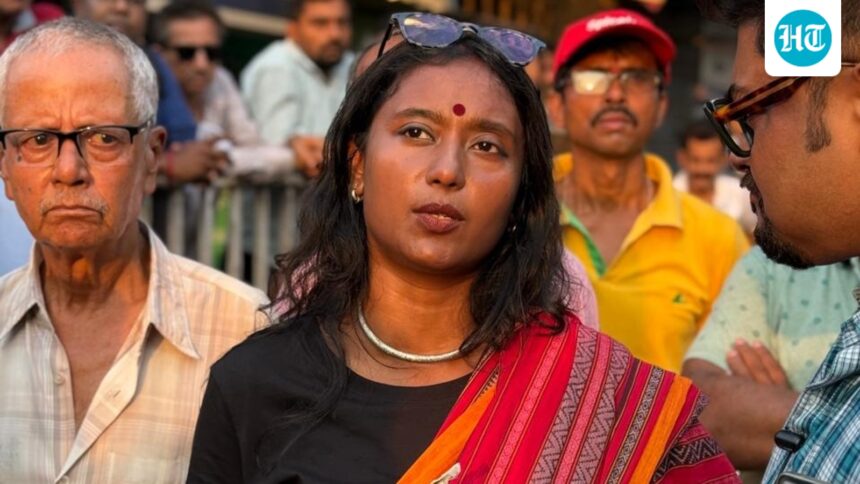
Debsitha Dhar, a promising candidate for the ‘Left of This Bengal’ poll, believes the Front remains relevant amid Masjid Mandir and BJP politics. Exclusive interview:

After ruling West Bengal for 34 years, the Left Front saw its dominance collapse in 2011 – and has since struggled with questions about its relevance. Now, amid the Trinamool Congress (TMC) versus Bharatiya Janata Party (BJP) spectacle, the Left is trying to make a comeback, presenting itself as the only alternative focusing on bread and butter issues.

At the forefront of this campaign is a promising Left Front candidate, Depsita Dhar, whose sharp and direct campaigning style has drawn comparisons to New York City Mayor Zahran Mamdani.
Debsitha Dhar, the Students Federation of India (SFI) leader fielded by the Left Front from Dum Dum Uttar seat for the 2026 Bengal Assembly elections, did her PhD in Population Geography at Jawaharlal Nehru University (JNU).
In an exclusive interview with Hindustantimes.com, Dar spoke about the decline of the Left, lessons learned from her years in power, and why she believes the party is poised for a political revival in Bengal.
Question: So, the left has governed for 34 years and has lost its relevance, so why do voters trust you?
A. We do not believe that the left has lost its importance. Even in the last panchayat elections, if you remember, the entire machinery of the ruling government was behind ensuring that people could not vote. Even during counting time, I was one of the counting agents.
Our ballot boxes have been hijacked. The counted voting lists were taken away. So I don’t think that if we are in any case irrelevant, the ruling government or the ruling party should be so proactive in taking away people’s rights. Track Bengal elections April 2029 updates here
If you look at the last elections, you will find that the left has made significant gains. Therefore, we do not agree with the idea that the left has nothing to do with the issue. In the entire last election period, the BJP was talking to its voters less and trying to talk to our voters more and asking them to vote for the BJP. If we were completely irrelevant, if our voters were completely irrelevant, I don’t think all of this would have happened.

We are relevant because we believe we are the only alternative that speaks for pro-people policies. Both Trinamool and the BJP, instead of talking about people’s development, instead of talking about the bread and butter issue, about employment, about education, their entire politics has been around the duality of mandir and mosque.
It’s all about your religion, it’s all about your identity. There is a lot of identity happening in Bengal, which did not exist before, before 2011. So we think we are the only ones looking beyond the binary.
Therefore we are the most important political force for every working class in Bengal.
Q: What went wrong for the left after 2011? What needs to change?
A. I think the main problem was, since we had been there in government for a longer period of time, we were dependent on the state. A lot of our people who came to power, who entered politics, didn’t really come because they believed in communist ideology, but they wanted to be around a political party that was in power.
So this dependence on the state is what affected us the most. Many of the people who became leaders of the Communist Party did not really represent the ideals of communism. So the people who voted for us felt upset.
They felt that this was not the kind of party we should vote for. There was, of course, opposition to the agreement. So after 2011, there was rejection.
People rejected everything they saw. Also, we as opposition leaders… Since most of our main leadership at that time, became leaders during the period that we were in power, they also did not have the necessary training to become, how to become opposition and power in their own right.
So, the first five or 10 years, it was a period of learning and unlearning for us. How do you undo what you’ve learned or undo what you’ve learned over the last 34 years, or the last 15 years, and try to incorporate a new form of dissent.

But I think we are ready now. There are a large number of young people who now hold leadership positions, who came to the party not because we are in power.
They came to the party because they believe in the principle and ideology.
Q: So, will this election be a comeback or just a rebound?
A. I think it will be a comeback. It will be back on the agenda. It will be a return to politics. 2011, if you look at that election, you will see what the political debate is, what industrial policy should be in West Bengal. Krishi Panam Shilpo – ThShould you go into industry, or whether you should go into more agricultural-based economic activity. This was the debate. But in 2020 or 2026, all these questions completely disappear from the political scenario.
So what I want is to renew the people’s agenda and power.
Q: What has changed in the left’s economic approach? How does the left plan not to repeat something like Senghor?
A. Look, there are two important things. First, we disagree with the idea that there is no need for industrialization.
If there is no industrialization, what will happen to the youth of Bengal? We all witness it. We have become an immigrant-sending country from an immigrant-receiving country. Our white collar workers or blue collar workers, they all have to go to other states or other cities to make sure they get some food in their bellies.
This is not the situation we expect when we think about manufacturing. The precise idea was to ensure that there were very many educated people, and that they needed to get jobs in their lands, not outside of them. So manufacturing is something we stand by.
But during Gumi Odigrohon Period, there was some kind of mistake made by our party. The kind of consultation that should have been done with landowners, the kind of consultation that should have been done for farmers and agricultural workers who were dependent on those lands, was not there in Singur. This was a mistake that we should have corrected.
But in the case of Nandigram, all these things were not there. That was rather a conspiracy, etc. So those are the two things.
We are committed to our policy of industrialization and bringing back our children from different parts of the country. But we also believe that this cannot be a hasty decision, nor can it be an imposed decision. It must be a collective decision by all other stakeholders.
Question: Tell us something about your Zoran Mamdani style campaign. I was reading about it somewhere.
A. It’s not exactly Zoran Mamdani, but it’s true. We are very inspired by everything Zoran has achieved. Not because…well, yeah, K He communicated very quickly, was very intelligent, was very direct, and was very effective. But instead, what Zahran did was that he never gave up on his ideology or politics.
When he started his work in New York, New York was the city with the largest Jewish population after Israel. Even after that, he never said that he did not have a pro-Palestine position. He has been very vocal about his pro-Palestine stance.
But besides that, what he kept talking about was the bread and butter issue. Talk about affordable housing, talk about affordable public transportation. And that’s something I think I’ve inspired, which is that even if it’s a tough battle, you shouldn’t compromise on your core ideologies.
You must stick to what you believe in. And maybe you have to change the way you talk to people, the way you communicate with people. Okay.
Question: Mamata Banerjee was claiming that access to non-vegetarian foods may become difficult to obtain if the BJP is voted out. What do you have to say about this whole non-vegan movement?
I have a very frustrating experience. Two days ago when we were campaigning, it was Hanuman Jayanti. We saw a man in a white shirt and white pants come and tell the fishmonger that you are selling fish today too, and today you should have stopped. So this boy is a little confused why today? He said today is Hanuman Jayanti. So we thought he was a BJP guy.
We went and said why are you saying all these things? Who are you? We knew he was the second hand of the Trinamool Congress there. So the idea that Trinamool is really trying to fight the BJP at the cultural level, and that Trinamool represents a counterculture, is a false claim. In Bengal, the kind of Hindutva imposition, the kind of Hindutva imposition that you see today, was brought by Mamata Banerjee.
A few years ago, no one knew that Ram Navami was a major religious event. We used to do Ram Navami but this is in the temple. We have hardly witnessed Ram Navami rallies.
Where I was born in Howrah, there is a place called Ram Rajatola, and there is a Ram temple that is 100 years old. People have been worshiping her for how many years, we never know. But nothing untoward happened at all.
But this year’s elections we saw that there is a competition between Trinamool and BJP over who can organize the biggest Ram Navami rally. So, by normalizing the Ram Navami marches that caused riots, which caused very political and religious violence in different parts of our country, by normalizing that, they actually normalized the Hindu Indian culture in Bengal. So, whatever their propaganda is to become a Bengal, or a Bengal-Nigeria-KHL, it is just a farce.
Question: What are the main issues you are addressing in your campaign, or do you plan to address if voted into office?
A. I think one of them is municipal services. It’s pathetic, it’s terrible. You can see here the amount of mosquitoes you have to avoid while speaking.
This is because our drains and gutters are not cleaned properly. This must be fixed. Our municipal workers, they are not getting paid properly.
They are mostly contractual. Their job is not fixed or on permanent terms, etc. This must be fixed.
Our hospital, the municipal hospital, is not functioning. You go there and you will be transferred to another hospital. So people who don’t have money are in a very difficult situation.

If you’re going to get your treatment, you’re not going to get it. Either you have to go to the private sector, which you cannot afford, or you have to go to government hospitals, which are far away from you. So that’s another thing.
And of course schools. There are a lot of schools that have been closed. We have to open our schools, we have to open our libraries, we have to open our playgrounds that have been closed and have become like a garbage dump or a parking lot.
Q: What is the Left’s idea to address the issue of unemployment in Bengal?
A. We have said here in our manifesto that we will create an employment centre, a training centre, where we will train people, we will give people counseling and try to create some kind of bridge where they are well paid and given opportunity. But we believe that this is not enough. This is a policy decision.
If we are chosen into the government at all, we will ensure the Supreme Security Committee and public security. This is done regularly, as it was before 2011. We will make sure that there are new farms, and there are new farms Kulkarkhana that are being built.
Question: Mamata Banerjee’s Lokkhi Bhandar scheme seems to have wooed a lot of women. Do you think this will be a challenge to face?
A. Look, we are not against Lokkhi Bhandars. We are not against any kind of welfare allowance. But the question is, welfare benefits are like multivitamins that will only work if you have some food in your stomach.
What Mamata Banerjee did is everything, all the permanent positions that were there, even for women, she did not fill. She said that if you are a woman and if you work after 11 am and if something happens, it is not the duty of my government. Why are you out at 11 o’clock? So, the moment you are saying all these things, if you are saying at all that the Lokhi Mohandas are about women empowerment, then women empowerment cannot happen only through cash transfers.
It must be supported by social empowerment and political empowerment. Throughout Mamata Banerjee’s tenure, these two things have disappeared. It’s not there at all.
If you are a political person, if you are against the ruling government, you cannot speak anything. If you are a woman especially, you will be bullied, you will be trolled. The kind of racist and sexist remarks that their MP now made, that he made to me during the last Lok Sabha elections, and nothing happened to him.
A few months ago, the same person made an insulting remark to a colleague, another female MP, and another female MP. So, if Mamata Banerjee does not punish these kind of people, if Mamata Banerjee asserts that they are the face of their party, how will she talk about women empowerment and women empowerment? What about their social and political empowerment?
Question: On the issue of SIR, do you think it is counterproductive for other parties except the BJP or does it favor the BJP?
A. I think SIR is counterproductive to every citizen of Bengal, no matter what they do with SIR. It’s as if they’re taking away the right to vote for people who are our neighbors, who are our friends.
We grew up with them and all of a sudden the government comes in and says you can’t vote, you’re no longer a legal voter, which is not encouraging at all. You can’t really stand by that. And yes, we can understand the BJP’s entire fascist agenda as well, but Mamata Banerjee should have played a counter role, right? She didn’t do that.

Well, you successfully created a political spectacle by wearing a black coat and going to court. But within the state, what is its role? She should have given more and more people who could have done the whole process more smoothly. She could have come and passed a bill in the Assembly saying that all this confusion with Chatterjee, Chattopadhyay, Banerjee, and Padyopadhyay, Begum, KhatunAll of this must be done n is cancelled.
If she could have played those two roles, I don’t think so many people would have lost their right to vote.
Q: Do you think the outcome after SIR will be different than it was before SIR?
A. Of course, I believe that. I also think that a lot of people, especially the Matua family, who were kind of trusting the BJP, will come and give us citizenship.
They understood. In 2002, when we were in power, no one questioned their credibility. No one can say we’ll throw you away.
No one took their rights. But now under the rule of Mamata Banerjee and Narendra Modi, the people who are most affected after the Muslims are the Matua, the Hindus.
Q: Finally, a message to the people of Bengal?
Vote for us if you want to defeat the BJP, if you want to defeat Trinamool, if you want a state or a constituency, where your bread and butter issues will be a priority. We are not here to guarantee our political life or our political career. We are not here because we want to make money through politics.
We are here because we still believe in the dream of change. I hope and hope that you will all stand with us.

Nayanika is a Senior Content Producer at Hindustan Times, based in New Delhi, with over six years of experience in the digital media industry. It specializes in providing clear, in-depth coverage across public, national and international events, with a strong focus on breaking news and in-depth explainers. Known for her ability to decipher complex developments, she enjoys deconstructing multi-layered political and policy issues into accessible, reader-friendly narratives that deliver information without distraction. She previously worked in India’s leading newsrooms, including India Today, News18 and Outlook, where she has been tracking news, covering major events for the last six years and leading teams. Nayanika holds a Master’s degree in Political Science and has a keen interest in international relations and world affairs. Her academic foundations shape her analytical approach to stories, enabling her to connect the dots between local events and broader geopolitical currents. She is particularly drawn to stories that require context, nuance, and clarity—turning complex topics into compelling reads. Outside the newsroom, Nayanika is a passionate gourmet who loves to cook and share meals with her loved ones. When she’s not writing or keeping up with the latest headlines, you can often find her exploring local markets for the freshest ingredients, looking for inspiration for her next culinary experiment.Read more