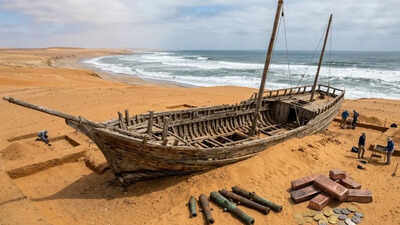
In 2008, a diamond mining operation near Oranjemond, Namibia, led to the discovery of an important piece of history when the wreck of Bom Jesus, a Portuguese merchant ship lost at sea in 1533, was found after being buried for more than 500 years under layers of sand and water.
The discovery allows archaeologists to view the wreck as a time capsule from the Age of Exploration, with the ship’s contents almost perfectly preserved, thanks to the ship’s load of copper alloy, which protected the ship from marine deterioration. The discovery of Bom Jesus opens a variety of new opportunities for studying global trade routes in the 16th century, as well as the shipbuilding techniques of the time and the dangers faced by early explorers on their voyages across the treacherous Atlantic.
Gold, ivory and cannons: a 500-year-old shipwreck discovered in the desert sands
According to a report in the Mariner’s Mirror, on March 7, 1533, the ship Bom Jesus departed from Lisbon en route to the Indian subcontinent with trade goods taken on board. Historical analysis by archaeologists and historians suggests that the ship foundered during a severe storm, causing it to be pushed towards the coast of Namibia by waves and then crash into a rocky cliff. Since most of the human remains have not been located, it is believed that some crew members survived the initial sinking, but the ship and its valuable cargo were buried under the sand of the Skeleton Coast for approximately 500 years.
How Toxic Cargo Preserved History
While excavating the wreck, experts found more than 40 tons of cargo — including a stunning array of artifacts that had survived excavation largely because they were located in an area previously protected from diamond mining. This shipment included thousands of gold and silver coins, bronze cannons, navigational astrolabes, and several hundred elephant tusks, as stated in the “Navigator’s Mirror” report.
One of the most interesting points about these items is that they were found in a well-preserved state (including organic material) due to the biocidal properties of the copper charge, which prevented marine organisms from consuming the organic remains of sunken ships.
What ivory and copper reveal Early world trade
One of the most important maritime archaeological finds in South Africa, a copper ingot (ca. 17 tons) bearing the trident of the Fugger family of Augsburg, Germany, is evidence that Renaissance Europe traded extensively with sub-Saharan Africa. The elephant ivory found has also provided important information to scientists about the historical numbers of West African forest elephants and how early global trade affected the environment.