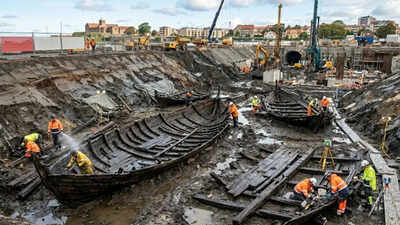
The events surrounding the construction of a tunnel in Varberg, Sweden, which is to be part of the West Coast Line expansion project, have been discovered to be the site of many things that will change our view of Varberg and its history.
While excavating, the construction crew discovered 6 shipwrecks (4 of which date back to the Middle Ages or late Middle Ages). Two of the shipwrecks have been confirmed by experts from Arkeologerna, part of Sweden’s National Historical Museums, and include medieval findings and one 17th-century ship (and one undated). These artefacts provide evidence of how Nordic people traded and defended themselves over hundreds of years and how shipbuilding developed during that time and under modern construction.
There is no doubt that these discoveries will update the way we view the Warberg and its historical significance for generations to come. The present time, compared to the historical records and other unique archaeological activities that have occurred since the beginning of the twentieth century, creates an interesting challenge for the study of maritime history and trade, especially the history of Scandinavian maritime trade.
Shipwrecks discovered under Varberg, Sweden
As noted in a study of the Arkeologerna, the six shipwrecks provide insight into the evolution of sailing ships through design and construction methods over time.
Wreck 2 reveals traditional timber clinker construction using overlapping boards, while Wreck 6 shows later carvel design using smoothly finished edge alignment boards and additional features indicating Dutch influences (preserved grooves on the keel) from the same period.
These examples demonstrate that ships were designed to adapt to changing shipping demands and Baltic Sea conditions between 1600 and 1700, but they create a record of material culture where historians can examine how ship designs changed to respond to trade patterns, environmental factors, and technological advances over several hundred years.
The conflict between modern infrastructure and history
The Bohuslan Museum, Visual Archeology and Cultural Environment in Halland cooperated in the excavation of the shipwrecks, but with increased pressure to complete the excavations due to the construction of a new railway tunnel scheduled for daily use. The need to speed up the excavation of Shipwrecks Nos. 5 and 6 may mean that parts of these historically important ships remain buried within the tunnel area. These shipwrecks are time capsules; However, the discovery of the shipwrecks has highlighted the ongoing conflict between the preservation of centuries-old cultural heritage and the ongoing development of modern urban areas.
Continued analysis of these shipwrecks will continue to provide insight into life during the early medieval period, including trade routes and living conditions on board the boats that have been found as part of the excavated remains of these ships.
The role of merchant ships in the Varberg economy in the Middle Ages
Aside from subsequent discoveries in the 16th and 17th centuries, archaeologists are currently focusing their analysis on Wrecks 3 and 4. These ships, identified as “koggs” (flat-bottomed trading ships) from the 14th century, serve as important artifacts for understanding medieval logistics.
By examining the timber and construction of these ancient ruins, researchers hope to map the maritime trade networks that supported medieval Warberg and its neighbor Ny Varberg.
The comprehensive reports developed by Arkeologerna and its partners aim to reconstruct the role these ships played in the economic and cultural life of the Baltic coast, ensuring that even the most fragmentary remains contribute to the wider historical record.