Logo text
Taylor Swift is looking to add trademarks to her portfolio of brands, a legal move that appears aimed at cracking down on unauthorized AI productions.
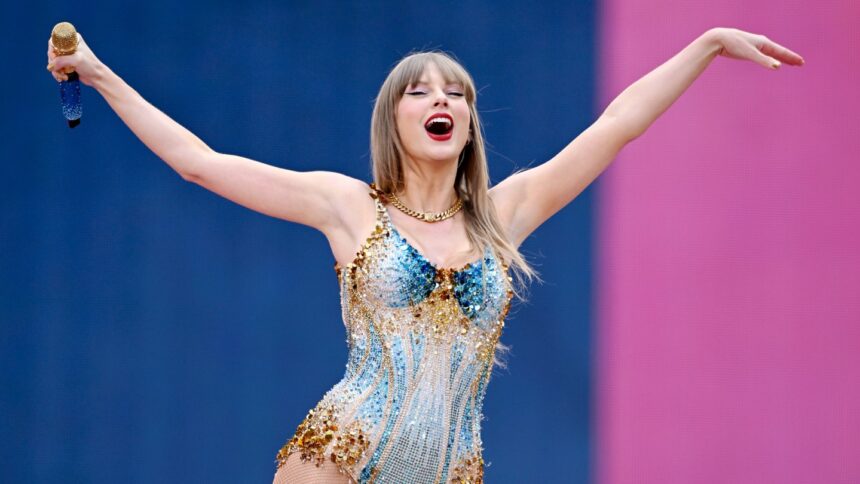
Two of the trademark applications, filed on Friday, seek protection for its voice. It contains clips of her saying “Hi, it’s Taylor Swift” and “Hi, it’s Taylor”. The third, which aims to combat AI-generated images on the internet, shows a photo of the singer holding a pink guitar, with a black belt and wearing a multi-colored suit with silver shoes.
Branding represents a new avenue for celebrities to challenge artificial intelligence companies and users who mimic their looks and voices without permission. Earlier this year, several trademark applications for Matthew McConaughey were approved, including an audio recording of him saying “Okay, okay, okay,” his famous line from the movie Dazed and confused Another shows him standing on the balcony.
The body of publicity rights laws aims to protect celebrities from having their trademarks stolen to advertise products. However, many states do not maintain such laws, making enforcement difficult.
With trademarks, Swift and McConaughey are likely hoping the specter of federal lawsuits will deter abuse. As for Swift, she could hypothetically argue that AI creations that use her voice and image infringe on her intellectual property rights.
However, the theory remains untested. Although trademarks protect against similar copies that could confuse consumers, they are not intended to be used as a blanket means of protecting every feature of a performer’s trademark.
“I don’t think it will be very effective, except in rare cases,” says Matthew Asbell, an intellectual property lawyer at Lipis Mathias. “Voice branding is particularly limited to what Taylor actually values: ‘Hey, it’s Taylor’ or ‘Hey, it’s Taylor Swift.’”
The result: The phrase in Swift’s brand pitch is more important than the singer’s voice. “So, unless used by another party [her] “If they vote to say the same thing or something very similar, it should be difficult to use those trademarks to enforce it against them,” Asbell adds.
The same issue applies to Swift’s overlay of her image. Any infringing copy must use an image similar to the trademark, if granted, in order to have significant use.
There’s also the issue of whether “Hey, it’s Taylor” is well-known enough to rise to the level of protection. The singer is very famous, but the line doesn’t seem to be.
Last year, an AI-generated version of Swift’s song “The Fate of Ophelia” entered the top 50 songs in Brazil on Spotify before being removed. The track used artificial intelligence to blend Swift’s voice with an artificial voice modeled after top Brazilian singers. Even if SWIFT is awarded its latest trademark, there are only a few avenues for creators to challenge cross-border AI copying.