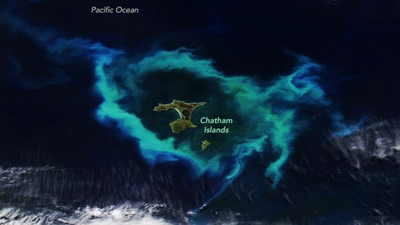
There was an abnormal bright halo formed around New Zealand’s Chatham Islands early this year due to the presence of a large amount of plankton that thrives on Earth which could be observed through the use of a satellite operated by NASA.
The formation of such a sheen is the result of a high concentration of lithospheres resulting from nutrients carried by ocean currents. The satellite image showing the relationship between phytoplankton blooms, ocean communities, whale strandings, and ocean currents is from the NOAA-20 satellite and infrared images.
NASA space Captures the corona from space: what it is made of
A stunning image captured by NASA’s Earth Observatory shows a glow of phytoplankton blooming like a ring around the remote Chatham Islands in the South Pacific. The image was captured by the NOAA-20 satellite with the help of the VIIRS sensor on January 10, 2026.Phytoplankton are small, microscopic plant organisms that float near the surface of the water. As they grow enormously, they reflect sunlight and become clearly visible from above. According to NASA, “phytoplankton become visible to satellites during explosions in their numbers.”The special thing about this phenomenon is its almost perfect circular shape. Due to the action of currents and eddies, the phytoplankton formed in the form of rings.
the Chatham Rise : The hidden power behind the glowing ring
It is associated with the presence of Chatham Rise, a large-scale seamount off the east coast of the South Island of New Zealand. This geological formation plays an important role in determining the state of the surrounding sea.When the cold, nutrient-laden waters of the Southern Ocean meet the Chatham Rise, they mix with the warm subtropical waters. This mixture provides excellent conditions for phytoplankton to thrive, especially when there is plenty of sunlight in the Australian summer months.Research has shown time and time again that areas with nutrient-rich water tend to be more productive. In this case, Chatham Rise is a natural machine driving one of the most magnificent blooms ever observed.
Marine biodiversity And the dark reality of whale stranding
While the bright halo represents a healthy marine ecosystem, it is also an indicator of a more serious problem. Environmental factors that help life forms thrive in the ocean environment can also be responsible for whales stranding in large numbers.The waters surrounding the Chatham Islands are home to a high degree of marine biodiversity, including fish, seabirds, seals and more than 25 species of whales and dolphins. These wildlife are attracted to these waters because phytoplankton form the foundation of the food chain.Conversely, the relatively shallow waters offered by Chatham Rise’s environment may confuse whales and other large marine animals. Based on reports from the Department of Conservation, whale formations, especially those of pilot whales, may pursue prey into such areas, leading to them stranding.
Why is this observation important?
The illuminated ring is more than just a stunning look; It opens a gateway to many of the complex workings of the Earth’s oceanic environment. Satellite studies allow researchers to track any changes in ocean color and better understand how climate change, currents and underwater topography are interconnected.As is clear from NASA’s findings, such an environment allows for some insight into even remote locations such as the Chatham Islands, suggesting what is happening in other parts of the world.Most importantly, the luminous ring represents life on the one hand and danger on the other, a perfect depiction of the perilous nature of Earth’s oceanic environments.