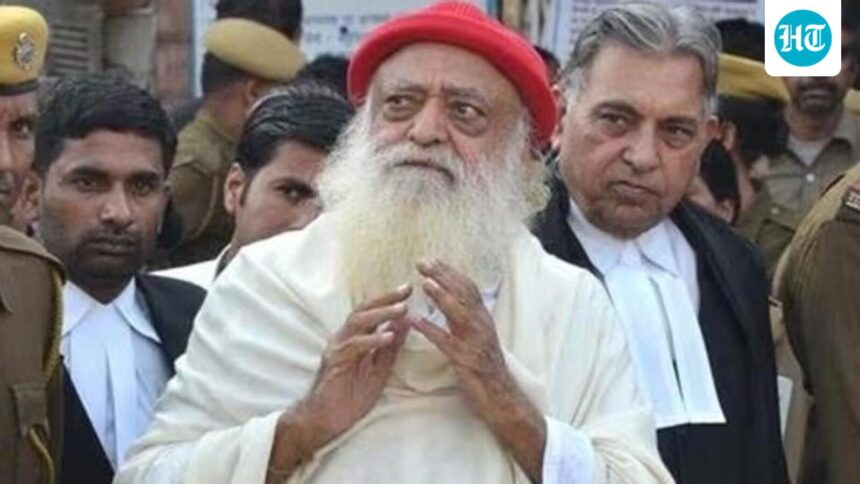
The Supreme Court on Monday restrained the Gujarat government from taking any coercive action against lands and properties owned by the shrine of ‘spiritual man’ Asaram Babu in Ahmedabad, observing that the show-cause notice filed by the municipal authorities “prima facie lacks material details”.

A bench of Justices Vikram Nath and Sandeep Mehta ordered the status quo to be maintained, effectively suspending the April 17 ruling by the Gujarat High Court that paved the way for the state to reclaim about 45,000 square meters of land occupied by the Sant Shri Asaram Ashram in Motera, near the Narendra Modi Stadium.
The land forms part of a larger 650-acre parcel earmarked for the proposed Sardar Patel Sports Park, including the Olympic Village and associated infrastructure linked to Ahmedabad’s bid to host the 2036 Olympic Games and preparations for the 2030 Commonwealth Games.
The Supreme Court’s intervention came after it found clear deficiencies in the foundation on which the state was founded – the show-cause notice issued to the ashram.
During the hearing, the panel repeatedly pressed the state to make its case based on the notice itself. “Ultimately, your case should remain under notice. The prima facie notice lacks material details,” the court told Solicitor General Tushar Mehta, representing the Gujarat government.
Read also:Gujarat HC supports the government’s decision to purchase the Asaram Ashram land in Motera
The bench also questioned the state’s changing stance over the years. Referring to previous settlement operations, she noted that the authorities had settled parts of the lands that were initially described as encroachments. “So, you were benevolent in settling the lands despite calling it an encroachment. What happened overnight that you want to cancel?” The court asked.
The state alleged that the ashram had exceeded its original allotment of 6,261 square meters set in 1980, encroaching on additional land that was later phased in. It also relied on the findings recorded by the Supreme Court regarding unauthorized constructions and alleged non-compliance with land use conditions.
The Board noted that such allegations should find a place in the notice itself. “Where is all this mentioned in your diary?” She requested, stressing that the administrative action must be judged based on the reasons disclosed to the aggrieved party.
Senior advocate Mukul Rohatgi, appearing for the ashram, asserted that the entire action was “illegal and in bad faith”, alleging that the trust was being targeted as the land falls within the proposed sports development area.
Read also:Land of convicted rape convict Asaram Babu’s ashram among sites to be acquired to host 2036 Olympics in Ahmedabad: Report
He said the ashram had valid sanction plans dating back to the 1980s and that eviction proceedings had been initiated selectively, although similar facilities had been extended to other entities.
The court gave the state three days to file its counter-affidavit, giving the petitioners an equal opportunity to respond.
The order has now been listed for May 5, with the bench directed to maintain the status quo in the meantime.
The Supreme Court order temporarily stays implementation of the Gujarat High Court’s April 17 ruling, which dismissed the ashram’s challenge to eviction notices issued by revenue authorities.
The Supreme Court held that the trust violated the terms of land allotment and encroached on large areas, including parts of the Sabarmati riverbed. It rejected the regulation petition, stating that any such leniency would conflict with the well-established legal principles governing public lands.
The court also refused to stay its ruling, allowing the state to move forward with reclaiming the land for the proposed sports infrastructure project.
Asaram, who founded the ashram in 1972, is serving a life sentence in multiple rape cases. In 2018, a Jodhpur court convicted him of sexually assaulting a minor girl in a Rajasthan ashram, and sentenced him to life imprisonment.
This was followed by another life imprisonment sentence in 2023 by a court in Gandhinagar in a separate case involving a schoolgirl who was repeatedly sexually assaulted between 2001 and 2006.
He is currently out on medical bail, even with convictions pending.