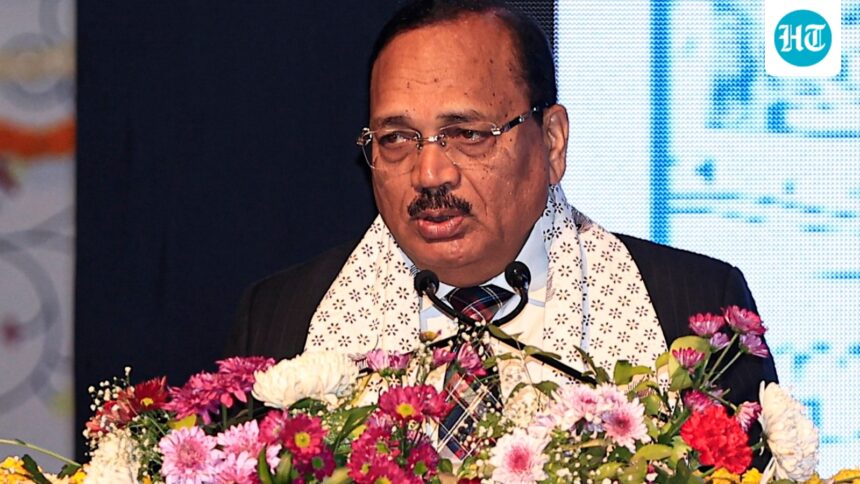
Chief Justice of India Surya Kant on Saturday called for the creation of a structured national framework to tap the expertise of retired judges in alternative dispute resolution (ADR), saying their continued participation should be treated as an institutional service with accountability and support.

The CJI said the experience of former judges is a valuable national resource that should not remain untapped after retirement.
He said: “I call for a formal framework: a structured national registry of former judges willing to work in the field of dispute resolution and legal awareness capabilities; memorandums of understanding between this association and the state legal services authorities and high courts; and most importantly, I call for recognition that this engagement is a service in every sense of the word.”
CJI Surya Kant was speaking at a conference of retired judges here.
He said that alternative dispute resolution mechanisms such as mediation, justice law and arbitration are essential to access to justice in the country.
Also Read: “Don’t be afraid of AI, use it carefully and consciously,” says CJI Surya Kant
“Mediation, equity, arbitration, conciliation: these are not the back door to justice. For millions of Indians, they are the only door,” he said.
He added: “In other words, these avenues are not complementary to the justice system. They are, at their best, justice itself delivered in a language that people understand, at a pace that people can live with, and in a place that people can access.”
The International Committee of Justice said that not benefiting from the experience of former judges represents a huge public loss.
“This trust, hard-earned over years of loyal service, is a precious national resource like water deep in the desert. Allowing it to remain unused at the moment of retirement would be not just an institutional oversight, but a huge public loss,” he said.
Also read: Lok Sabha panel concludes probe against Justice Yashwant Varma
Highlighting the potential roles of retired judges, he said they could contribute as mediators, arbitrators, legal educators, pre-litigation advisors and institution builders.
“First,” he said, “as mediators and arbitrators, particularly in commercial and family matters where standing and impartiality are crucial, and where a real settlement is reached worth a hundred reluctantly adhered to.”
“Secondly, as legal educators, in schools, colleges and in gram panchayats, they explain rights in plain language to citizens who were never told they had them,” he added.
Retired judges can act “as pre-litigation advisors, within the DLSA and SLSA mechanisms, and intercept disputes before they calcify into cases,” he said.
They can also serve as “institution builders: mentoring the next generation of mediators, training legal aid lawyers, and preserving institutional memory that courts cannot afford to lose when a judge leaves office.”
India has already made progress in strengthening ADR systems, he said, citing large-scale mediation and national dispute resolution exercises in large numbers, as well as the growth of arbitration centers across the country.
The CJI said the judiciary and its allied institutions enjoy deep public trust and it is their responsibility to maintain and strengthen that faith.
“Just as wells store water during rains and serve people in times of scarcity, retired judges are a valuable resource for us. In cases of difficulty – be it Lok Adalats, arbitration or advisory roles – we look to these experienced judges for guidance on what is right and what is not right,” he said.
Rajasthan Chief Minister Bhajanlal Sharma said the society takes guidance from the words of the judges and the judicial rulings have played a major role in bringing about positive change in the country.
He urged people to consider contacting mediation centers or Lok Adalats before taking disputes to courts.
He said, “The judiciary acts as a guardian of the Constitution and guarantees equal rights for every citizen. The judiciary has remained at the forefront in protecting basic rights, protecting the environment, supporting women’s rights, and combating corruption.”