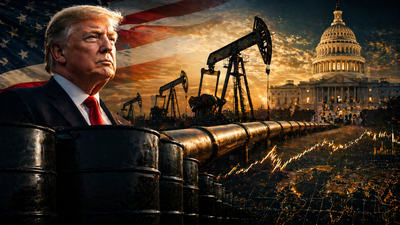
 What once looked like a “drill, baby, drill” election rhetoric has now evolved into an organized economic doctrine, in which energy dominance becomes not just a goal but an instrument of global influence.
He watches
Oil supplies crippled due to Iran’s stranded cargo ships and tankers in Hormuz video
However, what makes this stage different is not only the scale of the decisions, but the system behind them. From patterns of campaign financing to policy implementation, the dividing line is clear: oil is at the heart of decision-making.
Follow the money: campaign finance and policy direction
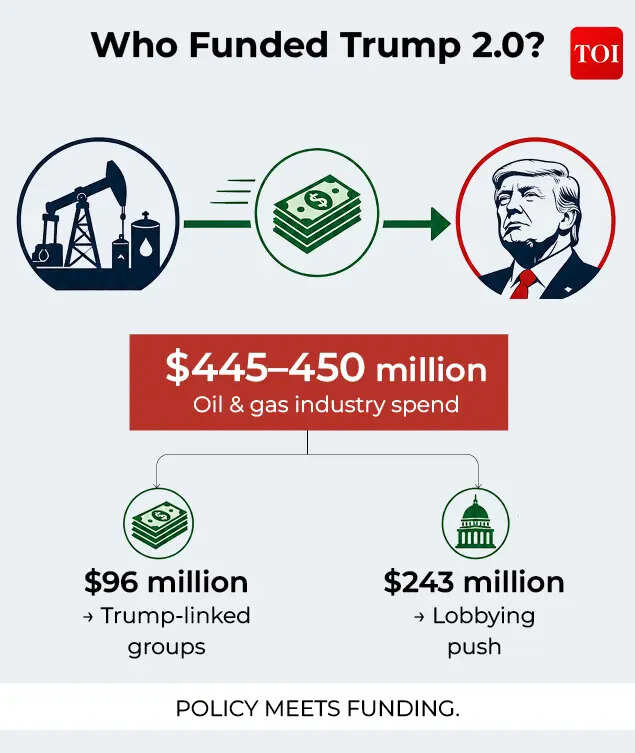
Any attempt to understand Trump’s energy endeavors during his second term begins before he returns to office. Campaign finance data compiled by watchdog groups showed that oil and gas interests remained among the most consistent financial backers of pro-Trump political committees.A 2025 analysis by Climate Power found that the oil and gas industry spent $445 million to $450 million during the 2024 election cycle to influence Trump and Republican leaders, including covering campaign contributions, lobbying and advertising.
Of that amount, nearly $96 million flowed directly to the Trump campaign and affiliated groups, while about $243 million was spent on lobbying efforts, along with tens of millions more in pro-industry advertising.
This scale of support is not unusual in American politics, but the alliance that followed was unusually direct. Almost point by point, the Trump 2.0 policy roadmap reflects the long-term priorities of the oil and gas industry.
Back to “Drill, Baby, Drill”
Within months of taking office, Trump doubled domestic production, as he promised to do during his election campaign. His administration has expanded leasing on federal lands, accelerated offshore drilling approvals, and rolled back environmental review timelines.The message was consistent with his campaign rhetoric: maximize production, reduce dependence, and turn the United States into a dominant energy exporter.The Trump administration granted approval for nearly 6,000 drilling permits on federal lands, representing a 55% increase over the equivalent time frame in 2024-2025.This political push has produced tangible results. By early 2026, Washington maintained near-record production levels while expanding export infrastructure, ensuring that increased production translated into global market influence.The White House recently said that America made history as the first country to export more than 100 million metric tons of liquefied natural gas in a single year.In February, Trump said in his 2026 State of the Union address, “U.S. natural gas production is at an all-time high because I kept my promise to drill, baby, drill,” addition, “US oil production rises by more than 600 thousand barrels per day”
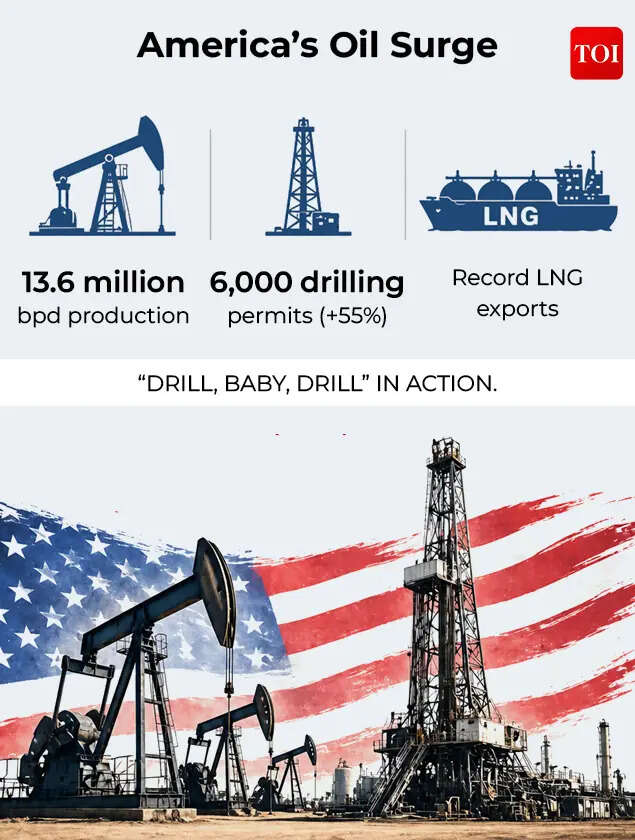
This approach comes at a time when the United States is already the world’s largest oil producer, with its production hovering around record levels.In 2025, US crude oil production reached an unprecedented level of 13.6 million barrels per day, and US offshore oil production also set a new record.Natural gas production also reached a record level of 118.5 billion cubic feet per day, with expectations for higher production levels in 2026 and 2027.
Meanwhile, Trump has repeatedly used his social media platform to reinforce this position, framing US energy exports as an economic and geopolitical tool. In several posts over the past year, he has asserted that American oil can “supply the world” and reduce dependence on competing producers, language that mixes economic ambition with strategic location.
Climate retreat and regulatory reset
Since the start of his second term in 2025, Trump has moved quickly to reset America’s energy direction.On January 7, the Trump administration ordered the United States to withdraw from 66 international organizations and treaties, citing the need to prioritize the national interest and sovereignty over national interests and sovereignty. “Globalization” Agendas. This sweeping move affected UN agencies and environmental treaties and affected US funding for climate action, development, and international cooperation.This list also included the Paris Climate Agreement and the India-led International Solar Alliance, whose leadership has signaled a decisive break from global decarbonisation commitments.
This decision was framed as a move to protect American industry, effectively removing regulatory restrictions on oil and gas expansion. Environmental compliance costs, long criticized by energy companies, were eased, bringing federal policy into line with industry requirements.This was not just symbolism. This was the first structural step in enabling the expansion of the use of fossil fuels on a large scale.Domestically, regulators have been directed to ease restrictions on oil and gas operations. This includes revising methane emissions rules, accelerating pipeline approvals, and reducing compliance burdens on producers.In parallel with promoting oil, the administration has slowed momentum in renewable energy.Subsidies and political support for solar and wind energy have faced criticism, while fossil fuels still have strong support. The cumulative effect is a lower cost operating environment for the industry, which directly improves profitability and encourages further investment.Tensions within Trump’s energy strategy also spill over into his political alliances. His fallout with Elon Musk, who was a prominent supporter during the campaign, highlighted these contradictions.The dispute reportedly centered around Trump’s aggressive rollback of electric vehicle incentives and his renewed push for fossil fuels, policies that are in direct conflict with Musk’s clean energy and electric mobility ambitions.
Sanctions and supply chains: engineering demand
Sanctions have emerged as a powerful tool in Trump’s oil playbook. Tight restrictions on Russian energy exports have disrupted long-established trade routes, especially for countries that depend on crude oil, such as India.By restricting alternative supply while global prices remain high, the United States has actually increased the attractiveness of its oil exports. It is not limited to As a result of reduced not only competition, but also engineering demand.This strategy transforms sanctions from a geopolitical tool into an economic tool.Since 2025, Russian energy sanctions have been tightened in stages, targeting not only exports but also shipping, insurance and financial transactions linked to oil trade.
While it is officially framed as geopolitical pressure to destabilize Russia’s war economy and force Moscow to negotiate an end to the war in Ukraine, it also has a significant economic impact: it limits supply of a key product, driving up prices.At the same time, American exports expanded, filling gaps in global markets. Data from the US Energy Information Administration show that US crude exports remained strong, especially to Europe and parts of Asia, as buyers look for alternatives to sanctioned supplies.
The Venezuela Question: Control Without Ownership
Trump’s Venezuela policy in his second term has moved beyond sanctions to direct control of oil flows, with clear economic implications for US energy interests.Trump has said several times that Venezuelan governments, from Hugo Chavez to Nicolas Maduro, seized American-owned property such as oil infrastructure, drilling rigs, and pipelines during the 2000s. He pointed this out “One of the largest thefts of American property in our country’s history.”In January, US forces arrested President Nicolas Maduro, after months of a naval blockade and seizure of oil tankers had already disrupted Venezuelan exports.In the immediate aftermath, the Trump administration moved quickly to integrate Venezuelan oil into supply chains linked to the United States. Washington oversaw about $500 million in initial oil sales as part of a broader $2 billion arrangement, effectively funneling Venezuelan crude through U.S.-controlled channels.The United States also planned to refine and sell up to 50 million barrels of sanctioned Venezuelan oil, signaling a shift from sanctions to monetization.
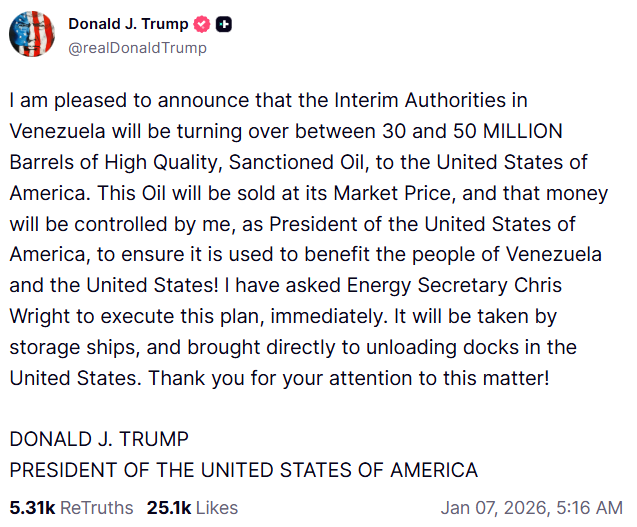
More importantly, this policy opened the door for major US oil companies to re-enter one of the world’s largest reserves – estimated at more than 300 billion barrels.Since then, companies such as Chevron and Shell have moved toward new production deals, while oilfield services giant Halliburton has begun discussions to resume operations after exiting in 2020 due to sanctions.Trump himself stated that US oil companies would invest billions to revive Venezuela’s collapsed oil sector through reform “Severely broken infrastructure” and “Start making money for the country”.The administration also encouraged companies to finance infrastructure rebuilding in advance, effectively linking commercial returns to geopolitical alignment.The immediate market reaction underscored the economic risks.
Global oil prices and energy stocks rose in the wake of the US intervention, reflecting expectations of tighter supply controls and future production gains under US-backed operations.Taken together, Venezuela represents perhaps the clearest example of Trump’s oil strategy 2.0, as geopolitical intervention, sanctions removal, and corporate access have converged to reposition American companies at the center of a major global energy reserve.
Tensions in Hormuz and the impact on prices
The Strait of Hormuz crisis during the ongoing war with Iran has emerged as one of the most significant oil market disruptions in decades, directly reshaping global energy economies in ways that benefit American producers.The strait, through which nearly 20% of global oil flows passed before the conflict, has witnessed frequent disruptions since late February, triggering a severe supply shock across Asia, the region most dependent on Middle Eastern crude.According to Reuters, seaborne oil exports to Asia collapsed to about 14.8 million barrels per day in April, down from 24.24 million barrels per day in January, meaning a loss of nearly 10 million barrels per day that cannot be easily replaced.In this supply vacuum, US exports have risen to record levels. According to Kpler data cited by Reuters, US crude shipments are expected to reach 5.44 million bpd in April and 5.48 million bpd in May, the two highest monthly export figures ever, up sharply from about 3.9 million bpd in the January-February period before the war began.This shift is most evident in Asia, where US crude oil exports are expected to reach 3.29 million barrels per day in May, nearly triple the pre-war levels of about 1.1-1.2 million barrels per day.Refined fuel exports tell a similar story. US shipments rose to 3.59 million bpd in April, with exports to Asia tripling from 132,000 bpd in January to 386,000 bpd, even as Strait of Hormuz-linked fuel flows to the region collapsed from 1.58 million bpd to just 11,000 bpd.However, it is crucial that even this record increase cannot fully compensate for this disruption. The loss of Middle Eastern supplies remains structurally greater than US replacement capacity, keeping global oil markets tight and prices high. This imbalance has created what analysts describe as a “residual premium” in oil prices, which benefits US producers who are able to sell at higher margins in supply-constrained markets.This has effectively turned geopolitical turmoil into a price support mechanism for US oil exporters.According to the US Energy Information Administration, US exports of crude oil and petroleum products rose to a record high of about 12.9 million barrels per day last week, highlighting how supply disruptions translate directly into export gains.The order signal is also visible at sea. More than 60 empty crude oil tankers were heading toward the U.S. Gulf Coast as of Wednesday — nearly three times prewar levels — suggesting global buyers are actively reorganizing supply chains around U.S. oil.Trump’s private messages during the crisis reflect a clear attempt to position American energy as the default global alternative.In a March 31 post by Truth Social, he urged fuel-short countries to “buy from the US, we have plenty,” while claiming in April that “hundreds of ships” were being redirected to US ports such as Texas and Louisiana to load oil.In another post, he highlighted “huge numbers of completely empty oil tankers” heading to the United States to access what he called “the best and sweetest oil anywhere in the world.”Even as tensions fluctuated, Trump portrayed the crisis not as a disruption but as an opportunity, suggesting at one point that the allies could simply “load their ships with oil” from the United States.Indeed, the Hormuz crisis shows how geopolitical instability, whether directly driven or strategically supported, feeds into the broader Trump 2.0 playbook, tightening global supply while positioning US oil as the most reliable and scalable alternative in a dysfunctional market.
Energy exports as an economic lever
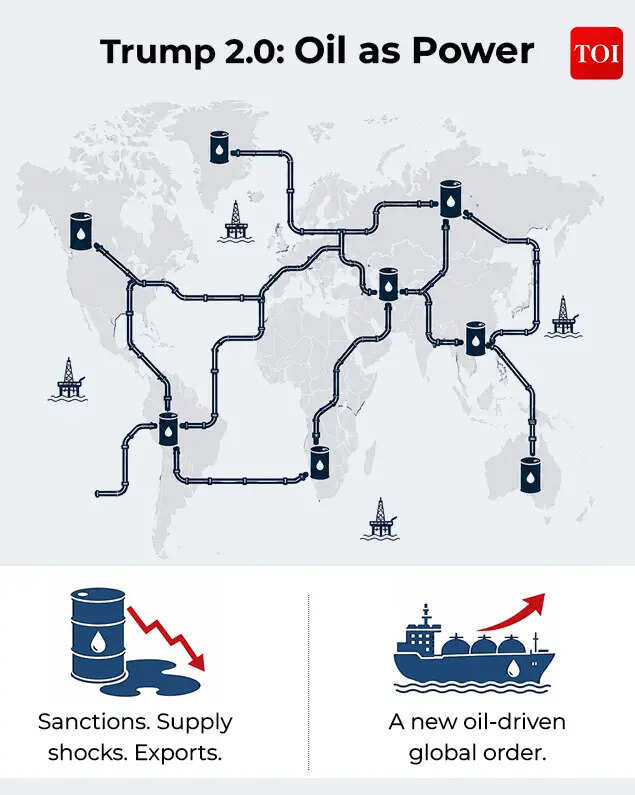
Individually, each decision may seem isolated. Together they form a cohesive system :
- Penalties restrict competitors.
- Geopolitical tensions raise prices.
- Local deregulation boosts production.
- Export infrastructure expands market access.
This creates a form of economic leverage that extends beyond traditional diplomacy.This shift has already become evident in trade flows. U.S. crude oil and liquefied natural gas (LNG) exports to Asia rose about 30% year-on-year in March-April, as buyers scrambled to replace Middle Eastern supplies, according to Kpler.Analysts warn that this increased reliance carries strategic risks.
“The fear is that the United States, especially under Trump, is using it as a political leverage,” said Henning Gloystein of the Eurasia Group, pointing to the possibility of linking energy supplies to broader negotiations on trade, security and climate policy, according to the Wall Street Journal.The logic is clear and straightforward. By increasing exports, the United States not only generates revenue but also builds dependency among importing countries.Trump has reinforced this economic strategy through consistent public messaging.Over the past year, his posts have repeatedly promoted US energy exports as a solution to global instability, positioning US oil as reliable, abundant, and geopolitically safe.This narrative supports policy by shaping perception and encouraging countries to view American energy not just as an option but as a necessity.This transformation is also institutionalized through deal making.
In March, US companies signed $56 billion in energy deals with Asian investors at a forum in Tokyo, signaling a long-term push to secure demand across major importing regions.Europe provides a parallel example of this increasing dependence. The European Union now imports about 60% of its LNG imports from the United States, according to official data, a shift that has accelerated after supplies from Russia and the Middle East were cut off.
Impact on India
For India, Trump’s energy rules of the game in his second term translated into direct economic pressures, especially with regard to its dependence on Russian crude at discounted prices.For most of 2023-2025, India has emerged as one of the largest buyers of Russian oil, importing more than 2 million barrels per day at peak levels, often accounting for 40-45% of the total crude oil basket, significantly dampening domestic inflation and protecting consumers from rising global prices.This strategy has allowed India, which imports nearly 90% of its oil needs, to maintain relative macroeconomic stability even as global oil prices remain volatile.However, under Trump’s pressure tactics in his second term, this equation has begun to shift. In August 2025, the United States imposed an additional 25% tariff on Indian exports, effectively raising the total tariffs to 50%, and explicitly linking trade concessions with India that reduced Russian oil imports.
Public rhetoric has also intensified, with Trump repeatedly criticizing India’s economy and energy ties, using terms such as “dead economy” to increase pressure in trade negotiations.Trump imposed sanctions on two major Russian oil companies, and the impact is becoming evident in trade flows. By January 2026, Russia’s share of India’s oil imports had fallen sharply to 21.2% (about 1.1 million barrels per day), its lowest level since 2022, as refiners reduced their purchases amid sanctions.In 2024, US oil would account for only about 3% to 4% of India’s imports. By October 2025, after the first wave of sanctions, this percentage had jumped to 10.7%. In December 2025 alone, India’s imports of US crude rose by 31% compared to the previous year. In terms of volume, imports rose to 1.1 million tons (an increase of 58% year-on-year).India has also deepened its engagement with the US energy sector beyond crude oil. Long-term LNG agreements have gained more attention, with Indian companies such as GAIL and Indian Oil Corporation expanding sourcing discussions with US exporters to secure stable supplies of gas.In February, the United States and India agreed to a trade framework under which India indicated its intention to purchase $500 billion worth of American goods, including energy, over five years.This is in line with broader government efforts to diversify energy imports and reduce over-reliance on any geographic region amid rising geopolitical risks.But this shift may come at a cost. In contrast to discounted Russian crude, US oil and LNG are priced closer to global standards, which could increase India’s import bill.For its part, India has never said it would stop buying Russian crude oil. In fact, with supplies cut off in the Strait of Hormuz, India’s purchases of Russian crude are near the highest levels ever seen before, a fact supported by the US sanctions waiver.
Bottom line
Trump’s energy policy in his second term is not a series of isolated decisions. It is a coordinated framework that links finance, regulation and geopolitics into a single economic narrative.However, the Trump administration has consistently framed these moves as efforts to strengthen American energy security, create jobs and stabilize global supply chains.From support for election campaigns by oil interests to political moves that expand production and restrict competitors, this pattern is consistent. Every decision, whether local or international, feeds a system that strengthens the position of the American oil industry.For global markets, this means continued volatility shaped by political choices. For countries like India, this means navigating a more complex energy landscape. For the oil industry itself, it signals a period when policy consensus may matter as much as market fundamentals.The strategy is clear. Implementation is ongoing. The impact is global.