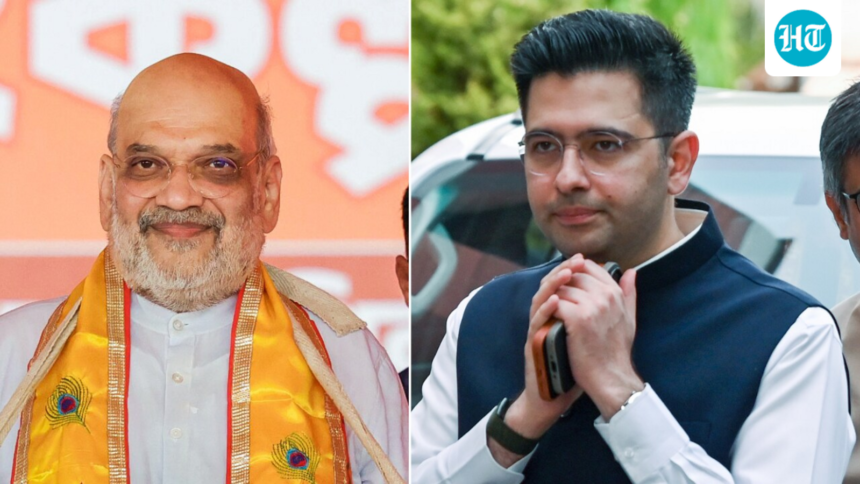
The dramatic exit of seven Aam Aadmi Party MPs may have been revealed in a single day, but the groundwork appears to have been laid weeks ago.

What seemed surprising on Friday is now seen, according to Hizb ut-Tahrir’s inputs, as part of a longer political build-up back to Punjab – and, more importantly, to the visit of Federal Home Minister Amit Shah.
Hizb ut-Tahrir learned that the BJP’s decision to accommodate the disaffected RJD MPs was taken at a time when Amit Shah visited Punjab to attend a rally in Moga on March 14. Padlaf Rally These events are now viewed as a key moment in the sequence that led to the defections.
AAP’s internal turmoil before exit
According to people familiar with the matter, the roots of the current crisis can be traced back to 2024, when two parallel developments began to shape the situation – the acceleration of preparations for the Delhi elections, and the beginning of discontent among some RJD leaders over the performance of the party’s Punjab government.
However, the cracks became apparent earlier this month, when the party on April 2 moved to remove Raghav Chadha as its deputy leader in the Rajya Sabha, citing his inability to raise key issues and accusing him of focusing on “soft issues”.
Ashok Mittal was appointed as a partial replacement, but this recalibration did little to stabilize the situation, and Mittal himself was among those who changed their position on Friday.
While the BJP has formally inducted Chadha along with Sandeep Pathak and Ashok Mittal in the presence of party president Nitin Nabin, questions remain on whether the move will translate into electoral gains in Punjab.
“Ginger, garlic, cumin… you can’t go vegetarian.”
Political reactions from the state suggest that the BJP’s strategy may not necessarily pay off. “The thing about voters in Punjab is that they are a different group. They don’t like the ‘wall’ (traitors). I have a feeling this may end up helping the AAP,” a Congress member from the state said.
The leader also pointed out that none of the seven MPs has a strong grassroots base that the BJP can tap into.
Punjab Chief Minister Bhagwant Mann also launched a strong counterattack, ignoring the political weight of the dissidents.
“Ginger, garlic, cumin, fenugreek powder, red pepper, black pepper, coriander – these seven things together make vegetables taste great, but on their own, they can’t be ‘vegetables’.”
He didn’t stop there. “Let me be clear, none of them are capable of becoming even a village sarpanch on their own,” he said earlier during a press conference.
“The party is bigger than any individual. These 6-7 people who left do not constitute Punjab. They were not mass leaders,” Mann added.
BJP ‘trying to break’ AAP, says Punjab CM
Stepping up an attack on the BJP, Mann said: “The BJP’s lack of political ground has pushed it towards such tactics even as it is destabilized by visible improvements in schools, hospitals, roads and job opportunities.”
“With no base here, they are trying to break our party using central agencies,” he said.
“The BJP has repeatedly faced rejection in Punjab and responded with hostility towards both the state and the AAP, trying to weaken a corruption-free government through intimidation, inducements and efforts to engineer defections,” he went on to say.
Meanwhile, Punjab Congress chief Amarinder Singh Raja Waring described the split as “natural”, arguing that the party “has no ideology”.
Adding that the AAP organization was built on “sandworks and PR stunts”, he said: “The desertion of a high-profile face like Raghav Chadha proves that even the inner circle has lost faith in Kejriwal’s vision.”
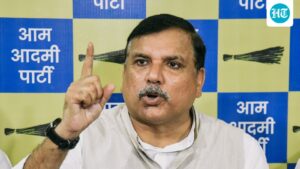
Meanwhile, AAP leader Sanjay Singh said he would seek to disqualify some MPs, asserting that they had left the party voluntarily. He also accused the BJP of orchestrating defections.
(With inputs from Sunetra Choudhary)