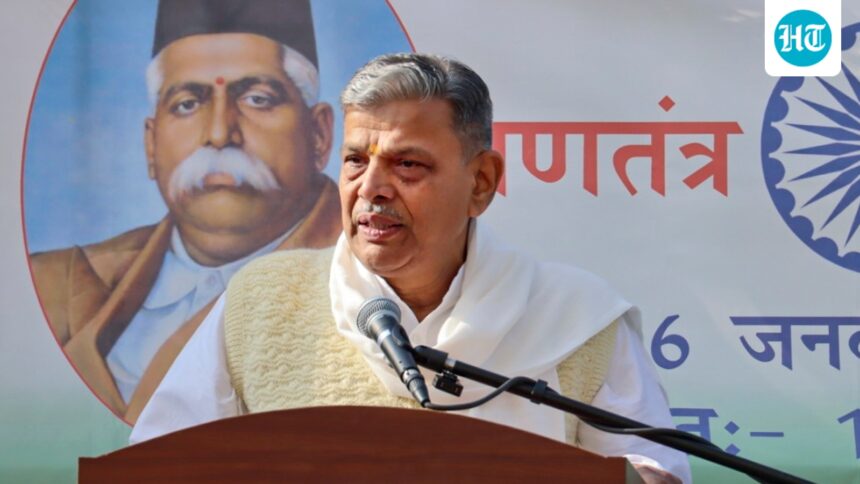
RSS Secretary General Dattatreya Hosabale on Thursday (local time) outlined India’s civilizational vision and its global role while addressing a community reception organized by the Greater Metropolitan Indian American Community in the Washington DC metro area.

The event, themed “India’s Global Vision and Role in the Emerging World: Civilizational Foundations for Prosperity Together,” brought together scholars and community leaders, including Walter K. Anderson (author and former MFA) and Walter Russell Mead (Hudson Institute).
Addressing the reception, Hosabale said: “It is wonderful to be here among all of you, and thanks go to the Hudson Institute and also to the organizers of this encounter. It is a special honor to be seated between these two great friends of India, and those who have tried to understand the RSS and the RSS movement and its contribution. Indeed, it is a pleasure for me to address this wonderful audience and to interact with them as well.”
He acknowledged Anderson’s work in explaining the organisation’s role, saying: “I thank Dr Anderson for his understanding of the organization and its contribution, as well as introducing the organization to a large section outside the RSS world. What he has said is very welcome.”
He explained the structure of organizations associated with the RSS, “In the RSS organizational network diagram, all the organizations he mentioned or even at the introduction level, he said are not wings or controlled by the RSS per se. They are all activities, organizations and forums inspired by the RSS. It is in a way that we can say that the vision of the RSS in action, the philosophy of the RSS is applied in those areas.”
He explained, “They started the Swayamsevaks, the RSS volunteers, and they started these activities in the form of organizations in various spheres of national life, which Dr. Anderson mentioned. They also attracted people inclined to work in those fields. That is why all the members of those organizations may not be from RSS background, but they accepted the views and philosophy of those organizations. There is no doubt that every one of them was inspired by the RSS’s philosophy and methodology. of the organization.”
Regarding coordination between these organizations, he said: “There is family coordination with these organizations. They are independent, their policies are independent, their work is independent, and each of them has its own constitutions, rules, and regulations that it follows and sets.”
Reflecting on contemporary global challenges, Hosabale cited what he described as the modern-day paradox, saying: “We have taller buildings but shorter moods, wider highways but narrower views. We spend more, but have less. We have bigger homes, but smaller families, more amenities, but less time. We have more degrees, but less sense, more knowledge, but less judgement, more experts, but more problems, more medicines, but less wellness.”
He continued: “We have multiplied our possessions, but diminished our values. We have learned how to make a living, but not a life. We have come all the way to the moon and back, but have trouble crossing the street to meet the new neighbor. We have conquered outer space, but not inner space. We want to clean the air, but pollute our souls. We have split the atom, but not our prejudices. We have higher incomes, but lower morals. We have grown long on quantity, but short on quality.”
Drawing on India’s historical experience, he highlighted examples of coexistence, noting that “not a single Parsi has ever said that they were mistreated or persecuted because of their small minority. Not only that, they did not even demand minority rights when the Constitution was drafted. His Holiness the Dalai Lama, his followers, disciples and Tibetans have sought refuge in India for decades. The Tibetans have been given land, and they live in India. They have lived in India in peace, honor and respect.”
Emphasizing India’s global outlook, he said, “When India says the world is one family, it says so with some experience and some practice. Wherever Indians have gone, they have contributed to that land. They have contributed to nation building in that country. They have mingled with the host society. Indians, because of their cultural civilizational values, have lived in peace and contributed to the well-being of that nation. That is why these visions of India are not shallow words or emotional outbursts, but are being practiced.”
Calling for India’s rise in the global order, Hosabale said, “India must be a self-confident and prosperous society with a united and harmonious people. India’s rise to this global calling is essential, so the RSS unit in India is engaged in this activity which Dr. Walter Anderson explained.”
He added: “To make India a self-confident and prosperous society that accepts modernity rooted in the cultural spirit and civilizational values. Therefore, India can play this role prominently, with continuous efforts and in cooperation with other countries, societies and civilizations.”
Concluding his forward-looking speech, he said, “I hope that the time will come soon when India is eminently capable of playing this role, and the world is looking towards India on many issues. In particular, family values, health, based on yoga and pranayama, and on many other fronts, India can play this historic role through this vision of the unity of humanity and the world as one family.”
The event was supported by a wide range of diaspora and community organizations, including the American Hindu Alliance, American Hindu Alliance for Engagement and Dialogue (AHEAD), Indo-Israel Alliance, Indian American Community (IAC), Indian American Diaspora Association (IADA), Friends of the BJP Abroad, Rajdhani Mandir of Virginia, Sikhs of America, United Hindu Jain Temples (UHJT), SV Lotus Temple, and Vishwa Hindu Parishad Americas. (VHPA), the US-Indian Security Council, and Samskrita Bharati, reflecting the broad participation of the Indian community in the United States.