

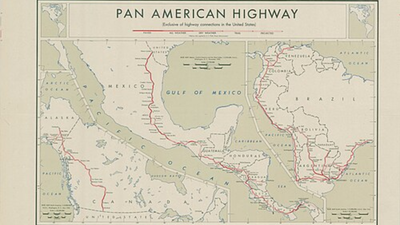
Consider embarking on a trip where you rarely have to make U-turns or return the same route. Rather, the road continues to stretch before you from one continent to another, through mountain ranges, rainforests, deserts and cities.
This road already exists, known as the Pan-American Highway, which many would argue is the longest highway in the world. Stretching 30,000 kilometers and connecting 14 countries along its route, the Pan American Highway is not just a road, but also a bridge and an adventure.
Inter-American Highway: The longest road in the world
Guinness World Records recognizes the Pan American Highway as the longest continuous motorable road system on Earth, connecting Prudhoe Bay in Alaska to Ushuaia in Argentina.
This highway extends approximately 30,000 kilometers (about 19,000 miles), connecting North, Central, and South America into one large-scale system.The Pan American Highway passes through more than 14 countries, including Canada, the United States, Mexico, Guatemala, Honduras, Costa Rica, Panama, Colombia, Peru, Chile and Argentina, among others.The concept of the highway originated in 1923 when leaders of the countries involved planned to build a road network that would promote communication, trade, and tourism in the Americas.
It should be noted that, despite its name, the Pan American Highway is not a single road but rather a combination of several highways built in different countries.
Why is it known as a “no-turn” road?
What makes this particular road so interesting is the well-known myth that one can drive all the way without having to make a U-turn anywhere along the way. Although such a statement cannot be considered a real traffic regulation, it emphasizes the continuous nature of forward progress on this road.From the point of view of reality, the road is built in such a way that travelers do not need to change the direction of their travel. This is why one can speak of a “road without turning.” The only exception to this pattern is the Darien Gap, which separates Panama from… Colombia. There are no roads in this rainforest area, and travelers have to cross them either on foot or in some other way.However, this route is the closest we can get to a single route between the continents.
Journey through Diverse landscapes And cultures
The appeal of the Pan-American Highway lies not only in its length, but in its diversity. From the icy tundra of Alaska, travelers pass through the tropical forests of Central America, cross the Andes, and finally pass through the desert regions of Chile. This makes the Pan American Highway one of the most interesting roads connecting these diverse geographical locations on Earth. As the Encyclopedia Britannica notes, this geographical diversity of regions, each with very different climates, ecosystems and cultures, provides a unique opportunity for people to experience the richness of the entire planet during a single trip.It also represents an act of international cooperation, as the signing of the Pan-American Highway Agreement in 1937 meant the construction and maintenance of this road across different continents by many countries.For many people around the world, covering a small portion of the overall route is a life goal.Thus, apart from being the longest road in the world, the Pan American Highway is an outstanding example of successful cooperation between geographically and culturally diverse countries. This amazing road can also be described as a “no U-turn” wonder.