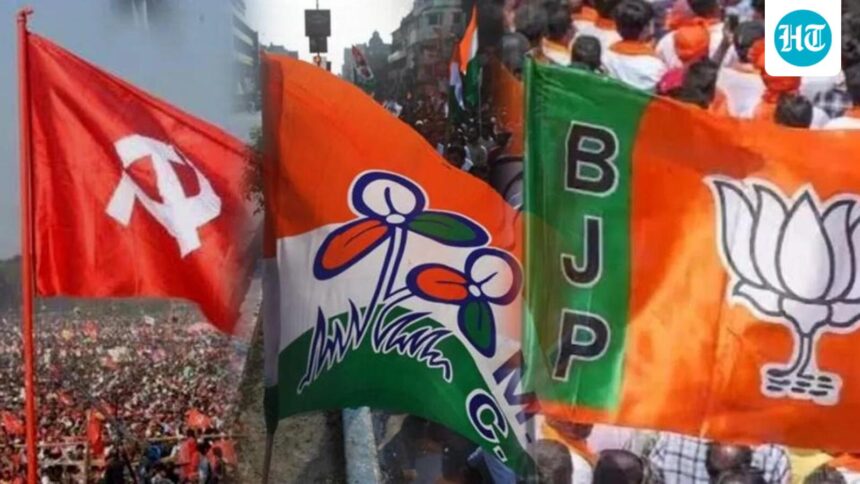
West Bengal is a unique state in India in that it is often underappreciated. Political power has changed hands only once in the state since 1977. This happened in 2011, when the Mamata Banerjee-led Trinamool Congress ended the 34-year rule of the Communist Party of India (Marxist) led Left Front in the state. The state’s CPI(M) has atrophied for all practical purposes. It could not win even a constituency in the state in the 2019 Lok Sabha elections, 2021 Assembly elections and 2024 Lok Sabha elections. The Bharatiya Janata Party (BJP) was the main opposition party in all these elections. Its best performance was in the 2019 Lok Sabha elections when it was just three percentage points behind the TMC in terms of vote share and just four seats behind in terms of number of parliamentary constituencies. The competition was more in favor of TMC in 2021 and 2024.

West Bengal will finish polling next week. Which way will he vote this time? Making predictions is stupid. We’ll know the answer on May 4th. This column will attempt to place the current elections within the broader historical context of West Bengal politics.
Two factors dominate the narrative of this election in West Bengal: the disproportionate delisting of voters in Muslim-dominated areas and constituencies and unprecedented “purification” measures implemented by bringing in central forces, a massive reshuffling of the state bureaucracy and an unheard-of security protocol including restrictions like people not riding motorcycles. The Election Commission of India (ECI), not the Bharatiya Janata Party (BJP), is implementing these measures.
Let us step aside for a moment from the debate on the alleged bias of the IHC, not to exonerate it, but to keep in mind the historical fact that elections in West Bengal have long been a violent affair. The 1972 election was perhaps the most controversial in the state. The Communist Party of India (Maoist) succeeded in winning the 1977 elections as an opposition party under very difficult circumstances. The TMC ousted the Communist Party of India (Maoist) amid widespread electoral and non-electoral violence that began with the 2006 agitation against land acquisition in Singur and later in Nandigram. The BJP has also developed as a strong political force in the state despite facing widespread electoral violence, especially the local body polls in 2018 and 2023. It is politically incorrect to say this, but no political party can hope to find a foothold in West Bengal, let alone win it, without the ability to confront political violence and counter-violence. This has been the DNA of state policy for more than half a century now.
It is no coincidence that the BJP’s main leader in the state, Suvendu Adhikari, is the proverbial Bengali Nelson of the Battle of Trafalgar, with an exotic twist. He led the TMC to victory and dominant position in the state after the Nandigram battle where he completely defeated the CPI(M). However, Adhikari did not die like the British Admiral and started demanding a share of power from Mamata Banerjee, which she was not ready to offer.
It goes without saying that the ruling party in the state will have an advantage on this front over the opposition party. However, this aberration in West Bengal politics should not fool one into believing that political rivalry is just muscle and there is no popular will or political strength for violence. West Bengal is too big a state for the tail of violence to wag the dog of politics.
The rise of communists in the country was an ideological triumph backed by political violence, carried out primarily by radicalized peasants and the poor. What began as a movement for tibhaga – literally meaning for the peasant to retain two-thirds of the produce rather than sharing it equally with the landowner – around independence was sanctified under the Parga process by securing tenancy rights when Jyoti Basu took over as chief minister of the state in 1977.
Once in power, having delivered on their key promise of land reform, the communists had the unenviable task of constructing the status quo within what the political scientist Dwipayan Bhattacharya described as the party society of West Bengal. His book Government as Practice: The Democratic Left in a Transforming India is a must-read for anyone who wants to understand current politics in the state. The quest facing the communists after 1977 necessarily entails depoliticization and decadence within their ranks. Critical left intellectuals, such as the late Ashok Mitra, had pointed this out long before the CPI(M) suffered electoral setbacks in the state.
What really catalyzed the downfall of the country’s communists was not ideological decline, but rather the leftist government’s high-risk strategy of land acquisition to promote industrialization (and improve collective welfare). The precipitation triggered by Singur and Nandigram, unlike previous agitations in the state, ended even the perceived political legitimacy of the CPI (Maoist) and created a shock that completely destroyed it as a political force to reckon with.
To be fair to the communists, the ideological impasse that forced them down the high-risk path of land acquisition – or more specifically the failure to bring about structural transformation in a country that was economically stagnant despite its agricultural outperformance – is not easy. Even states that have done much better than West Bengal in meeting this challenge recognize that they have done little to generate gainful employment on a large scale.
In hindsight, the now marginalized comrades on Alamuddin Street – the headquarters of the West Bengal CPI(M) that once served as the center of power in the state – will curse themselves for not adopting the freebie route of managing political aspirations. This is what their killer Mamata Banerjee, or their Kerala comrade Pinarayi Vijayan, succeeded in doing. Almost all the country’s prime ministers are now following the same scenario, and there is good reason to believe that voters give much more importance to the money that comes into their bank accounts rather than the state’s investment account.
The question of greater economic transformation in West Bengal, and much of India, has been resolved politically through the back-end work of distributing palliatives rather than the capitalist or communist vanguard of accelerating private accumulation or eliminating private property. The material basis of Mamata Banerjee’s popularity is not much different from what it is for most prime ministers in the country today. All conspiracy theorists would do well to appreciate this basic fact.
However, the euphemistic path to power is not the only political economic feature of West Bengal. What sets it apart from most of the larger states in India is the institutional bullying in how popular politics works in West Bengal. While this greatest vice in the state was preserved despite the communists’ loss of power, the TMC modified it and turned it into an ideology-neutral, even opportunistic, institution to resemble what Dwipayan Bhattacharya described as the politics of privilege model in a 2023 paper in the Economic and Political Weekly. This involves a political practice whereby local party leaders (i.e. strongmen) preside over a fiefdom steeped in economic power. A brutal but not necessarily religiously hostile rent-seeker in exchange for providing boots on the ground for the TMC. This debate plays into the larger political arbitrage of Mamata Banerjee’s provision of subsidies and to some extent regional exclusion of the Bengali elite against what is portrayed as a rabid non-Bengali national hegemon (read BJP).
The unprecedented security environment surrounding the 2026 elections is clearly an all-out attempt by ECI to curtail the privileges of local franchisees of the TMC. While it could temporarily constrain these elements, it would be wrong to assume that the junta’s electoral support is merely fraudulent and there is nothing organic. Of course, the net effect in terms of electoral outcomes can be significant in closely contested places. However, the fact that the TMC’s dominance in local body polls (many of these seats are won ‘unopposed’) was much greater than in Assembly polls or Lok Sabha elections – the former being more loosely supervised than the latter – suggests that competition is ‘fairer’ in state and national elections anyway.
The final piece of the political puzzle in West Bengal is the Muslim vote in the state. It is closer to 30% of the electorate in the state, and is now overwhelmingly united behind the TMC. Thanks to Muslims losing their party character in the state system with the rise of the Bharatiya Janata Party, it was clear that there was significant sectarian polarization in the state. Basic calculations on the headline vote share numbers suggest that the BJP actually leads the TMC in the Hindu electorate. The BJP’s roughly 40% vote share in a state where Hindus make up about 70% of the population entails a 57% vote share among Hindus, if we assume Muslims do not vote for the BJP. While the BJP may see this as a sign of impending victory, it could also be seen as a sign that it has reached its peak in terms of political support. For example, the BJP’s share of the vote in Gujarat, a state that is about 90% Hindu, is about 50%, which suggests that the vote share among Hindus is about 55%.
That the SIR exercise in West Bengal involved a unique adjudication portion which, unlike the usual SIR process, resulted in disproportionately large deletions in Muslim-dominated parts of the state, has given credence to opposition claims of pro-BJP voter manipulation in West Bengal. However, as long as the TMC does not suffer from significant attrition of Hindu voters, which is exactly what it faced in the 2019 elections, and has since recovered thanks to economic palliatives, it would be premature to assume that something like this will necessarily happen this time.
The TMC’s victory in West Bengal will be portrayed as an ideological-political victory over the BJP and its alleged institutional excesses. If the BJP wins, it will attribute it to the fact that the election was fair thanks to India’s India Corporation.
The actual political fault line in West Bengal, when viewed historically, is different and less amenable to convenient or utopian political explanations. It is a country that uses economic palliatives to ease economic concerns, and has moved from a dogmatically empty party society to a political model that is ideologically bankrupt and staring at a religious fault line that has perhaps never been deeper after independence. The first undermines long-term economic interests, the second makes politics a stranglehold on society, especially its weakest sections, and the third is a time bomb, which if exploded could lead to unprecedented disruption and damage to the social fabric of one of India’s largest states.
The ongoing rhetoric between the TMC and the BJP in the state, which makes the elections look like a do-gooder ideological contest between regional exceptionalism/pluralism versus good governance without acknowledging the fundamental problems plaguing the state’s politics, is best described using a Bengali phrase learned by this (non-Bengali) author from a comment made by Ashok Mitra in the face of the CPI(M)’s unsuccessful ideological gymnastics in the Singur and Nandigram debate. Chak diy makh dhaka gaye na (You can’t hide fish by putting spinach on it).
(Roshan Kishore, data and political economy editor at HT, writes a weekly column on the state of the country’s economy and its political implications, and vice versa)