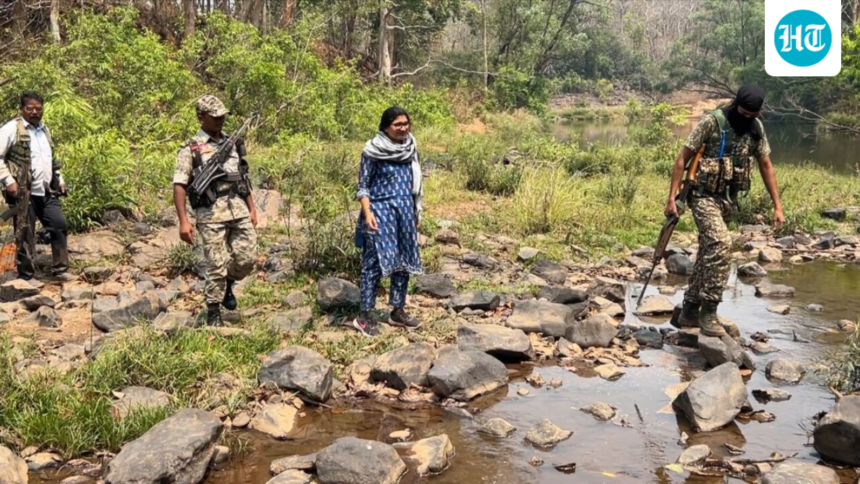
One day last week, Narayanpur district collector Namrata Jain hopped on the back of a motorcycle and rode through a dense forest, navigating narrow forest paths and, at times, no paths at all, and traveling to villages not yet visible on the map.

Narayanpur, Chhattisgarh, is one of the three districts (Bijapur and Dantewada are the other two) covered by one of India’s harshest forests, the Abujamad, which translates as the unknown hills of Gondi. The large forest, with an area of 5,000 square kilometers, was unknown until now.
Jane and her team are part of a mapping team for the area. They traveled by bicycle, sometimes by tractor, and often on foot, crossing streams under the hot summer sun to reach villages that had hitherto only existed in oral histories. This is an unprecedented operation – surveying and mapping an area that has remained outside the state’s administrative control since independence. The villages and their residents were isolated not only by geography, but also by the five-decade-long Maoist insurgency. For most residents, this represents their first direct interaction with the government.
Read also | Twin daughters, wife and 6-year-old son murdered in next room: horrifying details of Kanpur murder case
Throughout the three districts, the government began surveying and mapping Abu Jhamad as Maoist armies were no longer present in this dense jungle, which served as the central guerrilla base of the CPI (Maoist).
Jain, who hails from Bastar, said she was not prepared for what the teams faced. “We heard about these villages only through word of mouth. We also found new villages in this exercise. This is the first time that villages have been mapped and surveyed. We are reaching out to people to connect them with government programmes,” she said, adding that the exercise is being implemented with the support of IIT Roorkee, following the MoU signed in January.
In Abu Jahmad, administrative records were scattered and access to them was limited. Spread across the Maoist hotspots of Narayanpur, Bijapur and Dantewada, the difficult terrain of dense sal, teak and tandu forests, the absence of roads, and Maoist omniscience, place indigenous communities – the Gond, Moria, Abujmarhia, Madia and Halba tribes – at the mercy of the insurgents and beyond the reach of the state. For many years, this isolation allowed the Maoists to maintain firm control; They created a parallel system of governance, known locally as ‘Jantana Sarkar’.
Explaining the kind of control exercised by the Maoists over Abu Jhamad, Rupesh alias T Vasudeva Rao, a surrendered central committee member of the Communist Party of India (Maoist), described the forest as a liberated area where no government teams dared to come.
“Central Committee meetings were always held in Maad (Abu Jahmad). It was our safest place where all the leaders could meet and hold conferences for days without worrying about security forces. You might see it as a forest with no roads for cars or electricity, but for us it was our headquarters. We had access to everything. We even had computers and printers running on generator sets. During the conference, we would print out our magazines or meeting minutes.”
This sense of total control began to erode in late 2024, when security forces were first able to penetrate the forest — a development that officials described as a turning point in the fight against the Maoists. Maoist leader Nampala Keshava Rao also known as Basavaraju, who was wanted for more than five decades, was also tracked down in the Abu Jumad forest last year by security forces and killed in a gun battle.
Bastar District Inspector General P Sundaraj said the entry of troops into Abu Jumaad and the gradual establishment of the camps dealt a psychological blow to the Maoists. “I have sent a message to the Naxals that they are no longer in control of their military base. There is no Maoist army there now. Forest department and other government teams are entering the area and mapping it.”
While mapping is underway in all three districts, Narayanpur represents the largest area of forest. The administration here has so far mapped 412 villages, of which 377 are inhabited. “We are meeting people with distinct traditions that have remained unseen all these years,” Jain said. “Local people are helping us and sharing information about the villagers inside. Three days ago, in a remote village, Alpida, where our teams arrived after crossing a stream and trekking through the hills, the villagers wore their traditional clothes and headdresses made of flowers, which they wear only for special occasions. In another village, we saw villagers storing their food grains outside and worshiping them. “His type.”
“The villages within the village are sparsely populated. In some villages there are only five or six families. These villages can be between five and 70 kilometers from the district headquarters. We are building roads to connect them. Our teams are preparing identity cards to make people eligible for social welfare schemes.”
The work has finally begun. Survey teams are spread throughout the forest. As a nationwide census is conducted, Abu Jahmad villages must be found, identified and entered into official records.
For decades these people existed as blank spaces in government records. As teams now move from one remote village to another, the blanks begin to be filled.