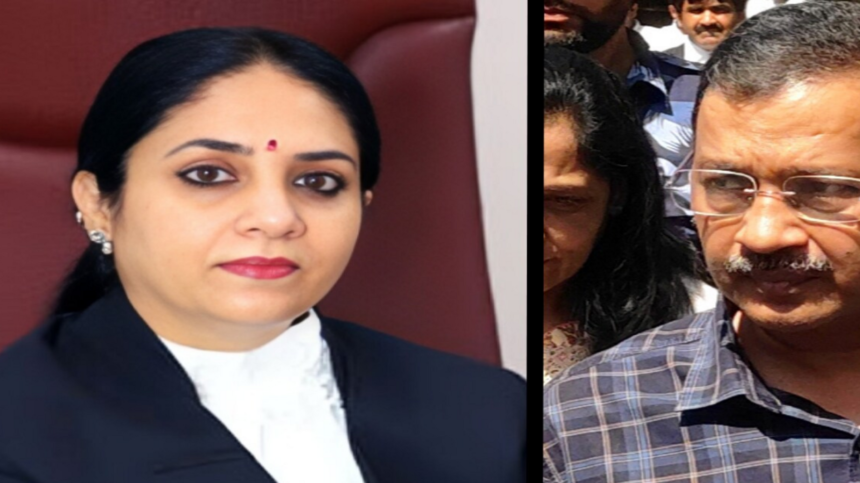
In one of the most bizarre legal dramas in India’s recent political history, Arvind Kejriwal, the Aam Aadmi Party leader, pleaded his case in the Delhi High Court last week – not the excise policy issue that has dogged him for years, but his petition asking the judge hearing the case to step aside.

At 4:30 pm on Monday, Justice Suwarana Kanta Sharma is scheduled to deliver her ruling on whether she should recuse herself from the case.
So who is Justice Swarana Kanta Sharma, and how did she become the center of one of India’s most fraught legal controversies?
From Daulat Ram College to Delhi High Court
Justice Sharma’s career began at an early age, according to details on the Delhi High Court website. She graduated in English Literature from Daulat Ram College, University of Delhi, where she was selected as the Student of the Year of the Year, and obtained an LLB in 1991 and an LLM in 2004.
In 2025, she also obtained a PhD for a thesis examining judicial education in the UK, USA, Singapore and Canada. She also holds a diploma in Marketing, Advertising and Public Relations Management. HC website says. She became a judge at the age of 24 and a sessions judge 11 years later, on the day she turned 35.
In her judicial career spanning over three decades in the District Courts of Delhi, she has presided over a wide range of courts: Family Court, Motor Accident Claims Tribunal, Mahila Court, Special Court for Sexual Offenses against Women, and as a Special Judge.
She was elevated to the post of permanent judge of the Delhi High Court on 28 March 2022, and it is in this capacity that the current controversy arose.
She is also the author of five books, ranging from Guidelines for Women During a Breakup, to Imagination and judicial education.
Orders that sparked disagreement
The recent controversy arose when Justice Sharma presided over cases linked to an alleged scam in… Delhi Excise Policy (Liquor Sales). Initially, the bail petitions filed by Kejriwal, fellow AAP leaders Manish Sisodia, Sanjay Singh and Telangana politician K Kavitha were rejected, as the CBI and Enforcement Directorate built a case.
When a lower court released Kejriwal and 22 other defendants on February 27 this year – concluding that the CBI materials did not constitute a meritorious case – the CBI appealed the order to the Supreme Court.
Justice Sharma, in the first hearing of the CBI petition on March 9, stayed the trial court’s directions on departmental action against the investigating officer of the CBI, terming some of the trial court’s observations as “prima facie erroneous”.
Kejriwal later argued in her court that this order had been passed, after listening to the CBI for just five minutes and without hearing its side even once.
Kejriwal’s arguments about the RSS, and her children working in the government
Kejriwal moved to transfer the case on March 11. When that was denied two days later, he, Sisodia and four others filed disqualification petitions specifically with the judge.
Kejriwal, who worked as a government tax officer and social activist before entering politics in 2012, appeared in court to defend himself.
His arguments listed several reasons why the judge should step down. First, he said the lower court’s order — reached after reviewing 40,000 documents — was effectively overturned in five minutes. Second, he cited the Supreme Court’s ruling in Ranjit Thakur v. Union of India, arguing that actual bias does not need to be proven: a reasonable apprehension of bias is in itself sufficient grounds for recusal.
Third, and most politically charged, Kejriwal noted that Justice Sharma attended four events organized by the Akhil Bharatiya Adhivakta Parishad, a body of lawyers affiliated with the RSS, the ideological parent of the Bharatiya Janata Party, the AAP’s main political rival and the ruling party at the Centre.
He told the court directly: “This case is political.”
When Justice Sharma asked her if he thought she followed this ideology, Kejriwal turned the question back to her: “Do you follow it?” She said she just wanted his claims to be properly recorded.
Fourth, in an additional affidavit, Kejriwal alleged a conflict of interest, because Justice Sharma’s son was appointed as a Group A counsel representing the Center before the Supreme Court, while her daughter was appointed as a Group C counsel and also appeared as an advocate for the Center before the Delhi High Court. He pointed out that both of them were assigned to work by Solicitor General Tushar Mehta, who is arguing the CBI case before Justice Sharma.
Central Bank of Iraq counter
The CBI strongly opposed this petition and Solicitor General Mehta called it a “dangerous precedent”. He said judges routinely handle bar association events regardless of political affiliations.
Regarding her children being government-certified lawyers, the agency said they have not handled or assisted in the tax case in any capacity, and are independent practitioners not associated with any senior lawyer.
Justice Sharma reserved her order last week, accepted Kejriwal’s additional statement, and has now scheduled sentencing at 4.30pm on Monday, after recording some additional documents.