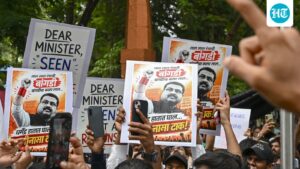
Communist Party of India (CPI) MP P Sandosh Kumar on Sunday alleged that Prime Minister Narendra Modi’s televised address to the nation a day ago violated the Model Code of Conduct (MCC) currently in place in five districts.

In a letter to the Chief Election Commissioner (CEC) on Sunday, seen by HT, Kumar argued that the speech – which was broadcast on Doordarshan TV and Sansad channel on Saturday evening – contains partisan assertions and direct attempts to influence public opinion while West Bengal, Assam, Tamil Nadu, Puducherry and Kerala are in the middle of elections, with the MCC continuing its work till May 6.
In his speech, PM Modi named members of the Congress, Dravida Munnetra Kazhagam (DMK), Trinamool Congress (TMC) and Samajwadi Party (SP), accusing them of committing what he called “feticide” of the Women’s Reservation Bill after its defeat in Parliament.
The MP said using the state-funded national broadcaster to transmit what was in effect political speech gave the ruling party an asymmetric advantage that the MCC was designed to prevent.
“Using state resources and publicly funded platforms to spread what is essentially political speech constitutes a serious violation of electoral norms,” Kumar said in the letter.
Congress leader Anil Akkara, who filed a separate complaint on the same day, alleged that the Prime Minister abused his official position by naming rival political parties in election-related states during the speech and termed it a “gross violation of election protocols”.
“In absolute terms, I am of the opinion that the Opposition should have been given equal time on all official media channels to express their concerns and views, in view of the ongoing elections. But the MCC in its current form allows anything that is not specifically targeted at poll-bound states or Union Territories to be done by the Center or other state governments,” the former OP of the CEC said.
The MCC’s special notification dated March 16, when the poll schedule was announced, said that the MCC would make an application to the Central government regarding political announcements or decisions relating to the poll-bound states and the Union Territory.
Meanwhile, two former central election chiefs gave their assessments on the issue.
Mr. Qureshi, a former member of the Central Election Commission, emphasized that the credibility of the Election Commission depends on its ability to ensure that opposition parties feel truly included and protected in the electoral process. On the issue of access to state media, Qureshi said that “the asymmetric use of state-funded platforms like Doordarshan and other official channels during the election period strikes at the principle of equal opportunity that underpins the MCC. The law explicitly prohibits the use of state media for partisan coverage during elections, but it does not guarantee opposition parties equal airtime on those same platforms to present their positions” – a gap that, in Qureshi’s view, goes to the heart of what equal opportunity should mean in practice. Process.
The European Commission has not yet responded to either complaint.