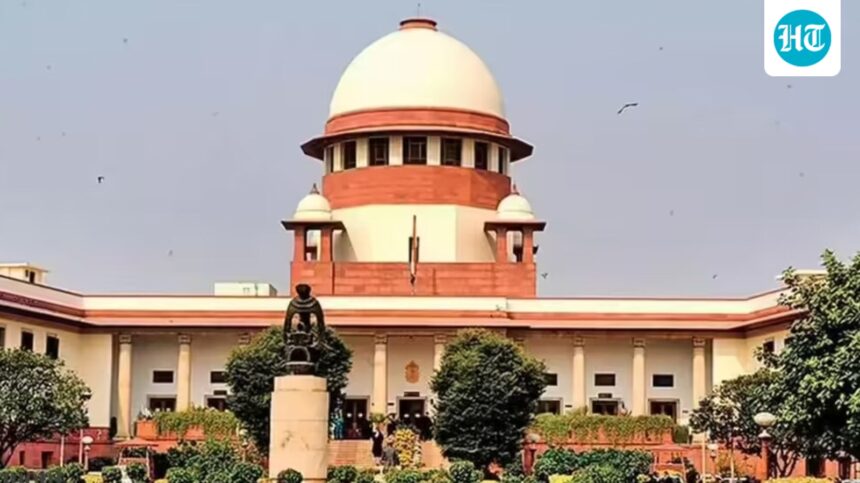
NEW DELHI: Three decades after he was dismissed from service in what the Supreme Court has now deemed an unsustainable exercise of power, a former Indian Air Force officer will finally get the dignity of a formal send-off.

In a rare order, the Supreme Court on Wednesday ordered the septuagenarian to be given a formal ceremonial send-off, declaring that for the soldier, “restoration of honor remains the paramount concern.”
A bench of Justices Dipankar Datta and KV Viswanathan quashed the dismissal of former Squadron Leader R Sood in 1993, holding that the decision-making process was flawed and legally indefensible. “We remand it with a direction that on the date specified by the Chief of Air Staff, the appellant must be signed in the normal manner to which he would have been entitled but for the dismissal order,” the court said.
The court also awarded him significant service benefits, including 50% back wages, presumptive promotion, retirement benefits, and interest on accruals.
Sood was separated from the service on September 22, 1993, under Title 19 of the Air Force Act after being found guilty of misconduct related to a 1987 accident in which a civilian driver was allegedly abandoned at a remote desert location, where his remains were later found.
However, the Supreme Court found that the basis of the disciplinary action itself was deeply flawed. More importantly, Sood had previously been dismissed by a criminal court for lack of evidence, a fact that the court said put him in an even stronger position than the person who was acquitted.
The court seriously took issue with the Air Force authorities’ understanding of the law, stating that discharge meant there was no material to proceed with prosecution and could not justify subsequent punitive administrative action based on the same facts.
It also pointed to glaring discrepancies in the treatment of participating officers. While Sood faced the maximum penalty of dismissal, his commanding officer, who had issued instructions forming part of the same chain of events, was released with the relatively minor penalty of “extreme disfavor.”
The court described this disparity as disturbing and said that the principle of equality had been violated. She stressed that a more severe punishment should not be imposed on a subordinate officer, especially when he acts under the direction of his superior.
The ruling also criticized the lack of sufficient reasons and the failure to consider the relevant circumstances, including the role of senior officers and the legal effect of the release order issued by the Criminal Court.
“In the absence of distinguishing features, the appellant should have been treated equally with (the commanding officer)… The principle of equality would be violated when a subordinate officer is given the harshest punishment for complying with an erroneous order of his superior, while the latter who issued the order gets lenient treatment leading to a reprieve of sorts,” it said, adding that the proceedings had been marred by arbitrariness.
Regardless of the dismissal, the court noted that Sood had already crossed the retirement age and could not be reinstated. However, it held that he was entitled to all consequential benefits as if the dismissal had never occurred.
While it awarded him 50% back pay due to the lack of information on whether he would remain unemployed after dismissal, the court ordered him to pay all financial benefits with 9% interest from the date of filing his lawsuit in the 1990s.
But beyond monetary relief, the Court placed particular emphasis on symbolic justice.
“Regardless of the merits of service, restoration of honor remains the primary concern of defense personnel,” the court said and ordered Sood to formally sign in the manner to which he would otherwise have been entitled.