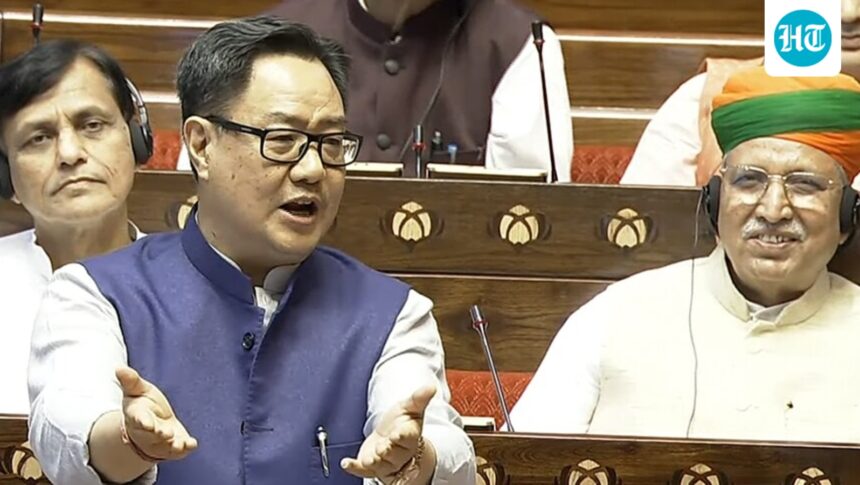
The proportional representation of all states will remain the same even after the government bills increasing the strength of Lok Sabha to 850 members and accelerating reservation for women, Union Parliamentary Affairs Minister Kiren Rijiju said in an interview, adding that this would be clarified in Parliament. Follow live updates on today’s extraordinary parliament session.

Edited excerpts:
The opposition’s complaint is the timing of the bills. It comes in the middle of elections and avoids the ongoing population census.
If we bring it before the Lok Sabha elections, they will say you are bringing it for benefit… If we do not do it now, after five months, there will be another round of elections. Next, you will say that you are doing this for the Uttar Pradesh elections. Every year there are two rounds of elections. How can we disrupt the issue and link it to the state elections? It has nothing to do with it. This is a completely undesirable argument put forward by the opposition. Let us be very clear, women’s conservatism cannot be equated with any kind of political agenda or used for political gain. The bill was approved earlier and is just a case of implementation.
Why don’t we wait another ten days until the elections are over?
Every day is becoming a very big burden and they are talking about 2-3 weeks (of waiting). Other parties have come, what is their problem (Congress, TMC, DMK)? This is not a mathematical problem. If we wanted to, we could have done it before the Assam and Kerala elections.
They also want to know the justification for the 50% mechanical increase in seats?
We have already brought this up while talking to different political parties, be it NDA allies, third parties (neutral) or some members of the INDI alliance, and only the four – Congress, TMC, Aam Aadmi Party and the Left – attended the meeting. All those parties have been informed that the 50% increase is because we must give 33% (seats) to women. Why do we increase seats? India is the only democratic country where each MP represents approximately 25 to 27 lakh people. This is the size of a small country. In the UK, the average number of MPs is 70,000, yet they have 600 MPs in the House of Commons. India has only 543. In 1971, when the last demarcation was carried out, India’s population was less than 60 crore, today, it is more than 140 crore. It is a heavy burden for representatives to represent such a large number.
Why evade the ongoing census?
If we wait, we will not be able to implement it by 2029. It will take nearly three years because of the caste-based population census. You know that there are over 51,000 different castes, and it would take a long time to determine who belongs to which caste. Secondly, in order to identify 543 seats, the committee will turn to drafting. After that, they will go everywhere for a public hearing. Do you think it can be finished in one year?
I have repeatedly said that the proportion of states will be maintained. So why did the percentage of words disappear from the bill?
Proportionately, the representation of states will remain the same. This will be clearly stated when the bill is introduced. The proportionality depends on the population within the state.
The draft says that the demarcation committee will decide the number of seats, according to the 2011 census.
Once Parliament decides that the representation will be proportionate to the existing proportion and the percentage and increase is 50%, it applies to the Lok Sabha and Assembly seats.
The committee will work within this framework set by Parliament… and it will be clearly defined. This will be within the powers of the Boundary Demarcation Committee. I would like to appeal to the opposition parties not to be confused. We made this proposal when we met last time, and it will be the same, and everything will be clarified.
At this moment they have your say.
No, it’s there (in the bill).
There are concerns, once again, about border demarcation, as at present it has become necessary for borders to be demarcated on the basis of the latest population census.
Because the next census will not be ready.
So will going forward be a political decision? It is now a constitutional obligation after every census.
Whatever was decided in 1971, the increase would be 50% of the seats that were specified at that time. In other words, the southern state should be happy and not have any problems because it successfully implemented family planning and not lose its seats… and the relative number of seats remains the same. They are not punished for reducing the population, but rather maintaining it. The percentage of increase and their share in the total seats will remain the same.
You are saying that from now on, whatever the demarcation process, the number of seats will be determined on the basis of 1971.
The 1971 demarcation determined the number of seats for each state, so the percentage of increase… the percentage of their share in the total seats in Parliament, which is what we were seeing.
I said that the southern states are lucky, but the opposition is not ready to accept that. P Chidambaram claims that the current representation of the five southern states is 24.3%; This percentage will decrease to 20.7% after the borders are demarcated.
But this is relative. Representatives in states with larger populations have more people to care for. Someone like Chidambaram should not give false numbers to dilute accounts.
Do you accept that there is something in the wording of the draft law that has created a state of mistrust?
Every MP in India represents at least 26 lakh people… Let’s get down to the math. Karnataka moved from 28 to 42, Tamil Nadu from 39 to 59, Kerala from 20 to 30, Andhra Pradesh from 25 to 38, and Telangana from 17 to 26. The five southern states gained 66 seats, and their collective share in the Lok Sabha now stands at 24% and remains the same. The coalition calculations that determine who will form the government do not change… The relative weight that shapes each legislative outcome remains the same.
Rahul Gandhi insists on OBC reservation and even Akhilesh Yadav said the government is trying to avoid caste census.
We are talking about women’s reservation. As of now, SC and ST reservation are part of the constitutional provisions, but OBC reservation is not; Where does the OBC question come from?
What if opposition parties oppose the bills? Are you confident that it will pass if Congress does not support it?
They will not be able to oppose this, otherwise they will have to live with the black spot of obstruction of reservation. It is not a matter of trust. It’s a matter of commitment. It is a national commitment.