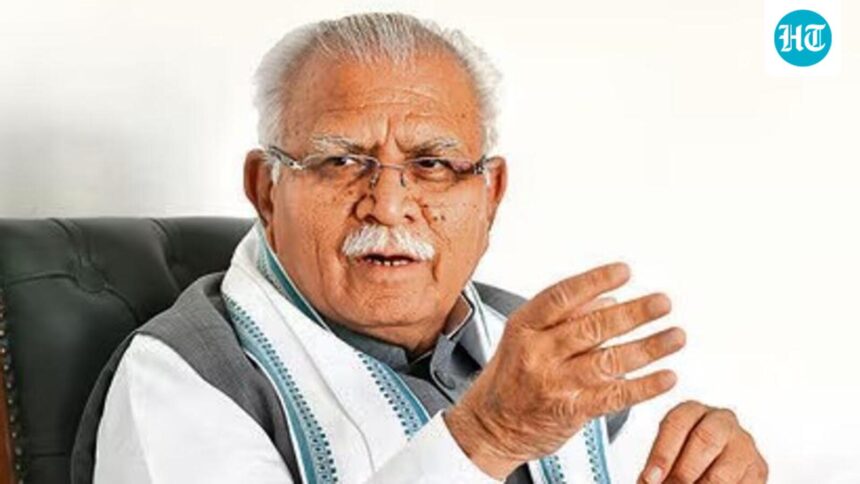
Starting from September, Housing and Urban Affairs Minister Manohar Lal Khattar said on Wednesday that 30% of central funds will be released for cities to implement projects under the government’s scheme. $Urban Challenge Fund (UCF) Lakh Crores.

The scheme announced in last year’s budget focuses on market-based financing, with a total investment of $4 lakh crore in the urban sector from FY 2025-26 to FY 2030-31, extendable by three years. While the Center and the state can finance 25% of the project cost, the remaining amount must be financed through bonds, loans or private participation.
According to the guidelines issued on Wednesday, private sector engagement could also include mobilizing community-led private investments. Neighborhood-level enterprises, resident social welfare associations, and community-based organizations are allowed to mobilize private investment for local urban facilities.
Urban Local Bodies (ULBs) can appoint private entities as “Special Purpose Urban Infrastructure Manager (SPUIM)” for the integrated delivery of housing, civic infrastructure, operations and maintenance in large-scale development.
Read also:Urban Challenge Fund to address challenges arising from rapid urbanization: Vaishnaw
“For the work of SPUIM, ULBs can notify simplified regulations and results-based regulatory frameworks, with clearly defined accountability mechanisms to ensure adherence to service standards, quality standards and implementation timelines,” Khattar said.
The Minister also said that while $Rs 90,000 crore of central funding has been allocated for infrastructure projects, $Rs 5,000 crore will be spent on project preparation costs and on credit guarantee mechanism, as announced earlier, for small and high-rise towns. Union budget allocated $10,000 crores for this purpose.
The UCF will also focus on urban governance reforms with states and union territories being asked to provide basic data on asset registries, land bank inventories, improved revenue collection, better project structuring, integrated planning that aligns land use, mobility, climate resilience, and economic growth with statutory plans, among others.
The minister said states and ULBs have also been asked to prepare proposals and aim to provide in-principle approval within 15 days for a workshop to be held in May, allowing work on detailed project reports (DPRs) to begin in May.
Khattar said that while funds will be allocated to states based on the size of their urban populations, laggards will lose out on funding, with funds being transferred from states with slower implementation to those that are more proactive in implementing their projects. “The earlier you come, the earlier you get (financing). If you are a little late, you will have to bear the delay,” he said.
What projects will be allowed under the UCF?
The guidelines allow for projects within the framework of digital governance, infrastructure expansion, sustainability and liveability improvement. It includes establishing integrated command and control centers, digital twins, digitizing properties and facilities, and mapping using drones to enhance governance and service delivery.
This will also include developing and modernizing key infrastructure, including water and sewerage systems and underground facilities, especially in cities, to reduce congestion.
There is an emphasis on circularity through waste recycling, waste-to-energy systems, and reuse of treated water.
Urban decongestion is addressed through multi-level parking, improved traffic systems, improved last-mile connectivity, transportation-oriented development, and integration of transportation hubs with residential areas.
The plan also aims to revitalize the old city’s areas and markets through redevelopment, improving public spaces, preserving heritage, and rehabilitating slums.
Read also: Small cities are first movers to access the Urban Challenge Fund
The scheme also allows for non-motorized transit through pedestrians, cycling networks, and safe school zones, along with transit-oriented development to create dense, accessible and walkable urban clusters.
Flood prevention measures through drainage and sponge infrastructure, integrated waste treatment, and urban development in emerging areas in emerging clusters such as airports and technology parks are also permitted.
Additional priorities include developing roads and bridges, riverfront projects, and supporting reforms, such as land banking systems and relocating polluting activities, such as dairies, within cities.
For major cities with populations of more than two million, secondary priorities extend to building convention centers, entertainment spaces, libraries, and sports infrastructure.