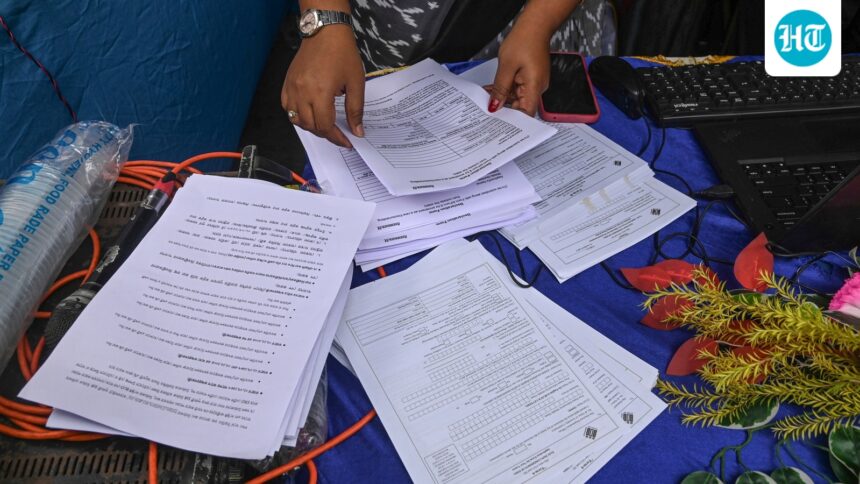
The Supreme Court on Monday said it cannot allow individuals whose appeals against their exclusion from electoral rolls are pending to vote in the upcoming West Bengal elections, warning that any such trend would create an anomalous situation and disrupt the integrity of the electoral process.

Hearing a batch of petitions challenging the special intensified review of electoral rolls, a bench of Chief Justice of India Surya Kant and Justice Joymalia Bagchi held that granting voting rights to those whose eligibility remains pending would lead to untenable consequences.
Read also: Arson, stone pelting in Noida as protests over wage hike turn violent
“What is the issue of allowing them to vote? If we allow it, then let us stop the voting rights of the then listed persons,” the bench commented, rejecting a suggestion moved by senior advocate Kalyan Bandopadhyay, who represented some of the petitioners in the case.
Urging the court to intervene, he said the people of West Bengal were looking to the Supreme Court for relief. Bandopadhyay asserted that the impression had been created that all claims had been adjudicated, when in reality “all voters are subject to adjudication” after the electoral list was published on April 6, underscoring the uncertainty faced by those excluded. He asked, “Are there 34,000 (3.4 million) people who are not real voters? They are real voters.”
Read also: Pressure to introduce women’s quota in line with opposition demands: PM Modi
But the bench noted that once the appeal is decided, registration officials can amend the lists immediately, allowing those people to vote.
It also noted the sheer scale of the ongoing process, recording that more than 34,000 appeals (3.4 million) have already been lodged before the Courts of Appeal by individuals challenging their exclusion. While the court made it clear that those whose appeals are allowed, even shortly after the deadline, will be included in the lists, the bench said it could not extend this reasoning to those whose claims have not yet been decided.
Also read: ‘2 hours 45 minutes drive’: Commuters bear brunt as Noida protest hits traffic
“We cannot create a situation in which we burden the judges of the Court of Appeal,” the bench observed, adding that judicial intervention at this stage should not derail the legal process already underway.
The bench took note of the “herculean” nature of the SIR exercise, and recorded that judicial officials disposed of over 60.04 lakh (six million) claims and objections, with only a small portion – about 1,800, pending due to technical issues. The Courts of Appeal, comprising former Chief Justices and senior judges of the Supreme Court, officially began functioning from April 13 with standard operating procedures in place.
Expressing confidence in the process, the court said it had “no reason to doubt” that the two courts would complete the task within a reasonable time frame and ensure due process.
Read also: Brigadier’s son assaulted in Delhi for opposing drinking outside their home
The hearing also covered the ongoing court proceedings suo motu in relation to the April 1 incident in Malda district, where seven judicial officers, who were participating in the SIR exercise, were held hostage for hours by protesters.
Taking into account the status report submitted by the National Investigation Agency (NIA), the Council noted that the investigation should not remain a mere formality. “We want to know whether any of these arrested persons has any political background. We do not want this to be an academic exercise. This matter must reach a logical conclusion,” the court said.
The court reiterated its earlier concern about the incident, which prompted it to take suo motu cognizance on April 2, when it described the incident as a “calculated” attempt to intimidate judicial officials and undermine the authority of the judiciary.
On his part, senior advocate Siddharth Luthra, representing the state Director General of Police and Chief Secretary, assured the bench of their full support to the NIA and the Chief Justice of the Calcutta High Court.
In its order issued on Monday, the court ordered that the guarantee provided to judicial employees must continue without interruption. He explained that this protection, which has been strengthened by the Central Armed Police Forces, cannot be withdrawn without its prior permission and, in any case, must remain in place until the entire electoral process is over.
“We appreciate the zeal and zeal of the judicial officers,” the bench noted, registering its recognition of the exceptional effort that went into completing the process, including the officers working on weekends and outside normal working hours.
The court also recorded affidavits submitted by the West Bengal Chief Secretary and Director General of Police, detailing enhanced security arrangements and coordination with central forces.
On April 2, the Supreme Court issued a harsh ruling on what it described as the “total failure of the civil administration and police administration” in handling the Malda incident, in which judicial officials were detained for nearly 10 hours without timely intervention from local authorities.
The court described the officers as “extended hands” in supervising the SIR process, and warned that any attempt to obstruct or intimidate them would amount to a direct challenge to its authority and could lead to contempt proceedings. It then directed the deployment of central forces, strict control of access to separation centres, and transfer of the investigation to a central agency.